
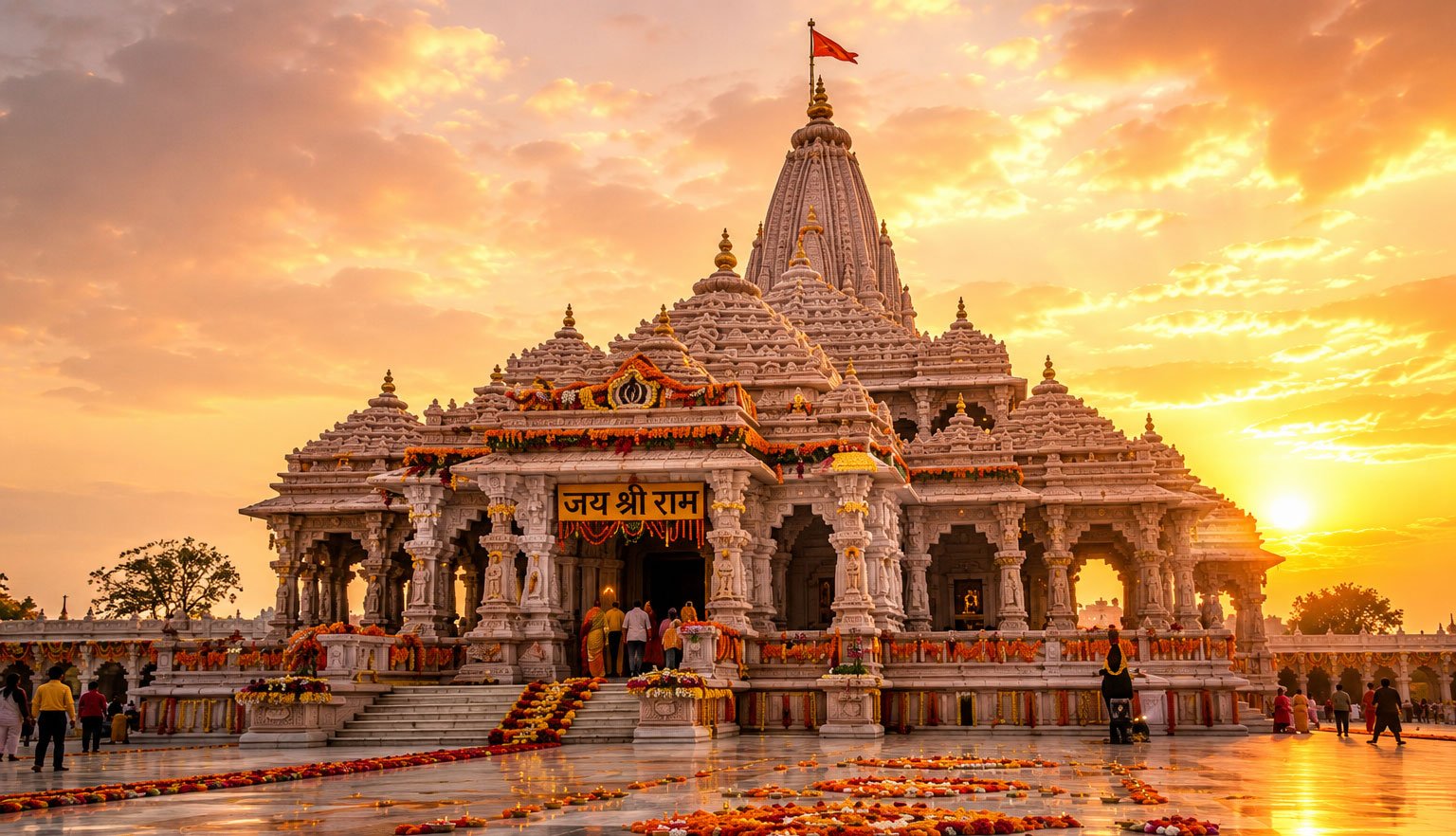


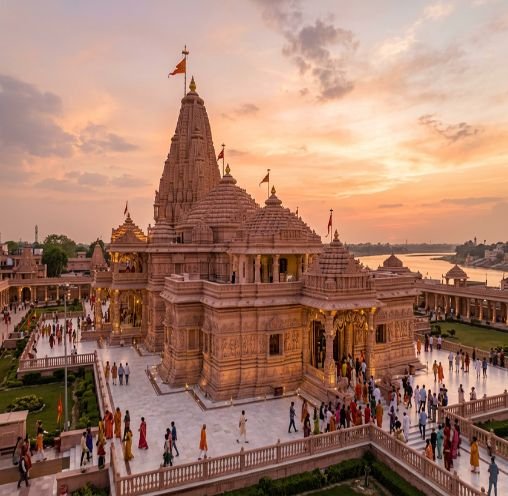
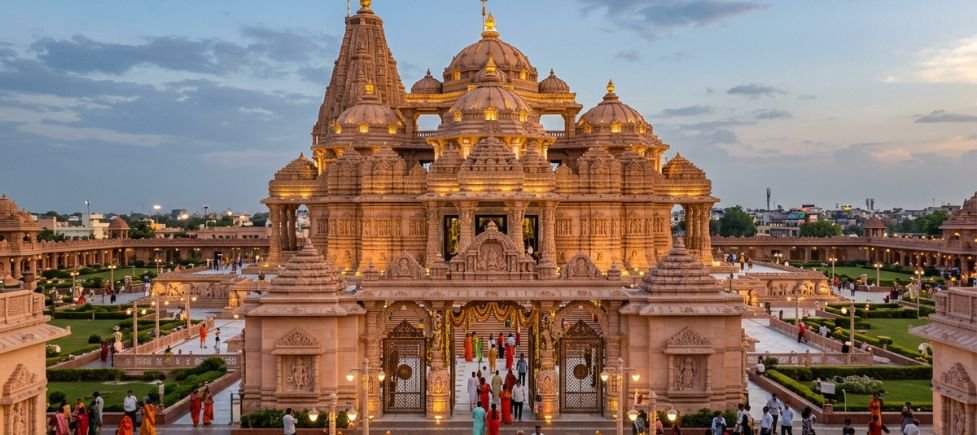


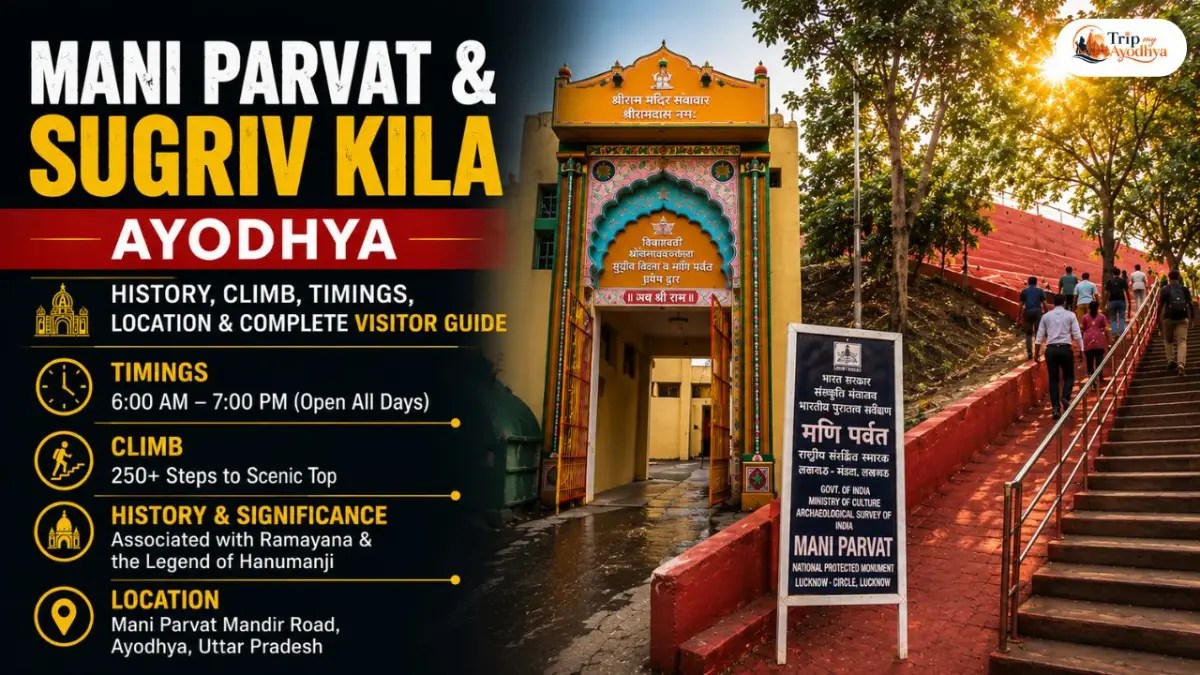
Mani Parvat and Sugriv Kila are ancient religious places in Ayodhya that also have legends attached with them as well as historical remains. These mounds are close to each other making them perfect for tourists who want to get away from the usual places of worships. Mani Parvat is the place of Hanuman Ji’s visit to the Sanjeevani mountain while Sugriv Kila represents Sugriv the son of Vali and a key associate of Rama in epic Ramayana.
These two historic spots are also in proximity to the ancient archaeological areas of Ayodhya. Tourists with a great interest in the Ramayana and ancient religious heritage can get to know the spiritual essence of Ayodhya by visiting Mani Parvat and Sugriv Kila together.
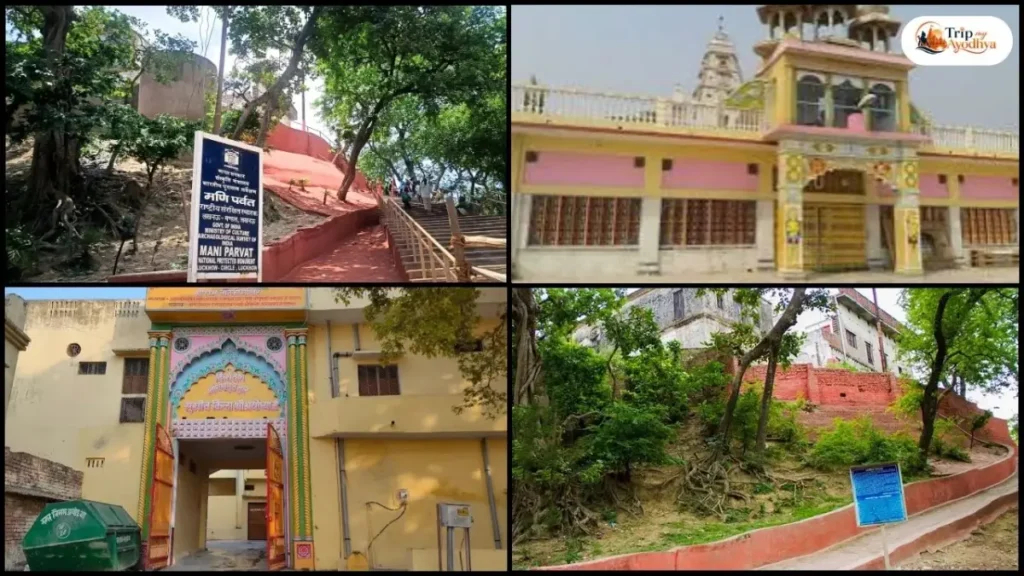
Mani Parvat and Sugriv Kila Ayodhya at a Glance
| Feature | Mani Parvat | Sugriv Kila / Sugriv Parvat |
| Location | Kami Ganj, Ayodhya | Near Mani Parvat, Ayodhya |
| Nature | Ancient sacred mound | Ancient mound |
| Traditional association | Sanjeevani mountain legend | Sugriv, Lord Rama’s ally |
| Approximate height | About 65 feet | Lower than Mani Parvat |
| Climb | Short flight of steps | Short stepped climb |
| Entry | Generally free | Generally free |
| Best time | Early morning or late afternoon | Morning or late afternoon |
| Main attraction | Shrines, mounds, views, and heritage | Mound, religious traditions and nearby shrine |
| Nearby attractions | Sugriv Kila, Ram Ki Paidi, Naya Ghat | Mani Parvat, Ram Ki Paidi, Naya Ghat |
| Recommended visit | 30–60 minutes | 20–30 minutes |
The official tourist information lists opening hours at Mani Parvat from 7:00 AM to 6:00 PM; other listings of tourist sites give around 6:00 am to 6:00 pm. As access is also affected by local arrangements, festivals, and conservation requirements, it is best to check for that day’s visiting situation before coming.
What Is Mani Parvat in Ayodhya?
Ancient times have called Mani Parvat as just a raised ground area of Ayodhya, where the place is traditionally considered to be of spiritual significance related to the Ramayana epic. The hill about 65 feet in height is one of the city’s major ancient mounds, Mani Parvat is also found close to Sugriv Parvat.
A popular religious tradition, according to which Hanuman had difficulty identifying the particular herb from the Sanjeevani plant, so he simply carried the entire mountain with him. The rock, from the fragment believed to be of that mountain, came down to Ayodhya, and got transformed into Mani Parvat is a religious tradition but not a fact proved archaeologically.
Therefore, it should be considered as an important aspect that also explains an archaeologically significant part of the history of the site. The hill, too, is linked with Ayodhya’s Buddhist era. Several narratives link Mani Parvat and the surrounding hills to old Buddhist religious institutions, stupas, and monasteries. The city of Ayodhya, for example, the historical description lists Mani Parvat, Sugriv Parvat, and Kuber Parvat as the main ancient hills.
Mani Parvat & Sugriv Kila Ayodhya Timings and Aart
If you are making a sightseeing plan for Ayodhya, Mani Parvat and Sugriv Kila are ideal to visit together because they are close to each other. There’s little inconsistency among the current sources about the visiting time, so, it is always wise to look at the time as approximately indicated and verify at the place on the day.
Mani Parvat Tempel, Opening Hours
| Detail | Timing |
| Opening | Around 6:00 AM |
| Closing | Around 6:00–7:00 PM |
| Entry Fee | Free |
| Best Time | 6:00–9:00 AM or 4:00–6:00 PM |
| Visit Duration | 30–45 minutes |
The official Incredible India listing currently gives 7:00 AM–6:00 PM, while other current visitor sources report approximately 6:00 AM–6:00/7:00 PM.
Aarti: Mani Parvat is primarily a sacred/heritage mound rather than a temple complex with a fixed, officially published daily aarti schedule. Therefore, it is better not to advertise a fixed Mani Parvat aarti time unless the local temple authorities confirm one for the particular day.
Sugriv Kila Ayodhya — Timings
| Detail | Timing |
| Morning | 5:00 AM–12:00 PM |
| Evening | 4:00 PM–8:00 PM |
| Entry Fee | Generally free |
| Best Time | Morning or after 4:00 PM |
| Visit Duration | 30–60 minutes |
Visitors to Sugriv Kila today are allowed in at two periods: 5:00 AM, 12:00 PM and 4:00 PM, 8:00 PM. Yet, 2026 local tourism guide says the mound opens to the public approximately 6:00 AM, 7:00 PM, and timings may differ for the mound or the temple/darshan area. Aarti: There is no publicly available, government-approved daily aarti schedule for Sugriv Kila.
We have decided to stop putting out specific aarti timings to avoid being wrong.
Saryu Aarti Timing Optimal Evening Choice
In order to get aarti after visiting Mani Parvat and Sugriv Kila you can be sure that the Saryu Aarti at Ram Ki Paidi is the best bet.
An efficient plan would be:
- 4:00 PM Mani Parvat
- 5:00 PM Sugriv Kila
- 5:45, 6:00 PM Head to Ram Ki Paidi
- Evening Saryu Aarti
Saryu Aarti exactly at what hour is decided each day based on when sunrise and sunset are and the locality program. Thus, confirm the ultimate Aarti timing only after the day is done.
Mani Parvat History and Religious Significance
It is fascinating how history of mani-parvat is interwoven with several traditions at this particular site.
1. Sanjeevani Mountain Tradition
Among the stories that pilgrims hear when visiting Hindu temples and holy sites, the most famous is the story that Mani Parvat is a fragment of the mountain where the Hanuman had carried it during the war of Rama and Ravana. When Lakshmana was severely hurt, Hanuman decided to find the life-giving Sanjeevani herb to save him. The legend says that after looking around for quite some time, Hanuman still could not figure out which of these herbs was the herb he was to bring to Lakshmana. As a result, Hanuman carried the whole mountain.
Local opinion views Mani Parvat as that fragment. Due to such a story, many people visit Mani Parvat who are interested in exploring Ramayana geography through temples and monuments.
2. Buddhist History of Ayodhya
From a historical and religious perspective, Ayodhya was an important city during the time of Buddhism. Besides the temple and palace descriptions of Ayodhya there are references to Buddhist monasteries, stupas and the hills, mounds, and so on. The description of the archaeological site, Mani Parvat, Sugriv Parvat, and Kuber Parvat (Sanskrit for the three hills) by the Archaeological Survey of India confirms their importance as protected ancient historical sites. The archaeological layer of evidence makes Mani Parvat not only a pilgrim spot but also an ancient part of the much larger heritage and history of Ayodhya.
Why Is Mani Parvat named Mani Parvat?
There are multiple interpretations of how the name Mani Parvat came to be in historical context, and some of these are derived from religious and local traditions. The prefix “parvat” means mountain or hill. However, the actual location is just a small mound, unlike a natural mountain. The “mani” in the name could refer to local understandings in Hinduism of a gemstone or a precious object.
The different stories behind the name have led people to regard their explanations as local traditions rather than proven, historical etymologies. The undeniable reality is that the name is now a key part of Ayodhya’ religious as well as geographical vernaculars.
Mani Parvat Height and Steps
Mani Parvat is commonly measured as about 65 feet tall. Tourism websites tell visitors that a pair of comfortable shoes would be necessary since there are many steps to climb in order to reach the main area of the site. However, the exact number of steps can be found different online. We suggest not giving any fixed step count as some people might get disappointed. In reality, the hill is quite short, one should still expect to walk.
How difficult is the Mani Parvat climb?
Barely most reasonably mobile visitors find the climb to be a very minor challenge. However:.
- If you decide to go out during peak of heat in summer, you might find the steps to be extremely hot.
- If it has been raining then it may be slippery on the step.
- Elder people might prefer to take it one stair at a time.
- Those with limited mobility need carefully considering whether the stairs are suitable before starting the climb.
- Comfortable shoes are a necessary item.
- In hot season please take water along with you.
In fact, most of visiting time will be spent climbing the hill and not the visit itself. Actually, one should value more being able to spend time at the summit while learning about the religious and historical significance of the hillock.
Mani Parvat Timings
Across various tourist websites, published timings of Mani Parvat are not coordinated. The website Incredible India states:
- Open at: 7:00 AM and close at: 6:00 PM
While a few other tourism sources say it about 6:00 AM-6:00 PM whereas some local guides are known to give even broader daytime access.
Recommended visiting window
For real and efficient planning, the visiting hours are:
- Morning: 6:30 AM-9:00 AM
- Late Afternoon: 4:00 PM-6:00 PM
But remember, the actual conditions could differ, in particular if there are festivals, ongoing repairs or events at site.
Best Time to Visit Mani Parvat
Early Morning
Early morning is one of the most relaxed and cool times to go up to Mani Parvat. Also, the surroundings are calm and the softer light is a great plus for photography.
Evening Time / Late Afternoon
The second best time is late afternoon. It is more comfortable than midday and the elevation also provides a beautiful view of the area of Ayodhya.
Winter Season: October-March
The winter season i.e., from October through March, is a very good time for those planning on doing more comfortable and less tiring sightseeing as compared to hottest summer months.
Sawand Jhulanotsava Time
The rainy season has a special religious importance as it is the right time for Mani Parvat, which traditionally is considered as the place for a Jhulanotsava or the Jhula festival of Ayodhya. The atmosphere in such a period can easily become quite lively and festive, very crowded as well.
What Can We See at Mani Parvat?
A visit to Mani Parvat is not limited to just one monument; the experience is composed of various elements.
Ancient Mound
The main heritage feature is the mound.
Religious Shrines
The ongoing sacred nature of the place is reflected in the small religious buildings and shrines at the site.
Elevated View
The height allows for a better overview of the urban surroundings.
Archaeological Context
In terms of history, the place has more impact because of its linkages with Mani Parbat and the other ancient mounds of Ayodhya.
Ramayana Tradition
For Hindu pilgrims, it is the identification of the site with Hanuman and the Sanjeevani mountain which gives it the strongest spiritual connection.
What Is Sugriv Kila in Ayodhya?
Another ancient mound, Sugriv Kila, also referred to as Sugriv Parvat, Sugriv Parbat, or Sugriv Tila, can be found near Mani Parbat in Ayodhya. Sugriv, the vanara king who became Rama’s principal allies after the death of Bali, is traditionally associated with this place. It should, however, be noted that the evidence is still very limited, and at this stage it is not possible to prove the existence of Sugriv’s fort on the mound. It is, therefore, best to treat the name as a tradition, even though such an interpretation may be controversial. The ASI has already listed Sugriv Parbat as one of Mani Parbat’s other protected sites.
Sugriv Kila History and Legend
Among the main Ramayana characters, Sugriv holds an essential position. Rama and Sugriya, being close allies, had several joint battles. Rama gave Sugriv support against Bali. It was the main reason Suriya, in turn, sent his troops to search for Sita and later fought Ravana. The local legend of Ayodhya connects Suriya with the neighboring hill.
Such legends are part of the oral traditions and may not be verified or proved through archaeological evidence. It is also important that such names of places are not just the outcome of local names for ancient forts but also reflect the changing religious landscapes over centuries.
The reason we still refer to some names of places in Ayodhya today is mainly that the religious traditions and local customs have changed them through generations, along with a combination of the religious memory aspect and archaeological interpretation.
Is Sugriv Kila Really a Fort?
Even though it includes “Kila”, a word that often designates forts, we suggest that the name does not refer to a huge fortress with strong walls, massive gateways, and defensive towers. Sugriv Kila should rather be thought of as just another ancient tile (mound) or place that gets associated with Sugriv by tradition.
The ASI has categorized a group of three mounds Mani-Parbat, Kuber Parbat, and Sugrib Parbat as protected areas but does not describe any of these as a surviving fort. Hence, this site can be of great interest to travel lovers who are curious to learn more about Ayodhya through its smaller details, apart from the main temples.
Sugriv Kila and Jain Heritage
In addition to the spiritual significance of the Sugriv site, there is an interesting aspect with regard to its religious history. Jainism has a very rich and deep spiritual heritage here, not only through the existence of several Jain places, but also as a major religious pilgrimage center for Jains in India. It is also a place of spiritual significance to be included in the spiritual landscape of India by “Incredible India” project. The visitor will have to keep in mind the fact that there are multiple religions represented here and treat them all with respect, rather than viewing only the Ramayana angle.
Sugriv Kila Timings
Sugriv Kila is basically, or in other words, a large ancient mound that is now associated with a religious structure and site, instead of the entrance that is the feature of a major temple complex.
Visitors can generally find information online about their timing at Sugriv Kila which says that they can mostly visit around daylight hours. Sometimes the timings of the mound are put up at about 6:00 AM to 7:00 PM. We advise you that since in the shrines and places of access the timings may vary you should plan to visit by daylight and see the local conditions on the day.
Best Sugriv Kila visiting time
The best time to visit Sugriv Kila and Mani Parvat in Ayodhya is during the early morning (6:00 AM to 8:00 PM) or late afternoon (4:30 PM to 6:30 PM).
Visiting Hours & Details:
- Best Season: October to March offers the most comfortable weather for sightseeing
- Timings: Both sites are generally open daily from 6:00 AM to 7:00 PM.
- Entry Fee: Free for all visitors.
Best Time of Day:
- Morning (6:00 AM – 8:00 AM): Enjoy a cool, quiet atmosphere and pleasant weather before the afternoon heat.
- Evening (4:30 PM – 6:30 PM): Ideal for climbing the hillocks, catching panoramic sunset views over the Ayodhya plains, and combining the trip with the Saryu Aarti.
Mani Parvat vs Sugriv Kila
Being so close to one another it is easy to confuse which is which, but apart from being at slightly various locations you might also have the opportunity to see exactly what is different about the two places.
| Point | Mani Parvat | Sugriv Kila |
| Main association | Hanuman and Sanjeevani tradition | Sugriv and Ramayana tradition |
| Archaeological identity | Ancient mound | Ancient mound |
| Height | About 65 feet | Lower mound |
| Climb | More noticeable | Shorter/easier |
| Experience | Views + shrines + heritage | Quiet heritage + religious setting |
| Time required | 30–60 minutes | 20–30 minutes |
| Ideal combination | Sugriv Kila | Mani Parvat |
In a broader sense, if one has to visit both Mani Parvat and sugriv kila, it is recommended that they should plan it in such a way that visiting them together is possible because they are part of one bigger historical area.
Distance Between Mani Parvat and Sugriv Kila
Roughly speaking, the two places are close together. Ayodhya tourism officials say that Sugriv Kila is at about 300 meters from Mani Parvat, making the walk between them quite convenient. That implies the visitors will be able to do one leg at least and will not be required to get a vehicle separately.
- An ideal walking plan would be Mani Parvat → Sugriv Kila → Naya Ghat/Ram Ki Paidi → Saryu River
- Thus, it will be a very short and easy day at a very few sights.
How to Reach Mani Parvat and Sugriv Kila
By Auto or E-Rickshaw
These are great ways of getting to the area from the main center of Ayodhya.
For a driver, it is always better to specify Mani Parvat at Kami Ganj in your instructions and not just say “Sugriv Kila” because it is possible that the local names will be different from those on the map and that the map listings too may not be consistent with the names used locally.
By Private Car
Getting a vehicle up to the area may be feasible but you probably need to keep track of any changes in local traffic arrangements to figure out your options regarding parking and vehicle access into the area.
On Foot
Walks from the central Ayodhya area are always more comfortable to combine with short auto or e-rickshaw rides. Travelers can also take the path that lies near the two hills and go on foot if they so desire since they are quite close.
How Long Do We Need for Mani Parvat and Sugriv Kila?
We generally feel that about an hour and a half should suffice for one’s visit to either Mani Parvat and Sugriv Kila or their combination, which is to say, both the hillocks.
Mani Parvat
- Finding your way after reaching Mani Parvat and getting used to the atmosphere for 5 to 10 minutes
- Gaining an overview of the surroundings around 10 or 15 minutes according to one’s pace
- Staying at the top for 15 to 25 minutes
- Getting down the hill in 5 10 minutes.
Sugriv Kila
- If you are coming on foot from Mani Parvat it will still accept to only a few minutes
- Strolling and climbing the steps for 10 to 15 minutes
- Performing religious/heritage activities 10 to 15 minutes
Therefore, an easy-going tour of the two hills could be a very pleasant interlude in your longer trip around Ayodhya.
Is Mani Parvat Suitable for Senior Citizens?
Mani Parvat itself is not quite like a flat place where you are going to see nothing but walking. In fact, it has stairs, and climbing is going to be required. Senior citizens whose legs are capable of moving a little further would be advised to go at an ease as they are likely to still be able to manage it quite easily. At the same time, people with quite a bit of movement problem have to decide whether or not to try the climb because the stairs may be quite a bit higher.
We advise you not to:
- Go out early in the morning.
- Stay out on the hot days of summer.
- Go barefoot.
- Make your climb a marathon.
- Drink water to stay hydrated.
- Be hasty with regard to your coming down after the visit.
In this case, going up Sugriv Kila with the family may not be quite a heavy duty since, typically speaking, the steps are not that lengthy at this hill, but you do need to check their present condition for yourselves while on-site.
Photography at Mani Parvat and Sugriv Kila
Mani Parvat’s location above the ground level is an attractive feature for photography.
The prime periods are usually around these times:
- Early morning
- Golden hour
- Sunset
- During special cultural events
It is important for visitors to know the difference between taking photos of the landscape and snapping pictures of the worshippers or a sacred object in the vicinity. If the place is a temple or a sacred site with a limit on photography, the directions given by the temple attendants as well as those posted on the noticeboard should be heeded and not exceeded at any stage.
What to Carry for the Climb
The only requirement of the day is a small bag. It makes more sense to carry:
- Water for drinking
- Shoe that can make you happy and keep you comfortable on a walking trip
- Sunglass
- A protective lotion (sun block) and a long-sleeved jacket
- Sometimes it is also useful to have a handkerchief in summer.
- A cell phone that is a camera as well or a small camera of its own.
- You can manage to take a small item or two with you.
Avoid carrying around things of value, as the tour includes a bit of walking and climbing.
Important Visitor Etiquette
Mani Parvat and Sugriv Kila are not simply sightseeing viewpoints. They are part of Ayodhya’s sacred and archaeological landscape.
We should therefore:
- Keep the area clean.
- Avoid littering.
- Follow marked paths.
- Respect worshippers.
- Follow temple photography rules.
- Avoid touching archaeological structures.
- Do not carve names or markings into surfaces.
- Dress appropriately around shrines.
- Follow local instructions during festivals.
- Avoid disturbing religious ceremonies.
Respectful tourism is especially important at sites where archaeological conservation and active religious practice exist side by side.
Best Time to Visit Mani Parvat and Sugriv Kila Together
For a comfortable trip, October to March is the strongest overall season.
- October-November: Pleasant weather and good conditions for walking.
- December-January: Cooler mornings can be chilly, but daytime sightseeing is comfortable.
- February-March: Generally excellent for combining the mounds with a full Ayodhya sightseeing itinerary.
- April-June: The heat can become intense. Early morning or late afternoon is preferable.
- July-September: The monsoon season can make steps slippery, but Sawan-related religious activities can create a special atmosphere around Mani Parvat.
Mani Parvat, Sugriv Kila and Sawan Jhula Mela
The Sawan period is particularly important in Ayodhya’s religious calendar. Mani Parvat is traditionally associated with Jhulanotsav, during which images of Rama, Sita and other deities are ceremonially placed on swings. This gives the normally quiet mound a much more vibrant atmosphere.
Travellers visiting Sawan should expect:
- Larger crowds
- Religious processions
- Increased pedestrian movement
- Temporary decorations
- Longer travel times
- More activity around nearby temples
Festival dates and arrangements can change from year to year, so we should verify the current year’s schedule before making a dedicated festival trip.
One-Day Ayodhya Itinerary Including Mani Parvat and Sugriv Kila
A well-planned one-day Ayodhya trip can cover the city’s most important temples, Ramayana landmarks, ancient mounds, and the sacred Saryu Riverfront. The itinerary below is designed to balance early-morning temple darshan, sightseeing, lunch, afternoon rest, Mani Parvat and Sugriv Kila, followed by the evening atmosphere along the Saryu.
6:00 AM – Start Your Ayodhya Sightseeing
Begin the day early to avoid heavy crowds and the afternoon heat. After breakfast or a light morning snack, head toward the old city and start with the important pilgrimage sites.
Recommended duration: 15–30 minutes for travel and preparation.
6:30 AM – Hanuman Garhi
Begin the pilgrimage with Hanuman Garhi, one of Ayodhya’s most prominent Hanuman temples. The temple is approached by a flight of steps, so visiting early makes the climb more comfortable. Spend time for darshan and explore the temple surroundings before moving toward the next destination.
Suggested time: 6:30 AM–7:30 AM
Travel Tip
Keep footwear and belongings organized because temple security procedures can take additional time during busy periods.
7:45 AM – Shri Ram Janmabhoomi
After Hanuman Garhi, proceed toward the Shri Ram Janmabhoomi complex for darshan. This is likely to be the busiest portion of the itinerary, so we recommend keeping additional buffer time for security checks, queues and walking between entry points.
Suggested time: 7:45 AM–9:30 AM
Important Tip
Temple access, security requirements, darshan arrangements and permissible belongings can change. Always follow the current instructions issued for the date of your visit.
10:00 AM – Kanak Bhawan
Continuing to Kanak Bhawan, one of Ayodhya’s most beautiful and historically significant temples. The temple is traditionally associated with Sita and Rama and is known for its richly decorated interiors and sacred atmosphere.
Suggested time: 10:00 AM–10:45 AM
After darshan, take a few minutes to explore the surrounding lanes and local shops.
11:00 AM – Dashrath Mahal
Next, visit Dashrath Mahal, traditionally associated with King Dashrath, the father of Lord Rama. The colourful temple complex and surrounding devotional atmosphere make it a natural continuation of the Ramayana-focused morning itinerary.
Suggested time: 11:00 AM–11:45 AM
12:00 PM – Lunch in Ayodhya
By noon, take a break for lunch. Choose a clean and convenient restaurant near your next route rather than travelling a long distance solely for food.
Suggested time: 12:00 PM–1:00 PM
A vegetarian meal is a practical choice during a temple-focused Ayodhya pilgrimage.
1:00 PM – Return to Hotel and Rest
Instead of filling every hour with sightseeing, use the early afternoon for a short hotel break.
Suggested time: 1:00 PM–3:30 PM
This break is particularly useful during warmer months and helps make the afternoon visit to Mani Parvat more comfortable.
4:00 PM – Visit Mani Parvat
Begin the second part of the itinerary with Mani Parvat. The ancient mound is traditionally associated with the Ramayana and the story of Hanuman carrying the mountain containing the Sanjeevani herb. The site also forms part of Ayodhya’s archaeological landscape. Climb the steps at a comfortable pace and spend some time at the elevated section.
Suggested time: 4:00 PM–4:45 PM
What to Do at Mani Parvat
- Climb the ancient mound
- Visit the associated religious shrines
- Observe the surrounding landscape
- Learn about its Ramayana traditions
- Appreciate its archaeological significance
- Take photographs where permitted
Late afternoon is particularly suitable because the temperature is generally more comfortable than at midday.
4:45 PM – Sugriv Kila
After Mani Parvat, continue to Sugriv Kila, also known as Sugriv Parvat or Sugriv Parbat. The two sites are close enough to combine in the same sightseeing circuit. Sugriv Kila is traditionally associated with Sugriv, the vanara king and ally of Lord Rama. The Archaeological Survey of India recognizes Sugrib Parbat as part of the group of ancient mounds in Ayodhya.
Suggested time: 4:45 PM–5:15 PM
What to See
- Sugriv Parvat
- Religious surroundings
- Ancient mound landscape
- Nearby local neighborhoods
- Ramayana-related traditions
5:30 PM – Naya Ghat and Ram Ki Paidi
After visiting Sugriv Kila, head toward Naya Ghat and Ram Ki Paidi. This is an ideal transition from Ayodhya’s ancient mounds to its famous riverfront. Spend time walking along the ghats, taking photographs, and enjoying the changing evening atmosphere.
Suggested time: 5:30 PM–6:30 PM
6:30 PM – Saryu Riverfront
Continue toward the Saryu Riverfront as daylight begins to fade. The riverfront becomes increasingly lively in the evening, with pilgrims and visitors gathering near the ghats. If the day’s schedule permits, take a peaceful walk along the river before attending the evening Aarti.
Evening – Saryu Aarti
End the one-day Ayodhya itinerary with the Saryu Aarti. The evening ceremony provides a spiritual conclusion to a day that has covered Ayodhya’s major temples, Ramayana landmarks, ancient mounds, and riverfront. Arrive early enough to find a comfortable viewing position, especially during weekends, festivals, and major religious occasions.
Suggested time: 6:30 PM onward
Important: Saryu Aarti timings can vary by season, festival, and local arrangements. Confirm the current day’s timing before planning your final departure.
Book Your Birla Mandir with Trip My Ayodhya
Plan and enjoy a spiritually enriching travel experience in a very convenient way through the expert assistance of Trip My Ayodhya. Being a reliable and trusted company for pilgrimage tour management, we ensure your tours from a temple to a temple go like a dream. We have customized tours and comfortable transport. You need not only get the spiritual darshan but also have an enjoyable time in visiting local tourist spots while you are there. With our services, you will not have hotel booking or travel planning worries, as everything is already well arranged by us.
Visit Ayodhya, Varanasi, Mathura, and Vrindavan with a peace of mind as we handle things on our end so that you can devote your time and energy solely to experiencing a spiritual and religious trip. Select our package as the best of all your options if you want a hassle-free, pleasant, and unforgettable travel venture to the most holy places in India.
Bookings with Trip My Ayodhya What You Gain
- Customized Tours We make the itineraries according to how the customer needs time and expenditure-wise
- Travel in Comfort Our vehicles are kept in a good condition and the drivers are experienced
- Celebrating Priority Darshan You will be able to save the time at temple visits if we handle temple visits well
- Local Experts The tour is explained in detail with spiritual knowledge by an expert guide
- Lower Cost There is a combination of many services with competitive price and no hidden fees
- Available Anytime Service Customer support team will give you help for the rest of your adventure
- Integrated Services All the necessary services like stay, transport, and sightseeing have to only be asked for once
Also BOOK: Same Day Ayodhya Tour Package – Itinerary – Explore the top temples and spiritual attractions of Ayodhya in one day with a well-planned sightseeing itinerary.
Plan your upcoming trip with us and experience a divine journey like never before!
📞 Call Us: +91 7078723132 | +91 9557104160
📲 WhatsApp Us: +91 7078723132 | +91 9557104160
🌐 Visit Our Website: Trip My Ayodhya | Vrindavan Mathura Tourism
🔗Explore all our packages here 👉 Trip My Ayodhya Packages
🔗 Read Our Blogs for Travel Inspiration: Trip My Ayodhya Blog’s
Nearby Places to Visit After Mani Parvat and Sugriv Kila
Ram ki Paidi
Ram ki Paidi is one of Ayodhya’s most iconic spots near the bank of Saryu River. It also makes for a great next stop after visiting the ancient earth mounds.
Naya Ghat
Naya Ghat is one of the very few riversides of the great city and it makes an impressive evening sightseeing location for the visitor.
Hanuman Garhi
Hanuman Garhi is one of the largest Hanuman temples in Ayodhya and one of the major temples included in most pilgrimage circuits.
Kanak Bhawan
Ram and Sita in exquisite gold are the highlights of Kanak Bhawan an important temple on the central Ayodhya circuit, also known as Ram Janmasthan (Rama Birthplace) circuit.
Nageshwarnath Temple
Nageshwarnath Temple located very close to Ram Ki Paidi provides a Shaiva or Shiva aspect to an otherwise exclusively Ramayana itinerary.
Why Mani Parvat and Sugriv Kila Are Worth Visiting
The reason which really pulls you into these two places is their capability to uncover a different Ayodhya from our perspective. A few of the major pilgrimage points are quite crowded. Mani Parvat and Sugriv Kila, on the other hand, give you a chance to breathe, reflect, and learn the city’s deeper layers at a leisurely pace.
In Mani Parvat you come to know of:
- The Ramayana tradition
- The legend of Sanjeevani that Hanuman brought
- Possible Buddhist connections
- Precious archaeological heritage
- Breathtaking aerial view of Ayodhya
In Sugriv Kila you find the following:
- Benevolent nature of the king Sugriv
- Ramayana terrain
- Age deep earth mounds of Ayodhya
- Very old Jain place of worship
- Ram’s story through different lenses
In this way, both of them collectively bring out the point that Ayodhya does not fit easily and entirely through a single storyline or religion.
Mani Parvat and Sugriv Kila: Mythology vs Archaeology
Understanding the difference between tradition and historical evidence makes the visit more meaningful.
| Subject | Traditional belief | Historical/archaeological perspective |
| Mani Parvat | Fragment of the mountain carried by Hanuman | Ancient archaeological mound |
| Sugriv Kila | Connected with Sugriv | Ancient mound known as Sugrib Parbat |
| Buddhist connection | Part of Ayodhya’s sacred landscape | Historical accounts associate Ayodhya with Buddhist establishments |
| “Fort” at Sugriv Kila | Suggested through local naming/tradition | ASI lists Sugrib Parbat as a mound |
| Sanjeevani connection | Strong pilgrimage tradition | Religious tradition rather than archaeological proof |
This separation does not make the spiritual significance of the place less important but rather enables one to experience both the living religion and the recorded heritage.
Practical Tips for Visiting Mani Parvat and Sugriv Kila
Visit earliest
Temperatures are better and visitors can also enjoy a quieter atmosphere in the morning.
Visit both together
The two mounds are so close to each other that one visit can save both the time and effort of going to them individually.
Avoid relying solely on the timings you find on the internet
Venue times vary from one source to another. Therefore, getting a local check the same day is a clever move.
Buy drinks
You may find that you need more than one bottle of water to last you through an extended climb on a sweltering day.
Kicks for the feet
The path might be quite steep yet only a short path but the ground might be uneven or even slippery.
Do not stay too long in the heat
Few are able to cope with the heat when going up the steep steps and getting back down to the ground through the main mound area without water on a midday or even sizzling summer day!
Plan to spend some extra time during major celebrations or festivals
Sawan and other religious gatherings might affect the atmosphere and crowd.
Protect the archaeological environment
Do not climb on protected structures or remove anything such as stones, bricks, or ancient remains and other relics from the place.
Conclusion: Mani Parvat & Sugriv Kila Ayodhya
Mani Parvat and Sugriv Kila provide rare insights into Ayodhya’s spiritual, historical, and archaeological aspects. Away from the major temple complexes of the city, these ancient monuments let visitors relive Ramayana traditions and folk tales to understand Ayodhya at a profound level. Hanuman and the Sanjeevani herb story are the main attractions at Mani Parvat whereas Sugriv Kila is a living memory of the heroic deeds of Sugriv and the divine Lord Rama.
Moreover, the natural surroundings of these places are indicative of the city’s Buddhist and Jain heritage of old. Visiting these places is highly recommended for the kind of travelers who prefer a more laid-back mode of exploring Ayodhea and uncovering ancient stories within its monumental structures.
📞 Call Us: +91 7078723132 | +91 9557104160
📲 WhatsApp Us: +91 7078723132 | +91 9557104160
🌐 Visit Our Website: Trip My Ayodhya | Vrindavan Mathura Tourism
Frequently Asked Questions About Mani Parvat and Sugriv Kila Ayodhya
What is Mani Parvat famous for?
Mani Parvat is widely known for being connected with Hanuman’s mountain of Sanjeevani in the Ramayana. It is also famous for being a historical site with religious and archaeological treasures from Ayodhya.
What is the height of Mani Parvat?
In the words of tourism resources, Mani Parvat is said to be about 65 feet high.
What are the Mani Parvat timings?
Published sources are not one in their information, but commonly reported visiting hours can easily be from 6:00 AM to 6:00 PM while Incredible India gives the visiting time to be from 7:00 AM to 6:00 PM.
Is there an entry fee for Mani Parvat?
Most sources say there is no entrance fee for Mani Parvat.
How difficult is the Mani Parvat climb?
It will not be a long climb, but the steps are there. If they are not walking on uneven ground, most people can comfortably manage it in a brief period of time.
What is Sugriv Kila?
Sugriv Kila is the second name (or sugrid parbat) of sugriv kila, also known by these names in the locality or outside. It, a historic site, or mound located at Ayodhya, is also one of those places linked with Sugriv, the vanara king, friend, and supporter of Lord Rama.
Is Sugriv Kila a real fort?
It may have been called “Kila”, meaning fort, but the Archaeological Survey of India, a very authoritative source in this field, has listed Sugrib Parbat (which, as it turns out, is the one and only name that this mound is now known by) as one of the ancient mounds of Ayodhya rather than one that has the characteristics of a typical preserved fort complex.
How far is Sugriv Kila from Mani Parvat?
In tourist maps Sugriv Kila, as one can expect, has been shown to be placed at about 300 meters away from Mani Parvat so it can be easily visited in one go if one starts by walking the short distance of the other.
Can we visit Mani Parvat and Sugriv Kila on the same day?
Various sources suggest that one hour to 1.5 hour long heritage visit can be comfortably planned which includes visiting both of these sites as the site locations are close to each other.
What is the best time to visit Mani Parvat?
In general, the time that is most comfortable to visit Mani Parvat is either early in the morning when the temperature has not gone high yet or in the late afternoon when it is getting cooler, especially during summer or the hottest times.
Is Mani Parvat related to Buddhism?
Yes. Buddhist heritage of Ayodhya is also described in historical documents connecting its ancient mounds with places of monks and Buddhist shrines.
Is Sugriv Kila related to Jainism?
Being the holy town of different religions, one of them is Jainism, the local people and even the visitor who visits Ayodhya come across some very impressive Jain shrines which make Jainism the one of its important religious dimensions.
Is photography allowed at Mani Parvat?
Although most visitors do get into taking pictures when it is allowed to be outdoors, a couple of religious places or ceremonies could have regulations regarding photography as the visitor will have to comply before they do so.
Is Mani Parvat suitable for elderly visitors?
People who do not have problems with moving their stairs or climbing up slowly can enjoy Mani Parvat. Those who have problems can take a look before deciding at the actual steps, slope, and site conditions.
What should we carry?
Generally, visitors carry some water, comfortable shoes or footwear, a cap or sun shield for sun rays and very little stuff is needed.