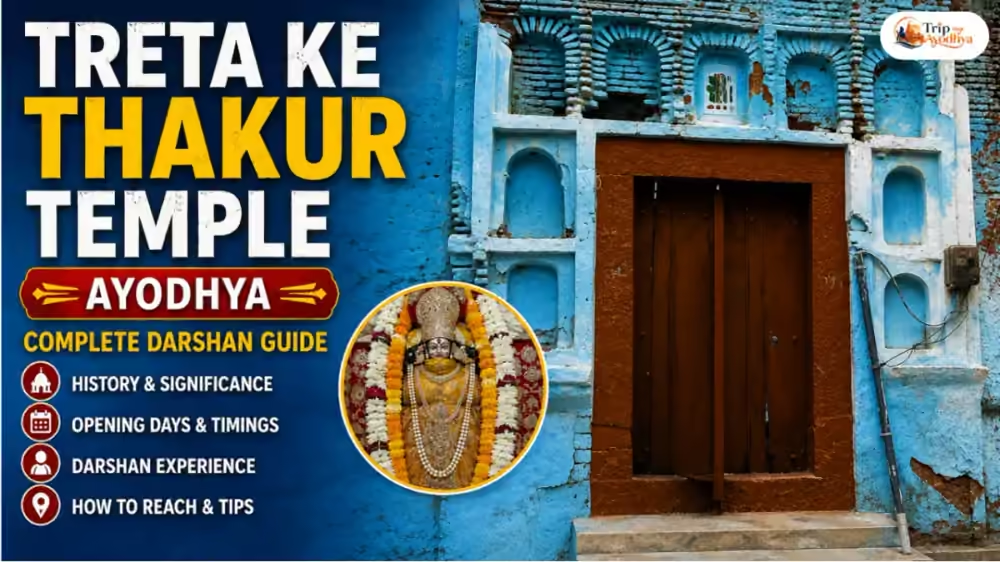
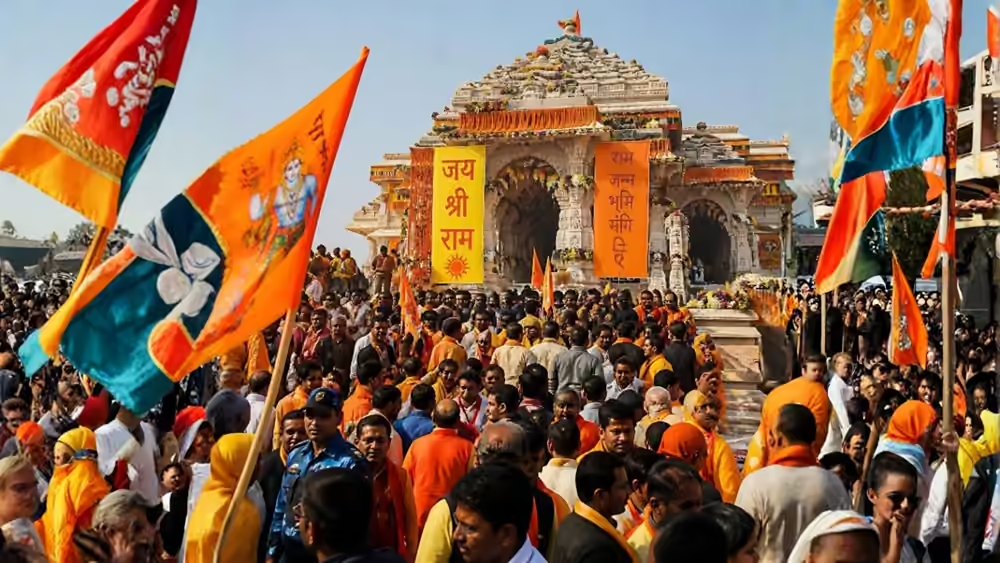
Treta Ke Thakur Temple Ayodhya - History, Opening Days & Darshan Guide
Quick Enquiry
Ayodhya is indeed a city rich in holy temples, yet none have a visiting pattern quite like Treta Ke Thakur Temple. A visitor may come across the temple on an ordinary day when the main gate is found to be closed and then the same place during a Kartik Shukla Dasami may become filled with pilgrims. This phenomenon brings up a valid question for a devotee: Which days can you actually worship God at Treta Ke Thakur Temple and what tips will make visiting a more fulfilling experience?
This article provides information about the history of the temple, its significance in religion, dates of openings for public darshan, visiting details, location, tourist spots nearby, architecture and practical advice for you to organize your visit without getting lost.
Important: Treta Ke Thakur Temple is a sacred ancient sanctum in Ayodhya. Unlike most famous Ayodhya temples, it is not open for regular daily darshan. The temple traditionally opens to devotees only around Kartik Shukla Ekadashi, making the visit very different from a normal temple trip. The Government of India’s Incredible India tourism portal also identifies its annual opening on Kartik Shukla Ekadashi.
What Is Treta Ke Thakur Temple?
Treta Ke Thakur Temple is one of the old Rama temples in Ayodhya which are said to represent Rama of Treta yuga. Different interpretations are given the term "Treta Ke Thakur", one of the common is the Lord who was born during the Treta period. Hence it is identified with the great saint Lord Shri Rama. It is also believed that it was on this spot that Ram after the great war was given an Ashwamedha Sacrifice in Ayodhya.
It is widely believed in this local area that this place of sacrifice was this one. On the other hand, the present-day building is obviously a relatively new temple if we take the Ramayana period for granted. According to the Ayodhya tourism portal, it is written that this place was originally a place of worship and a temple for people and was built around the year 300 by the King of Kullu. Later in 1784, Queen Ahilyabai Holkar of the Marathas renovated the same temple.
Why is the temple different from other Ayodhya temples?
The main difference is the opening time. A normal temple gives daily darshan for worshippers. Treta Ke Thakur Temple is a traditional temple which only opens once a year on Kartik Shukla Ekadashi.
Ayodhya's Incredible India also lists the same Kartik Shukla Ekadashi as the day the main deity is open to the public once a year only. Hence planning to visit the temple needs accurate timing. If you plan your Ayodhya tour outside the dates of Jan, Feb, Mar, or any other month, do not expect that you can enter the main room.
Treta Ke Thakur Temple History
The origin of Ramanand Treta Thakur Temple includes Ramayana lore, local religious lore, and recorded information of temple construction from later-periods. One should be able to clearly differentiate these three sources from one another rather than mixing up all traditional stories and claiming each one to be a factual historical piece.
The connection with Lord Rama
It has been a religious belief for ages that this site has been one of Ram's places where he was engaged in an Ashwamedha Yajna after going back from Lankā.2 Ashwamedha Yajna is a king's sacrifice of a horse with which he can claim a part of land after chasing a horse over it, it is said to represent his sovereignty.
Some records about the city of Ayodhya mention Treta-Ke-Thakur as a sacred site of the great sacrifice of Ram along with an image of Ram and Sita. This religious connection with a powerful sacrifice, which is the Ashwamedha, made it clear that this temple is not a temple of a god who was born to a mortal woman, a devoted worshipper of Ram, or the goddess with whom he was separated.
The Kullu connection
The present-day shrine is said to have been built by a Kullu king around 300 years ago. This tradition is mentioned and supported by the Ayodhya Dham tourism portal and, it is mentioned that the temple was given a new shape with the help of Ahilyabai Holkar in 1784. Some tourism sources mention the temple as the "Kaleram " temple and link its construction with Kullu's ruler because of differences between names and dates found in historical and local sources; it is better just to view the early details of reconstruction as a sort of tradition, rather than take there to be one agreed and unchallengeable line of history.
Ahilyabai Holkar's contribution
Perhaps the only detail that remains consistent throughout historical accounts, even after changes, is the relation to Queen Ahilyabai Holkar. A queen belonging to the Maratha dynasty, she was an ardent supporter of reconstruction works related to significant religious sites of Hinduism.
The architectural form at Treta Ke Thakur is normally ascribed to be a product of the 18th century rebuild attributed to Ahilyabai Holkar with 1784 as a common point of reference. Ahilyabai's backing has further importance since Ayodhya did not only undergo some major restructuring at that time but also experienced a renewed surge in holy pilgrimage.
Why the history should be read carefully
Sometimes you may read on websites that the temple in its present-day state has existed for thousands of years or each part of the building can be directly connected with the Treta Yuga. One better way to understand it is:
Religious tradition: The location is the site of Lord Rama's Ashwamedha Yajna.
Temple history: The shrine as we see it has come about due to various rebuilding processes of medieval as well as early modern period.
18th-century: Ahilyabai Holkar's involvement in its reconstruction in 1784 is very popularly cited.
Present pilgrimage: The temple forms a very vital part of Ayodhya's sacred terrain till date
This sort of demarcation would make history both history-aware and reverent.
Also BOOK: Same Day Ayodhya Tour Package – Itinerary – Explore the top temples and spiritual attractions of Ayodhya in one day with a well-planned sightseeing itinerary.
Treta Ke Thakur Temple Opening Days and Darshan Timings
Knowing this information well is the foremost requirement of planning a shrine visit.
Is Treta Ke Thakur Temple open every day?
In fact, the Treta Ke Thakur Temple is normally not accessible to public darshan every day. Instead, the temple is a traditional site for devotional visits which opens only once a year on the occasion of Kartika Shukla Ekadashi or approximately in the months of November or December.
The Indian Panchang calendar states that on this day the Temple is open to devotees. Therefore, you can rely only on those regular visiting hours of a temple that are not the case of an extraordinary situation such as a darshan at a regular temple.
For example, a "6:00 AM to 12:00 PM morning" timing should not be considered as the standard hours of visiting the main Temple if they are given by the same source that also states the day of opening to public (which is only once a year).
Treta Ke Thakur Temple opening day in 2026
In 2026, Kartik Shukla Ekadashi would be equivalent to Devutthana/Prabodhini Ekadashi, falling on Friday, 20 November 2026 as per many of the popular Indian Panchang calculations. The first day of this Ekadashi starts with the morning of Sunday 14th and ends on Monday the 15th.
A point worth mentioning, however, is how traditions have different interpretations. Therefore, temple darshan arrangements, and opening and closing of the temple gates can vary considerably locally.
For a last confirmation, therefore, before the visit to Treta Ke Thakur darshan specifically, contact an individual or office who is in the location in question.
Treta Ke Thakur Temple Timings Quick Guide
Information
Details
Regular daily darshan
Not normally available
Main annual opening
Kartik Shukla Ekadashi
2026 Ekadashi date
20 November 2026
Usual period
November–December
Location
Ayodhya, Uttar Pradesh
Main deity
Lord Rama
Best planning strategy
Confirm the annual opening schedule before travel
The latest Ayodhya tourism site focused on temples mentions the shrine as well opens once a year around Kartik Shukla Ekadashi.
How long does the temple remain open?
According to at least one local source the annual opening lasts for a darshan window of a day or slightly longer but a fixed duration of just 24 hours should not be expected. Visitors need to check the arrangements as they change every year. Crowd control, security issues, and religious festivals can make differences.
If you plan your 2026 trip, please check this link just before departure for the latest Ayodhya authority’s announcement.
Treta Ke Thakur Temple Religious Significance
Lord Rama and the holy land of Ayodhya connection mainly determine the sanctity of the temple.
Connection with the Ashwamedha Yajna
The most sacred tradition at Treta Ke Thakur is the Ashwamedha Yajna performed by Lord Rama. Devotees look at it as more than another Rama temple but also as Rama's return to his Ayodhya and an ideal ruler.The Ramayana's aftermath describes the story of the ruler of Ayodhya. The historical descriptions also mention this as one of the places where Rama performed His great sacrifice.
Sacred images of Rama and his family
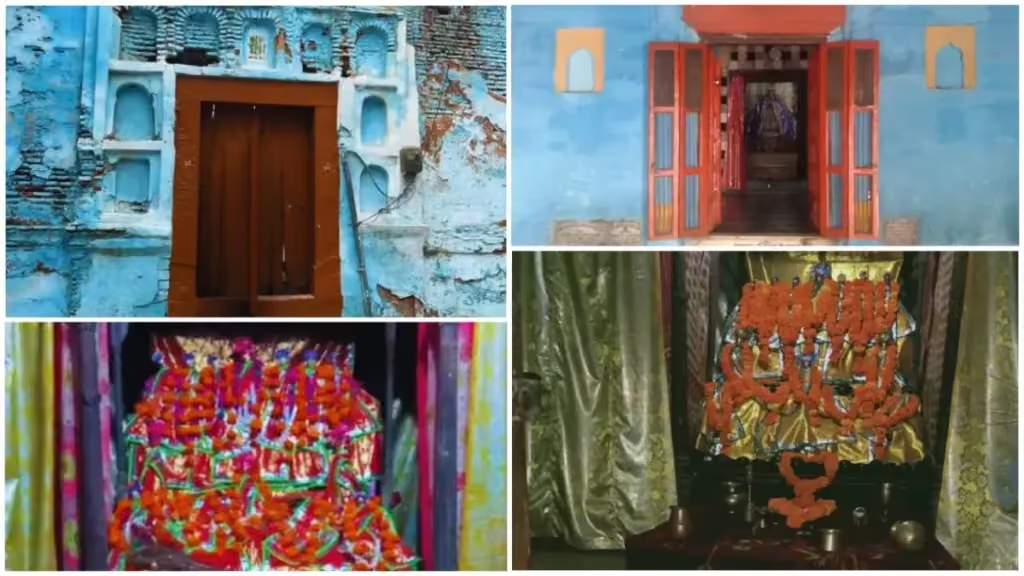
The majority mention Rama, Sita and Lakshmana as figures represented in the images while some also say Ravana. The only consistent feature among all accounts is that the images depicted in the temple would have been made of black stone. The depiction in a dark shade is one of the aspects that make this temple particularly appealing to religious enthusiasts and art lovers alike.
Why devotees visit on Ekadashi
Devout followers of Hinduism know Kartik Shukla Ekadashi as one of the sacred Hindu festivals and also call it Devutthana Ekadashi or Prabodhini Ekadashi. The festival marks the symbolic awakening of Lord Vishnu after the four-month long Chaturmas period. The year 2026 Kartik Shukla Ekadashi day falls on November 20. Besides, there are other reasons a religious pilgrimage might make sense to visit the spot when there is also an opportunity for the opening of Treta Ke Thakur on this day.
Architecture and What to See at Treta Ke Thakur Temple
The history and the spiritual story of this site are not the only reasons this place should be visited.
The architecture also reveals how diverse the heritage of Ayodhya is and how different architectural styles could be mixed in one building complex. Ayodhya's Treta Ke Thakur has been described by India's Government as combining styles of Hindu and Moslem buildings with detailed carving, dome-shaped pavilions, red sandstone decoration, and a gold-plated spire.
Black-stone deity images
This detail is one of the features most closely connected with the temple, its dark stone representation. One of the best ways of getting the most out of visiting a sacred site during the annual opening day is to stop and look at the artistry rather than passing through the shrine just to see what the fuss is.
The value of the temple, the traditional images of God, and the sanctified space are at least as much a factor in the overall worth as the experience of darshan itself.
Architectural details
If access and crowd conditions permit, visitors are likely to notice the following features:
Sculpted and chiselled details of stones
Parts and elements of domed structures
Temple decoration following the traditional style
Surfaces made of red sandstone
Ornamented columns and pillars
Main idol chamber and surrounding open-air temple area
On the opening day, when the numbers of visitors increase, it becomes difficult to use the camera and to look closely at the architectural details. Please check the photos, security and crowds’ rules that are valid on that particular day.
Book Your Ram Ki Paidi Ayodhya with Trip My Ayodhya
Plan and enjoy a spiritually enriching travel experience in a very convenient way through the expert assistance of Trip My Ayodhya. Being a reliable and trusted company for pilgrimage tour management, we ensure your tours from a temple to a temple go like a dream. We have customized tours and comfortable transport. You need not only get the spiritual darshan but also have an enjoyable time in visiting local tourist spots while you are there. With our services, you will not have hotel booking or travel planning worries, as everything is already well arranged by us.
Visit Ayodhya, Varanasi, Ayodhya, and Varanasi with a peace of mind as we handle things on our end so that you can devote your time and energy solely to experiencing a spiritual and religious trip. Select our package as the best of all your options if you want a hassle-free, pleasant, and unforgettable travel venture to the most holy places in India.
Bookings with Trip My Ayodhya What You Gain
Customized Tours We make the itineraries according to how the customer needs time and expenditure-wise
Travel in Comfort Our vehicles are kept in a good condition and the drivers are experienced
Celebrating Priority Darshan You will be able to save the time at temple visits if we handle temple visits well
Local Experts The tour is explained in detail with spiritual knowledge by an expert guide
Lower Cost There is a combination of many services with competitive price and no hidden fees
Available Anytime Service Customer support team will give you help for the rest of your adventure
Integrated Services All the necessary services like stay, transport, and sightseeing have to only be asked for once
Also BOOK: Same Day Ayodhya Tour Package – Itinerary – Explore the top temples and spiritual attractions of Ayodhya in one day with a well-planned sightseeing itinerary.
It is worth mentioning that a visit to a Treta Ke Thakur temple requires more elaborate preparation compared to going to a temple that works all day.
1. Choose the correct date first
Do not let yourself be tempted to plan for visiting the temple at any moment if you get the idea, or you may turn up at Ayodhya and find that the temple is closed.
If Treta Ke Thakur is your first concern then find out the date for Kartik Shukla Ekadashi and then decide on the dates for your stay and travel accordingly.
In 2026 the relevant date for Ekadashi is 20th November but the official darshan schedule should be verified by local sources in case there are unexpected arrangements or cancellations.
2. Arrive early
Annual opening days can bring a concentrated crowd.
A practical strategy is to reach the area early in the morning rather than arriving around the busiest part of the day.
A recent Ayodhya travel guide recommends an early-morning arrival for shorter queues, although actual crowd conditions can vary.
3. Allow walking and be ready for traffic controls.
During major religious events in Ayodhya, one can expect:
Restrictions on using the car
Barricades across the road
Huge human masses wandering around
New route directions
Security scans
Do not suppose that a taxi driver or an autorickshaw driver can bring you to the doorsteps of the temple just by dropping you near the road.
Come in a pair of shoes with the right shoes and have some free time in your itinerary, at least enough, to walk around the temple for a bit and explore it in detail without missing much during your stay.
4. Dress respectfully
Treta Ke Thakur is a functional place of worship not just a historical site, even if some may argue that.
It is advised to wear clothes that are modest in style as well as light in weight because the main problem that the visitors might have to face inside the temple is that they will not be allowed to carry any big bags or items which might take the security staff a lot of time to check them.
5. Keep your itinerary flexible
If Treta Ke Thakur open day is your main reason for coming to Ayodhya, then it is a very bad idea to book other big attractions right after you expect to see this place.
One has to realize how quickly one can be trapped by the crowds in an unexpected way if one has a schedule and a timetable that are not very flexible.
Keeping your plans for a visit to Ayodhya loose will work well for those who accompany seniors or children, senior citizen companions, first-time visitors to Ayodhya and also for those who are very easy-going in terms of planning for their trip.
How to Reach Treta Ke Thakur Temple
Treta Ke Thakur is the only Treta deity which can be found here in the holy city Ayodhya in the state of Uttar Pradesh and also is a very near location to the sacred front of the city river.
Ayodhya has pilgrimage sites on its west which has one of its major riverside areas and the temple lies in that region, one which is quite popular. It could serve as a point which could be part of multiple sightseeing attractions located nearby.
By air
If one has to reach there by flight in the nearest airport to Ayodhya would be Maharishi Valmiki International Airport, Ayodhya (AYJ). India Travel lists AYJ among the neighboring airports of the temple. Lucknow’s Chaudhary Charan Singh International Airport is also an option for those who prefer finding more convenient flights there.
By train
You can reach Ayodhya via trains as its major railway stations like Ayodhya Dham offer connectivity by train. Once you step out of the railway station, you may choose from a taxi, autorickshaw or other authorized local transport whichever is suitable depending on the traffic and if there are any day-related restrictions.
By road
Ayodhya is very effectively linked by roads with other major cities in Uttar Pradesh. If your visit is during the annual opening event then expect some delays due to traffic management and pedestrian movement that will be conducted around both the temple and Saryu riverfront.
Places to Visit Near Treta Ke Thakur Temple
Actually, you will gain much pleasure from the fact that visiting this place in the city can lead you to combining a few other key points of interest in the way of one pilgrimage.
Ram Ki Paidi is one of the highlights of this area and represents a series of ghats along the river Saryu, which are quite picturesque during sunrise and sunset. Combining Treta Ke Thakur visit with Ram Ki Paidi will give you a more enriching day rather than spending the entire day going back and forth across the city.
Nageshwarnath Temple is quite a famous place of worship here in Ram Ki Paidi area. As per the local traditions, it represents the legacy of a son of Lord Rama and Shiva worship.
Kanak Bhawan of Ayodhya is one of the top places of worship that are dedicated to Rama and Sita. It is famous due to its very detailed and beautiful interior as well as the devotions present there. You can easily fit it into a pilgrimage based mainly on Rama if you are visiting Ayodhya.
This is definitely one of the most famous temples in the whole Ayodhya with the temple being considered to be the birthplace of Lord Raman's best warrior Hanuman.
You will need to factor in the time for standing in lines and going through security as this very popular spot will have a vast number of devotees visiting on a regular basis.
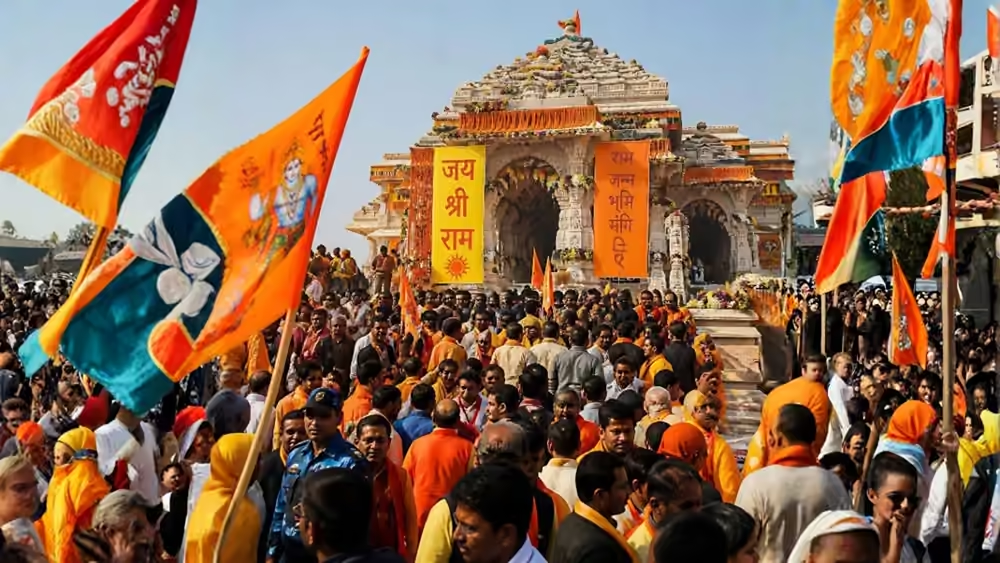
Temple of Ram -Ram Mandir- is one major place to visit in modern-day Ayodhya for many pilgrims.
If Ram Mandir visit is planned around any major festival or special religious event then it would be wise to organize your darshan to Ram Mandir separately rather than being under the assumption that you would be able to do everything within few hours or so.
Best Time to Visit Treta Ke Thakur Temple
"Best time" is rather a subjective phrase the meaning may vary. Thus, two answers have to be given:
Best time for Treta Ke Thakur darshan
Here is the simple fact:
Go to the temple on its annual Kartik Shukla Ekadashi opening day
that is basically the main time for people to get a glimpse of the deity.
Darshan in 2026 will be on 20 November, but it could be subject to change depending on final temple schedule.
Best time for general Ayodhya sightseeing
The general rule is not the case for Ayodhya if you visit just to see the main temple from the street and check out the city. The months from October to March are normally the coolest one and it would feel good walking around the temples, ghats and other religious sites in Ayodhya. November in particular may be appealing as Ayodhya has a festive vibe but then at the same time it can also be pretty crowded.
Practical Tips for Visitors
Here are some things for you to remember before taking off to the temple:
Darshan may not be open every day so be aware of that.
Find out about the temple's annual opening day first before your travel date.
Your first choice of dates for a visit to 2026 would be 20 November on the occasion of Kartik Shukla Ekadashi.
The final confirmation of gate opening and darshan times will have to be made shortly before your trip.
You will want to join the queue early to be in the crowd for the smallest time.
Your plans may need change and be a little bit flexible if needed.
Wear shoes you can walk easily in since there might be quite a lot of time spent on your feet.
Listen to the directions of the police, the temple, and the security staff.
Carrying a heavy bag is not a clever idea, better not to have unnecessary luggage with you.
The time you spend at the temple will be more meaningful if you combine it with some other temples nearby like Ram Ki Paidi and Nageshwarnath Temple.
If you are a parent with small toddlers or a caretaker of a senior person, be ready for long waiting times and plan accordingly.
It is advisable to get a hotel booked ahead especially during the period of a big festival.
Final Thoughts
Treta Ke Thakur Temple is one of the weirdest ones in Ayodhya since only one day a year is open for darshan. It is so because people have the idea that this is the spot connected to Lord Rama's Ashwamedha Yajna although the current temple complex is built on various reconstructions with a noted 1700s connection with Ahilyabai Holkar.
The date for the major event in 2026, i.e., the festival of Kartik Shukla Ekadashi/Devutthana Ekadashi, is the 22nd of October. Please bear in mind that this is also a year where some events might have been rearranged on the calendar. Therefore, you should confirm the final details and the arrangement of darshan from local temples or authorities right away before you go.
The best way for someone who is going for pilgrimage in Ayodhya on a comprehensive level would be to include the temple of Treta Ke Thakur at the same time as the ones of Ram Ki Paidi, Nageshwarnath, and Shri Ram Janmabhoomi temples rather than making them the first step in a chain on a completely isolated basis.
Important Travel Note: Temple timings, parking fees, local transport prices, entry arrangements, and traffic restrictions may change during festivals, holidays, or special events. Please confirm the latest information with the relevant authority before travelling.
PLAN YOUR VISIT WITH LOCAL EXPERTS
Ready to Plan Your Sacred Ayodhya & Varanasi Yatra?
Get customized itineraries with dedicated private AC cabs, verified hotel stays, and temple timing coordination.
Rohit is the Founder of Trip My Bharat Network with over 8+ years coordinating pilgrimages through the sacred shrines of Ayodhya, Varanasi, Prayagraj, and Gaya. He specializes in verified temple schedules, sthala purana documentation, and crowd-safe darshan planning.
Frequently Asked Questions About Treta Ke Thakur Temple Ayodhya
Verified answers from local pilgrimage guides for peaceful temple darshans, timings, and transportation.
QIs Treta Ke Thakur Temple open every day?▼
On no account is Treta Ke Thakur Temple available for the common people on a daily basis. The temple is said to grant darshan to the devotees only once a year on Kartik Shukla Ekadashi
QWhen to go to Treta Ke Thakur Temple in 2026?▼
Kartik Shukla Ekadashi/Devutthana Ekadashi will fall in the Hindu calendar on 20 November 2026. This tithi is going to last till 21st so visitors are advised to ask for the opening and closing schedule of this ancient temple and plan accordingly.
QReasons behind the popularity of Treta Ke Thakur Temple?▼
Along with being one of the few temples that is believed to be constructed by the Lord Rama for His Ashwamedha Yajna. Treta Ke Thakur temple has an interesting connection with various histories such as Kullu royal family and the patronage from Ahilyabai Holkar for the reconstruction in 18th century.
QLocation of Treta Ke Thakur Temple?▼
It is located at Ayodhya in the state of Uttar Pradesh. It forms part of the Saryu/Naya Ghat pilgrimage complex of the city. It is a very convenient location as you can visit other sites like Ram Ki Paidi and Nageshwarnath Temple at the vicinity.
QAm I allowed to go Treta Ke Thakur Temple even if I come to Ayodhya on another day?▼
Visitors can walk around the premises and admire its exterior view but the inner sanctum is not open for darshan outside the annual open period. If the main goal of your visit is to enter the Treta Ke Thakur Temple, then you must time your visit so that you can be in time for the Kartik Shukla Ekadashi opening of the temple.
The cost per person for an Ayodhya–Varanasi–Prayagraj tour ranges from ₹5,499 (shared tempo traveller group tour) to ₹28,999+ (luxury private package). A realistic mid-range budget with a private cab and 3-star hotels is ₹8,999–₹14,999 per person. A couple in a private sedan pays ₹12,999 per person for transport, while a group of 10+ pays ₹8,499 per person for the same route. The UPSTDC Spiritual Triangle package costs ₹14,400 per person in a sedan (minimum 4). General darshan at Ram Mandir, Kashi Vishwanath, and Triveni Sangam is free. Hotel rates range from ₹800–₹1,500 (budget) to ₹3,000–₹6,000 (premium). Food costs ₹200–₹600 per person per day. For a fixed, transparent per-person quote, contact Rohit at 7078723132 or visit tripmybharat.com.
The best time to visit Ayodhya is October to March, when temperatures stay between 12°C and 28°C and the weather is comfortable for temple visits and the Saryu Aarti. January and February are the calmest and coolest months. November brings Deepotsav and the million-diya spectacle, but also peak crowds and 2–4x hotel prices. May and June are brutally hot, with highs crossing 40°C, and should be avoided. July to September is monsoon season — quiet, green, and humid, with the shortest darshan queues. For elders, photographers, and budget travellers, the right month depends on your priority. For a season-wise Ayodhya package with darshan assistance, contact Rohit at 7078723132 or visit tripmyayodhya.com.
Parking charges, vehicle-entry restrictions and penalties may change during festivals, peak pilgrimage periods and special traffic arrangements in Ayodhya. Visitors should use designated parking facilities and follow the instructions of local traffic authorities. Before travelling, confirm the current parking rates, permitted vehicle access and last-mile transport arrangements through official notices or the parking operator.