

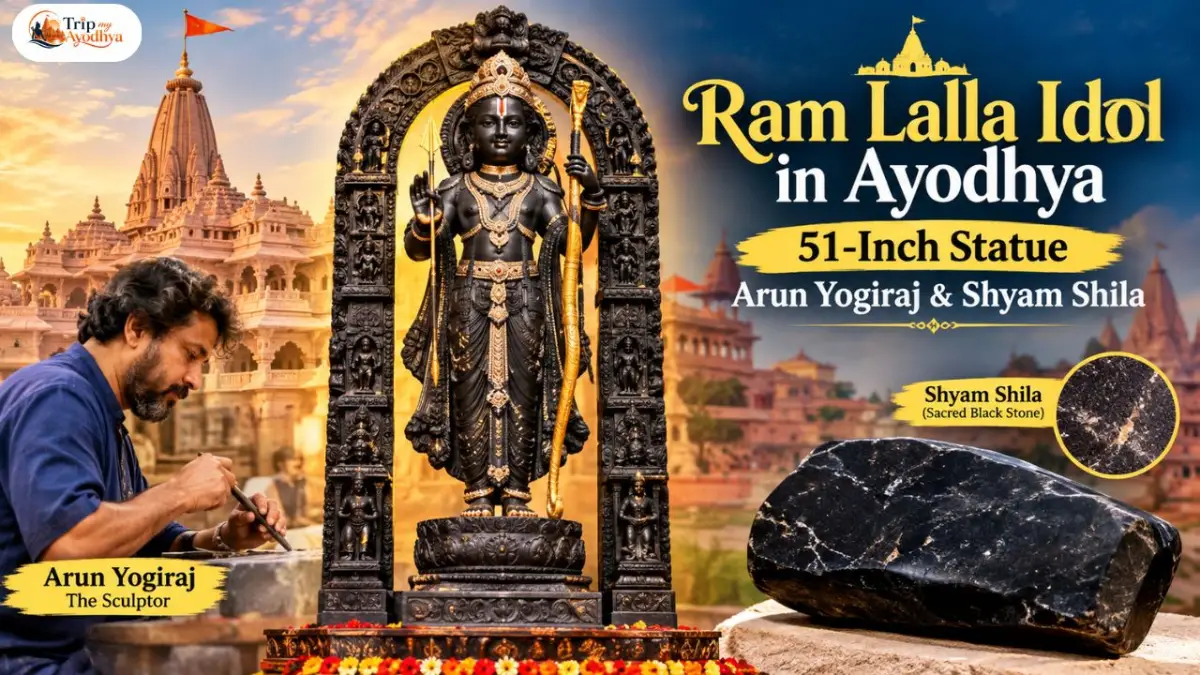
Ram Lalla is worshiped as the head god at the Ram Janmbhoomi Mandir newly constructed at Ayodhya and is the image of a five-year-old child. This article describes all aspects of the 51-inch Ram Lalla statue made by Arun Yogiraj. Starting the story, it includes the Krishna Shila stone, design, symbolism, selection process, installation, and Pran Pratishtha. It further discusses the previous Ram Lalla idol, clarifies myths from facts, and provides visitors’ practical details for visiting Ayodhya and offering prayers.
Ram Lalla Idol at a Glance
If you prefer a quick introduction before moving into the story, here are the central pieces of information that most people want to know: Who is Ram Lalla?
| Feature | Details |
| Deity | Ram Lalla, the child form of Lord Ram |
| Temple | Shri Ram Janmbhoomi Mandir, Ayodhya |
| Principal sculptor | Arun Yogiraj |
| Height | 51 inches |
| Representation | Five-year-old Ram in standing form |
| Stone | Krishna Shila, also commonly described as Shyam Shila |
| Stone source associated with the selected idol | HD Kote, Mysuru |
| Selected from | Three sculptural proposals |
| Installation | January 2024 |
| Pran Pratishtha | January 22, 2024 |
| Location | Ground-floor sanctum of the Ram Janmbhoomi Mandir |
The height of the idol was 51 inches, posture standing form of a child about five years old was the main idea. The carved black idol from Krishna Shila was selected out of the ones offered by various artists to the temple. Arun Yogiraj, a sculptor from Mysuru, Karnataka, sculpted it. You may take the opportunity to create an internal link here: Link to your Ayodhya Ram Mandir Complete Guide article.
Who Sculpted the Ram Lalla Idol?
Besides Arun Yogiraj, there were other sculptors who got selected to make the possible candidates for the statue of the new Ram temple at the location where the birthplace of the Lord is believed to be situated. The other sculptor names are Ganesh Bhatt and Satyanarayan Pandey. They created sculptures that were following a standard model: a 51 inch 5 years old Ram standing.
However, the basis of selection was not merely aesthetics. Selection board, according to reports, wanted an image that conveys a balance of the purity of a child, the characteristics, and the appearance of the subject, as well as the divine nature of the figure. The choice made in the end was a young child-looking idol in dark stone, the work of Yogiraj. The Indian Express reported that 11 of the 15 Trust members had selected the idol based on their impression that was formed by interacting with it.
That is probably one reason the face of the idol catches so much attention. The challenge was an artistic one: how to depict a deity as a five-year-old without losing the sense of royalty and divinity. Yogiraj’s way was to observe children very carefully first and use only Lord Ram’s classic depictions as a reference when necessary.
How Arun Yogiraj Created Ram Lalla
It’s not really possible of an artist to create a statue of Ram Lalaji just by carving with his hands.
Studying the appearance of a five-year-old
The biggest issue for making the figure a realistic five-year-old was lack of images. Yogiraj mentioned that he went to schools and children’s fairs in Mysuru to see the kids. In fact, he has spent the major chunk of time with 1, 200 photos during the preparation of child features and proportions.
He noted that the difference between a five-year-old and four-year-old is quite evident, therefore the need for age-specific observation was clear. Since the figure was not just an adult Ram’s version that’s much smaller in size there needed to be an expression of a child in the proportions.
Creating the balance between innocence and divinity
Yogiraj also described the necessity of blending a child’s purity with holiness. According to Yogiraj’s recollection, the idol was a mere visualization for two months before actual sculpting and sculpting took another four months for its completion. He said he worked in Ayodhya for long shifts. The idea was for the Ram Lalla murti to still look young but at the same time maintain the visual grandeur usually connected with images of temple Gods.
Selecting the stone
The sculptors had access to diverse types of stones. Yogiraj said among them were stones from Nepal, Karkala, HD Kote in Mysuru and Makrana in Rajasthan. However, Yogiraj chose Krishna Shila from H.D. Kote for his sculpture.
There were diverse types of decisions that the Ram Lalla project involved: One of them was artistic. It included, e.g., the face, the figure, the posture, and the expression. The other type concerned the material. The quality of the stone, its durability and suitability for use in a temple, were all the factors at play. The blend makes the Ram Lalla art-historically, significant project.
Why Is the Ram Lalla Idol 51 Inches Tall?
The 51-inch height is one of the most searched facts about Ram Lalla. The simple answer is that the temple Trust’s design brief specified a standing figure of approximately 51 inches to represent a five-year-old Ram. Contemporary reporting quotes the sculptors as saying the brief required the idol to look like a five-year-old and be 51 inches tall. Fifty-one inches is approximately 4.25 feet.
Does 51 have an officially confirmed hidden meaning?
This is where readers should be cautious. You may find online explanations assigning elaborate numerological or spiritual significance to number 51. Some of these may reflect personal devotional interpretations, but the documented selection brief gives a much more straightforward explanation: the height was specified as part of the design requirements for a five-year-old standing Ram Lalla. A trustworthy article should therefore distinguish between:
- Documented information: 51 inches was part of the Trust’s brief.
- Interpretive claims: additional meanings sometimes attributed to the number online.
That distinction is especially important when writing about a major pilgrimage site, where unsupported claims can spread quickly through social media.
Why height mattered visually
The height was also connected to visibility. The older Ram Lalla murti was considerably smaller. Contemporary reporting said the earlier idol measured roughly five to six inches, and concerns had been raised that it could not be seen clearly by devotees from a greater distance. The new 51-inch sculpture therefore created a very different visual presence within the sanctum.
What Is Shyam Shila or Krishna Shila?
The stone used for the selected idol is another major point of interest. The sculpture is made from Krishna Shila, a dark stone that has also been widely described in reporting as Shyam Shila or bluish-black stone. The selected stone was associated with HD Kote in Mysuru district.
Why is it called Shyam?
The word shyam is commonly associated with a dark or dusky appearance. In media coverage of the Ram Lalla selection, the chosen sculpture was described as shyam rang, or dark-colored, in contrast to a white marble candidate. This is why readers may encounter several terms:
- Krishna Shila
- Shyam Shila
- Shyam-colored stone
- Dark or bluish-black stone
They are often used in public discussions of the same selected idol and its material.
What did Arun Yogiraj say about the stone?
Yogiraj said he chose Krishna Shila after stones from different regions were made available. He also said that scientists from the Department of Mines and Geology provided inputs during the stone selection process. According to his account, Krishna Shila had been used in Karnataka temples for an extended period and was considered suitable for a temple environment. It is worth keeping a sensible distinction here too.
Claims that the stone has supernatural or scientifically extraordinary properties should not be presented as established fact without reliable technical evidence. The strongest evidence available concerns the sculptor’s selection process and the stone’s reported suitability for the intended use.
Ram Lalla Idol: Design, Features and Symbolism
The appearance of Ram Lalla combines realism, traditional religious imagery, and the requirements of temple worship.
A five-year-old face
The most noticeable feature is the youthful face. The Trust’s stated objective was not simply to create a small Ram. The sculptors were asked to represent a child while preserving innocence and divinity. The face therefore becomes central to the identity of the sculpture.
Standing posture
The selected Ram Lalla represents standing. This was part of the original brief given to the three sculptors. The posture gives the figure a strong vertical presence and works with 51-inch height to make the deity visually prominent in the sanctum.
Crown, ornaments and bow and arrow
The first images released after the Pran Pratishtha showed Ram Lalla adorned with a crown, jewellery and a bow and arrow. Contemporary reporting also described a forehead tilak and elaborate ornamentation. These elements are important to how devotees recognize the deity.
From an iconographic perspective, the ornaments communicate a royal and divine identity, while the bow and arrow are strongly associated with Lord Ram in Hindu tradition.
What the expression is intended to convey
The expression can be understood as an artistic attempt to hold several qualities together:
- Childhood: softness and innocence.
- Royal identity: composure and dignity
- Divinity: a sacred presence rather than an ordinary portrait.
Those are interpretations of the artistic intention; they should not be confused with a single officially prescribed explanation for every visual detail.
How Idol Was Selected and Installed
The selection of the Ram Lalla idol took place before the January 2024 Pran Pratishtha ceremony. Three sculptures were prepared by three sculptors.
The Trust’s brief required all three to depict a five-year-old Ram in a standing form at around 51 inches.
The candidate sculptures differed in both appearance and material.
Yogiraj’s sculpture was made from dark Krishna Shila. Ganesh Bhatt also worked with a dark stone, while Satyanarayan Pandey’s candidate was made from white Makrana marble.
Selection of Arun Yogiraj’s sculpture
The Trust selected Yogiraj’s sculpture for installation in the sanctum. The Indian Express reported that the decision was supported by 11 of the Trust’s 15 members, with the idol being selected for the impression it created.
Installation in the sanctum
The selected Ram Lalla Idol was installed in the sanctum in January 2024 before the public Pran Pratishtha ceremony. Reporting from January 18, 2024, confirmed that the 51-inch idol had been installed in the sanctum.
The Government of India identifies January 22, 2024, as the date of the Pran Pratishtha ceremony at the newly built Shri Ram Janmbhoomi Mandir.
The ceremony was therefore the culmination of a much longer process of selecting the deity, preparing the temple, and conducting the associated rituals.
What is Pran Pratishtha?
Pran Pratishtha is a consecration ceremony within Hindu temple tradition. In this context, it marked the ritual establishment of the sacred deity in the new temple’s sanctum. The event was not simply an inauguration of a building. It was a religious ceremony centered on the deity.
👉Ram Mandir Dress Code – What to Wear & What to Avoid in Ayodhya
What Happened to the Earlier Ram Lalla Murti?
This is one of the most important additions to the article because many visitors confuse the old Ram Lalla murti with the new 51-inch idol. They are not the same sculpture.
The earlier Ram Lalla idol was a much smaller image that had been worshipped for decades. Contemporary reporting described it as around five to six inches tall. Before the Pran Pratishtha, it was moved from the makeshift shrine into the new temple’s sanctum. The old idol therefore continued to have a place in the temple.
Why was a larger idol introduced?
One practical explanation reported at the time was visibility. The old idol was very small, and reports said it could not be clearly seen by devotees from a distance of roughly 25 to 30 feet. The new 51-inch idol provided a much larger visual presence in the sanctum.
This does not mean that the older idol became unimportant. The Trust’s position, reported in January 2024, was that the old deity would remain in the sanctum and that the new idol would be the stationary principal figure, with the older idol having a particular role during festivals.
What about the other two newly carved idols?
The two candidate idols that were not selected for the Pran Pratishtha were also intended to be treated with honour. At the time, reporting stated that the Trust planned to retain the additional sculptures within the temple complex.
Because arrangements can evolve after construction and installation, it is better to avoid publishing permanent claims about their exact present-day display location without checking the latest official information.
👉Ram Mandir Dress Code – What to Wear & What to Avoid in Ayodhya
Ram Lalla Idol: Facts vs Myths
Ram Lalla is a subject that attracts huge interest online, but that also means misinformation can spread quickly. A good travel guide should make the difference between documented evidence and speculation obvious.
| Claim | What the available evidence supports |
| Ram Lalla is shown as a child | Yes. The temple brief called for a five-year-old form. |
| The idol is 51 inches tall | Yes. This was part of the sculpting brief. |
| Arun Yogiraj sculpted the selected idol | Yes. |
| The selected idol is made from Krishna Shila | Yes, according to reporting and the Trust’s announcement. |
| The stone was associated with HD Kote in Mysuru | Yes, according to Yogiraj’s account. |
| The number 51 has one officially confirmed secret numerological meaning | Not established by the sources cited here. |
| Krishna Shila has supernatural properties scientifically proven by modern research | Not established by the sources cited here. |
| Every Ram Lalla image circulated online shows the installed idol | No. Candidate sculptures, replicas and edited images also circulate. |
| The old Ram Lalla murti disappeared after the new idol was installed | No. It was moved into the new temple’s sanctum. |
This approach to factchecking is especially helpful for an article that focuses on gaining long-lasting traffic through search results. Visitors can easily rely upon a resource where the author clearly explains the factual basis of statements, the part of the work where the interpretation of facts takes place, the part of the work where things are simply written the best, and the part which is best viewed as a work of fiction and should be treated as such.
Ram Lalla Darshan in Ayodhya: What to expect when you arrive
- For the sake of visitors, the point which needs to be emphasized the most is that temple procedures are subject to change.
- Planning visit to Ayodhya in 2025 on the basis of an article published in 2024 or a social media video may not be a clever idea.
- One should check for the latest official information from the temple site before leaving for the trip. As far back as April 2025, the All India Radio had mentioned that the Shri Ram Janmabhoomi Teerth Kshetra Trust had started issuing Sugam Darshan and General Darshan passes apart from the existing ones.
- According to the report, the Sugam Darshan is a kind of a general pass that includes the worship of the deity Ram Lalla, the members of his family, and even the six temples inside the Parkota. A General Darshan pass covers worship of Ram Lalla, the family members of Ram, Sheshavatar Temple, seven temples, and Kuber Tila.
- Again, from the April 2025 report it was stated that the maximum number of devotees that a single pass would allow had been increased from four to five.
- Safety arrangements in temples can change quickly, so the above list gives you an idea of what one can expect as per the last date. Hence, if you want to know how things currently function around you in temples you may have to look no far.
Do not confuse travel packages with official temple arrangements
One more thing visitor are likely to do is to check what the latest changes have been made or what the temple regulations are.
Also do not trust what a tourist agent would tell the tourists and take it as the gospel truth just because the tourist agent arranged for the transport, hotels, sightseeing or making your plans, there is absolutely no guarantee that you need to follow the instructions of this tourist operator to go to the temple in the morning.
Before you go to a shop and purchase an article like a book or a souvenir which also happens to involve purchasing a temple pass, the only thing left for you to do is to check whether the one selling is authorized.
- Who is issuing this pass?
- Is it available online? (Official source?)
- What exactly is the pass for? (Facility?)
- Is it valid nowadays? (Current?)
The line about this distinction is very clear and important during a busy period or a religious festival.
What should you carry?
Security at the temples might prevent visitors from taking some things through them. Since safety measures can be changed or upgraded, one should check for updates before packing.
It is also quite practical for families and senior citizens to plan extra time for walking between temples, for passing through security checks and for being around large numbers of people.
👉2-day Ayodhya tour packages page here.
When Is the Best Time to Visit Ram Lalla in Ayodhya?
There is no one fixed month for your visit to Ayodhya which will work best for every tourist. The best season depends on your main priority whether that is weather conditions, festivals, making sure the whole family is comfortable or you want to visit at a special religious event.
October to March
During the cooler months of Ayodhya, the weather is usually more pleasant for tourists than during the peak summer months. The Uttar Pradesh Department of Religious Affairs has indicated that October to March is a favorable time visiting the holy town of Ayodhya, and it has reminded us of the fact that temperatures in the summers may be very high. Besides that, this time of year can also be very hectic and especially during the major festival period and holidays
Festival periods
The holy periods offer an ideal opportunity for devotees who want to participate in a major religious celebration. However, visitors may face difficulties of being overwhelmed due to higher than anticipated levels of demand and crowd.
So, it is advisable not to choose your visit date based solely on an old blog suggesting that it will guarantee access arrangements.
For families and senior citizens
It is better to take a slower route and see one major attraction a day rather than be overwhelmed by trying to see everything in one single day. Besides Ram Lalla darshan, you may include some nearby places such as Hanuman Garhi, Kanak Bhawan, and Saryu riverfront to your sightseeing tour of Ayodhya.
It would be helpful to leave adequate time for your rest periods too. Interestingly, the District Ayodhya administration has itself identified several Ram Lalla-connected religious places as tourist attractions for visitors, such as Ram Ki Paidi, Kanak Bhawan, Hanuman Garhi, and other religious and heritage attractions in the city. Internal link opportunity: You may refer to Best Places to Visit in Ayodhya here.
How to Get to Ayodhya
The city is well connected by train, air, road, and bus to most pilgrimage points in India. Depending on where you come from and how much time you have, the best way will vary.
By Train
For a hassle-free travel, you can take the train to Ayodhya, especially if you are a pilgrim heading to the city from Delhi, Lucknow, Varanasi, Prayagraj, etc. There are regular trains from almost all the major cities in India which terminates at Ayodhya or passes through it.
- Most of the tourists will get alighted and continue from Ayodhya Dham Railway Station (AY).
- There is another Ayodhya Cantt Railway Station (AYC) for the tourists.
- Major Indian cities are linked by various trains to Ayodhya.
- From the railway station, you can go by autorickshaw, taxi, or local transport to your hotel.
By Air
If you’re travelling from a different part of the country and do not want to spend too much time on the way, then catching a flight is probably the most convenient option.
- City’s main and biggest airport called Maharishi Valmiki International Airport Ayodhya Dham is AYJ.
- Flights are available for only some of the major Indian cities the availability of routes usually varies depending on the season and the schedule of a particular airline.
- You can use either taxi or another form of local transport from the airport to the city & your hotel upon arrival.
- It is important that you find out the details about when & for whom each flight is offered before getting your ticket.
By Car (Driving) / By Road
Ayodhya can be accessed with the use of car and other road transport from various major cities of North India, so that you can have time for other attractions on the road, if you wish, or plan the journey with a great degree of comfort, which may help a family and a group of friends.
- One of the shortest travel distances to Ayodhya is from the city of Lucknow which is about 135 km.
- The distance from Varanasi to Ayodhya is about 200 km.
- From Prayagraj, Ayodhya is approximately 165 km.
- Delhi, on the other hand, is pretty far from Ayodhya so going via train or air might be a better option.
Of course, the actual distance will depend on the road chosen for travel and also you may start from and drop off at different points.
By Bus
There is hardly any dearth of local bus transport services that are running regularly connecting Ayodhya to other nearby cities and towns like Lucknow, Varanasi, Prayagraj, Gorakhpur, etc.
- State-run and private buses are available on most of the routes.
- Based on the route of the bus, you may have Air Conditioned buses or non-A.C buses available.
- Bus travelling is the most economical way of transportation.
- It is recommended that just before your travel, you check the newest timetable and pick-up spot.
Which Is the Best Way to Reach Ayodhya?
In general, the pilgrims who travel with a small amount of luggage may prefer the railways because it is the most economical option which they can get when compared against other means like air or road transportation.
Whereas, it might be a better idea for a visitor, who happens to be from a distant city, to prefer airway transportation so that they can cover the distance faster and with fewer hassles.
On the other hand, if someone is making a trip with a family or friends’ group who like to have the freedom to plan and change their daily itinerary at any time, then probably by having their own private car or a taxi will suit such people better because the car provides maximum flexibility of sightseeing all around Ayodhya.
Suggested Ayodhya Itinerary Around Ram Lalla
A two-day Ayodhya trip can cover the city’s most important temples, ghats, and spiritual attractions without making the journey too rushed. This itinerary focuses on Ram Mandir, Hanuman Garhi, Kanak Bhawan, Nageshwarnath Temple, and the Saryu River, while keeping enough flexibility for darshan and changing crowd conditions.
Day 1: Ram Mandir and Core Ayodhya
Start your Ayodhya journey by settling into your hotel before beginning the main sightseeing. Since temple visits can take longer during busy periods, keep your schedule flexible and allow extra time for security checks and darshan.
Morning – Arrival and Hotel Check-In
Arrive in Ayodhya by train or flight and transfer to your hotel. Depending on your arrival time, complete check-in and take some time to freshen up and rest.
- Arrive at Ayodhya by train or flight.
- Transfer to your hotel.
- Complete check-in formalities.
- Freshen up and have breakfast or refreshments.
- Keep your luggage safe at the hotel before sightseeing.
Late Morning or Early Afternoon – Ram Mandir
The main highlight of your Ayodhya trip is Ram Mandir, dedicated to Ram Lalla. Follow the latest visitor and darshan arrangements and allow sufficient time for security checks and the temple visit.
- Visit Ram Mandir and seek darshan of Ram Lalla.
- Follow the current entry and security guidelines.
- Keep some extra time for queues and crowd movement.
- Avoid carrying unnecessary belongings.
- Follow the instructions provided by temple authorities.
Afternoon – Hanuman Garhi
After visiting Ram Mandir, continue to Hanuman Garhi, one of Ayodhya’s prominent religious sites. The temple is an important stop for devotees and can be included easily in a central Ayodhya sightseeing route.
- Visit Hanuman Garhi.
- Spend time exploring the temple surroundings.
- Offer prayers and experience the spiritual atmosphere.
- Continue towards the nearby attractions after your visit.
Evening – Saryu River and Nearby Ghats
In the evening, head towards the Saryu River. The ghats provide a peaceful setting to relax after a day of temple visits and experience Ayodhya’s spiritual atmosphere.
- Walk along the Saryu ghats.
- Spend some quiet time beside the river.
- Explore nearby areas at a relaxed pace.
- If your schedule permits, attend the Saryu Aarti.
Night – Kanak Bhawan and Return to Hotel
Before ending the day, visit Kanak Bhawan, an important temple associated with Lord Rama and Mata Sita. After the visit, return to your hotel and rest.
- Visit Kanak Bhawan.
- Spend time inside the temple complex.
- Explore the surrounding old-city area if time permits.
- Return to your hotel for dinner and overnight stay.
Day 2: Temples, Heritage, and Saryu Aarti
The second day can be kept more flexible. Use the morning and afternoon to explore additional temples and heritage attractions, depending on your interests and the time available before departure.
Morning – Breakfast and Temple Visits
Begin the day with breakfast at your hotel and prepare for another round of sightseeing.
- Have breakfast at the hotel.
- Visit additional temples and religious sites.
- Explore nearby heritage attractions.
- Keep enough time for darshan and local travel.
Late Morning – Nageshwarnath Temple
Visit Nageshwarnath Temple, an important religious site in Ayodhya. You can spend some time exploring the temple and its surroundings before continuing to other attractions.
- Visit Nageshwarnath Temple.
- Explore the surrounding area.
- Learn about the temple’s religious significance.
- Keep your schedule flexible rather than assigning a strict time limit.
Afternoon – Lunch and Local Exploration
Take a break for lunch and some rest before continuing your sightseeing. If you have enough time, explore local markets and nearby areas to experience Ayodhya beyond its major temples.
- Have lunch at a suitable local restaurant.
- Take a short rest.
- Explore local markets.
- Shop for traditional souvenirs and devotional items.
- Continue sightseeing according to your departure schedule.
Evening – Saryu Ghats and Aarti
Spend your final evening in Ayodhya near the Saryu River. If the timing and arrangements are suitable, attending the Saryu Aarti can be a memorable way to conclude your trip.
- Visit the Saryu ghats.
- Enjoy the evening atmosphere beside the river.
- Attend Saryu Aarti if available and convenient.
- Take some time for photography and peaceful sightseeing.
Plan Your Ayodhya Trip with Trip My Ayodhya
Plan and enjoy a spiritually enriching travel experience in a very convenient way through the expert assistance of Trip My Ayodhya. Being a reliable and trusted company for pilgrimage tour management, we ensure your tours from a temple to a temple go like a dream. We have customized tours and comfortable transport. You need not only get the spiritual darshan but also have an enjoyable time in visiting local tourist spots while you are there. With our services, you will not have hotel booking or travel planning worries, as everything is already well arranged by us.
Visit Ayodhya, Varanasi, Mathura, and Vrindavan with a peace of mind as we handle things on our end so that you can devote your time and energy solely to experiencing a spiritual and religious trip. Select our package as the best of all your options if you want a hassle-free, pleasant, and unforgettable travel venture to the most holy places in India.
Bookings with Trip My Ayodhya What You Gain
- Customized Tours We make the itineraries according to how the customer needs time and expenditure-wise
- Travel in Comfort Our vehicles are kept in a good condition and the drivers are experienced
- Celebrating Priority Darshan You will be able to save the time at temple visits if we handle temple visits well
- Local Experts The tour is explained in detail with spiritual knowledge by an expert guide
- Lower Cost There is a combination of many services with competitive price and no hidden fees
- Available Anytime Service Customer support team will give you help for the rest of your adventure
- Integrated Services All the necessary services like stay, transport, and sightseeing have to only be asked for once
Also BOOK: Same Day Ayodhya Tour Package – Itinerary – Explore the top temples and spiritual attractions of Ayodhya in one day with a well-planned sightseeing itinerary.
Plan your upcoming trip with us and experience a divine journey like never before!
📞 Call Us: +91 7078723132 | +91 9557104160
📲 WhatsApp Us: +91 7078723132 | +91 9557104160
🌐 Visit Our Website: Trip My Ayodhya | Vrindavan Mathura Tourism
🔗Explore all our packages here 👉 Trip My Ayodhya Packages
🔗 Read Our Blogs for Travel Inspiration: Trip My Ayodhya Blog’s
Important Tips for Planning Your Ayodhya Trip
This itinerary is a general travel plan rather than a fixed schedule. Ayodhya can experience significant crowds during festivals, weekends, and major religious occasions, so the order of sightseeing may need to change.
- Keep your itinerary flexible.
- Check the latest temple entry and darshan arrangements before visiting.
- Allow additional time for security checks and crowds.
- Avoid planning too many attractions back-to-back.
- Keep your hotel location in mind when deciding the sightseeing order.
- Follow local traffic and security instructions.
- Confirm current timings before visiting any specific temple or attraction.
Plan Your 2-Day Ayodhya Trip
If you prefer a more convenient travel experience, you can also explore our 2 Days Ayodhya Tour Package with Ram Mandir and Saryu Aarti, which can help combine the major attractions into a practical short-trip itinerary.
Conclusion
Devotees of Ram Lalla will find spiritual satisfaction in this statue located at the ground level of the Ram Mandir in Ayodhya. The 51-inch idol, representing the childish form of the Lord Ram, is a masterpiece sculpted on a slab known as Krishna Shila by a sculptor named Arun Yogiraj.
This statue has an aura of art, the craft, and the legacy behind it that will make visiting it a more profound experience. People on an Ayodhya pilgrimage are strongly advised to visit the Ayodhya website regularly and keep track of darshan and temple-related notices before setting out so that the trip is hassle-free and well-organized.
📞 Call Us: +91 7078723132 | +91 9557104160
📲 WhatsApp Us: +91 7078723132 | +91 9557104160
🌐 Visit Our Website: Trip My Ayodhya | Vrindavan Mathura Tourism
Frequently Asked Questions
Who is Ram Lalla?
Ram Lalla refers to the infant form of Lord Ram. The main deity of the ground-floor Sanctum of the Shri Ram Janm bhumi Mandir is depicted as the childish form of Bhagwan Shri Ram.
Who sculpted the idol of Ram Lalla kept in the holy city of Ayodhya?
The final 51-inch statue of Ram Lalla was sculpted from the heart of a city located far away namely Mysore, by Arun Yogiraj, a sculptor. He was one among only three selected to carve out candidate idols.
Why is Ram Lalla 51 inches tall?
Purposing to create a standing statue for worship, the temple Trust has asked the sculptures to design one of 51-inches height representing a child of the age of five.
From what kind of rock is Ram Lalla sculpted?
The statue that was eventually chosen was made from Krishna Shila, a type of very hard stone, which belongs to HD Kote area of Mysore. In the public reporting, it’s called Shyam Shila.
Was the previously placed idol of Ram Lalla in the same temple replaced?
Not really. Just before the formal consecration of the new temple, a considerably diminuitive Ram Lalla idol had been placed in the ground-floor sanctum, coming from a temporary shrine at Ram Janmabhoomi.
When was Ram Lalla consecrated on earth?
On the day, i.e., January 22, 2024, a big ceremony called ‘The Consecration ‘ for Ram Lalla, the baby form of Lord Ram, was held at the new Shri Ram Janmbhoomi Mandir. The sacred ceremony is referred to as ‘Pran Pratishtha’.
Does one get chance to see Ram Lalla now through darshan?
At the same time, Ram Lalla will still be the main divine entity that the followers get to see through darshan in the new Shri Ram Janmbhoomi Mandir. As the visitor arrangement and pass are changing, it is suggested that the visitors get acquainted with the latest information through a check-up on the official website before making the visit. Latest 2026 reports state availability of General Darshan and Sugam Darshan Passes.
Is it that Lord Ram and Ram Lalla are the same?
Ram Lalla is a devotee’s representation of Lord Ram in the child form. One is not referring to a different deity by these terms but that Ram is being depicted as the divine child.
What is the cause for dark complexion in the sculpture of Ram Lalla?
The dark skin of this stone used to make dark idols is a natural characteristic of the dark stone. That is why the stone used for the main idols, i.e., Krishna stones, will give these idols a very dark complexion. And hence, such statues are reported to look very dark after the idols are picked by the temple.