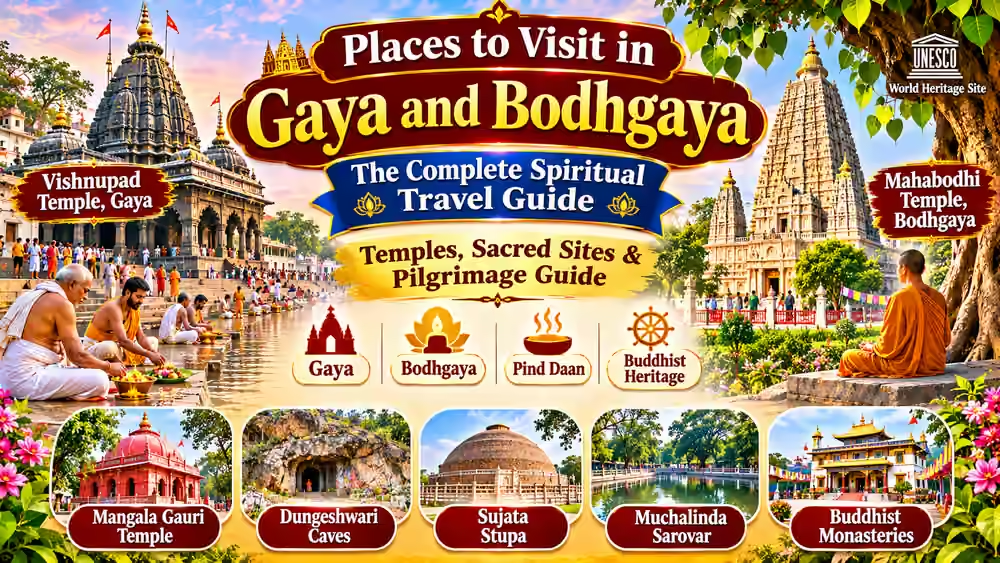
Namaste. I am Rohit, a guide. I have been helping pilgrims for the past 8 years. While my home is in Braj, I have guided many families to Gaya and Bodhgaya – two towns that sit side by side but belong to two different spiritual worlds.
Bodhgaya is where Prince Siddhartha became the Buddha. It is the axis of global Buddhism, with monasteries built by Thailand, Japan, Bhutan, Tibet, and Myanmar standing within walking distance of each other. Gaya is older. It is the land of Vishnupad, where Hindus perform Pind Daan for their ancestors along the Falgu River.
Travellers often confuse the two or assume they are the same place. They are not. But they are close enough to be visited together – and that is exactly what most pilgrims do.
This guide covers the essential places to visit in both towns, the practical details of getting between them, and the honest advice that makes your pilgrimage smooth and meaningful.
Let us begin.
Bodhgaya – The Land of Enlightenment
Bodhgaya is about 12 km south of Gaya and is revered worldwide as the place where Gautama Buddha attained supreme enlightenment under a Peepal tree in 528 BCE. It is a UNESCO World Heritage Site and a global centre of Buddhist pilgrimage.
Mahabodhi Temple and the Sacred Bodhi Tree
The Mahabodhi Temple is the spiritual heart of Bodhgaya. The temple complex marks the exact spot where Prince Siddhartha meditated and attained enlightenment more than 2,500 years ago.
What to See:
-
The 50-metre-tall pyramidal spire, dating back to the Gupta period, enshrining a gilded statue of Buddha in the Bhumisparsha mudra (earth-touching gesture)
-
The sacred Bodhi Tree, a direct descendant of the original Peepal tree under which Buddha meditated for 49 days
-
The Vajrasana or Diamond Throne, an ancient polished sandstone slab placed by Emperor Ashoka marking the unshakeable centre of the universe
-
The Animesh Lochana Chaitya, Mucalinda Lake, and several ancient meditation sites
Timings and Entry:
Etiquette: Dress respectfully, maintain silence, and follow the photography instructions displayed at the entrance.
The Great Buddha Statue
The 80-foot Great Buddha Statue is a monumental sandstone statue unveiled by the 14th Dalai Lama, surrounded by 10 great disciples of the Buddha.
The International Monasteries
Bodhgaya is home to monasteries built by Buddhist communities from across the world. Each offers a different architectural style and spiritual tradition.
Note: Monasteries may follow different opening hours. Check locally before visiting.
Sujata Stupa and Dungeshwari Caves
Sujata Stupa is where Buddha accepted Sujata's milk rice, breaking his six-year fast. It is open until sunset and is a 10-minute shared auto ride (₹20) from Bodhgaya.
Dungeshwari Caves are where Buddha meditated for six years before enlightenment. The caves are open from 6:00 AM to 6:00 PM and are about a 45-minute taxi ride (₹800 round trip) from Bodhgaya. Wear sturdy shoes for the short hike.
Gaya – The Land of Ancestral Rites
Gaya is one of Hinduism's most sacred pilgrimage centres, particularly known for the Pind Daan ritual performed in memory of departed ancestors. It is an ancient city, mentioned in the Ramayana and Mahabharata, and carries a spiritual weight distinct from Bodhgaya's Buddhist focus.
Vishnupad Temple
Vishnupad Temple is the principal pilgrimage site in Gaya, dedicated to Lord Vishnu and associated with a sacred footprint believed to be that of the deity.
Evening Aarti: The aarti at 6:30 PM is vibrant with bells and chanting. It is the most atmospheric time to visit.
The Falgu River and Akshay Vat
The Falgu River flows on the east side of Gaya and is central to the Pind Daan rituals. It carries water only during the monsoon; at other times, the riverbed is dry, but water can be found just below the surface – a phenomenon linked to a curse by Sita Devi.
Akshay Vat is an ancient banyan tree near Vishnupad Temple, blessed by Sita Devi to be immortal and never shed its leaves. It is one of the primary locations for Pind Daan rituals.
Sita Kund is on the opposite bank of the Falgu River, marking the spot where Sita Devi performed Pind Daan for her father-in-law. Devotees bathe here before beginning the rituals.
Mangla Gauri Temple
Mangla Gauri Temple sits on a small hill on the south side of Gaya and is one of the famous Shakti Peethas.
Significance: According to the Puranas, when Lord Shiva was performing the dance of dissolution after Sati's death, Lord Vishnu cut her body into pieces to stop him. Each piece fell at a different location, and each became a Shakti Peeth.
Ramshila Hill and Pretshila Hill
Ramshila Hill is on the south-east side of Gaya and is believed to be the place where Lord Rama offered Pind Daan. The Ramesvara or Patalesvara Temple on the hilltop was originally built in 1014 AD and has undergone many restorations.
Pretshila Hill is about 10 km from Ramshila Hill. At the base lies Brahma Kund, where devotees bathe before performing Pind Daan. On the hilltop is the Ahilya Bai Temple, built in 1787 by the Queen of Indore, known for its unique architecture and sculptures.
How to Reach Gaya and Bodhgaya
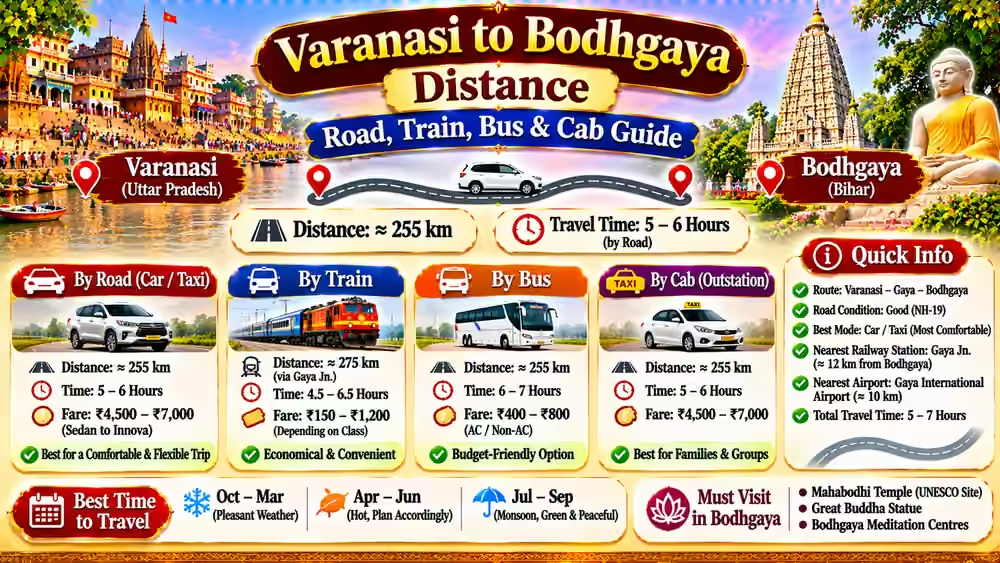
Distance Between Gaya and Bodhgaya
Note: Travel time increases during Pitru Paksha, when thousands of devotees visit Gaya.
Best Time to Visit
Festival Note: Bodhgaya becomes very busy during major Buddhist events. Gaya experiences heavy pilgrimage traffic during Pitru Paksha. Book hotels and transport well in advance during these periods.
Suggested Itinerary (2 to 3 Days)
2-Day Itinerary – The Essentials
3-Day Itinerary – With the Caves and Hills
For travellers with an additional day: Add Rajgir (Vishwa Shanti Stupa, Venu Van) and Nalanda (the ancient Mahavihara, another UNESCO site).
Nearby Parking and Transport Options
Local Transport: Autos and taxis are the main modes. For families and elders, a private taxi is the most comfortable option for covering multiple sites in a day.
What to Wear and Carry
What to Wear:
-
Modest clothing covering shoulders and knees
-
Comfortable walking shoes (temples involve walking and some climbing)
-
Warm layers in winter (December–January)
-
Remove shoes before entering temple sanctums
What to Carry:
-
Government photo ID
-
Cash (ATMs may be limited in Bodhgaya)
-
Water bottle
-
Power bank
-
Sunscreen and hat
-
Basic medicines
-
A small bag for essentials
What Not to Carry:
Budget Breakdown for Your Trip
| Expense | Budget (Per Person) | Mid-Range (Per Person) |
|---|---|---|
| Hotel (2 nights) | ₹1,000–₹2,000 | ₹2,500–₹5,000 |
| Food (3 days) | ₹600–₹1,000 | ₹1,200–₹2,500 |
| Local transport | ₹500–₹800 | ₹800–₹1,500 |
| Pind Daan rituals (if applicable) | ₹1,000–₹2,500 | ₹2,500–₹5,000 |
| Entry fees | Free (temples) | ₹10 (Gaya Museum) |
| Total (excluding travel to Gaya) | ₹2,100–₹3,800 | ₹5,000–₹9,000 |
Note: Pind Daan costs vary depending on the priest and the package chosen. Arrange with a trusted priest in advance, especially during Pitru Paksha.
Conclusion
Gaya and Bodhgaya are not the same place. They are two different prayers, spoken in two different languages, a few kilometres apart. Bodhgaya is where the mind awakens. Gaya is where the heart remembers.
If you can, come for both. Sit under the Bodhi Tree at dawn. Walk the dry bed of the Falgu River at noon. Stand before Vishnupad at dusk. And when the bells ring for the evening aarti, let the two worlds meet in you.
This is Bihar. This is the land of enlightenment and ancestral memory. This is an experience of a lifetime.
Jai Shri Ram. Namo Buddhaya.
Plan Your Gaya and Bodhgaya Pilgrimage
For bookings, queries, and custom packages:
📞 Call Us: +91 7078723132 | +91 9557104160
📲 WhatsApp Us: +91 7078723132 | +91 9557104160
Hours: 8 AM to 9 PM daily
Our Services:
-
Gaya and Bodhgaya Pilgrimage Tour Packages
-
Pind Daan Ritual Assistance with Verified Priests
-
Private AC Cab for Gaya-Bodhgaya Circuit
-
Hotel Reservations in Bodhgaya and Gaya
-
Local Guide for Buddhist and Hindu Sites
-
Customized Itineraries for Families, Couples, and Groups