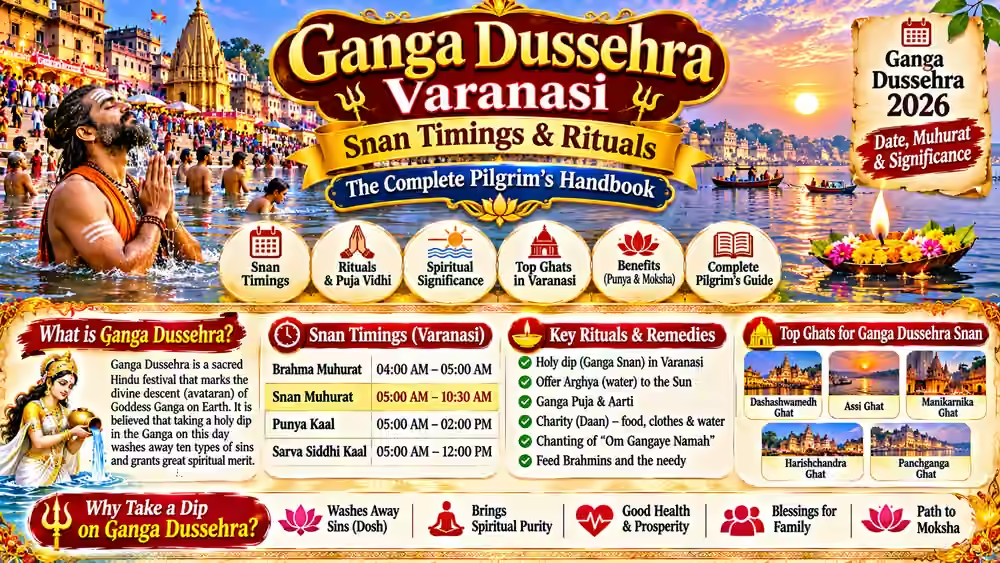
Namaste. I am Rohit, a guide. I have been helping pilgrims for the past 8 years. And in that time, I have learned that Ganga Dussehra is the one Varanasi festival that rewards preparation more than devotion alone.
The devotion is easy. Anyone can stand at a ghat and fold their hands. But the timing is not easy. The Brahma Muhurat window is barely forty minutes long. The sunrise snan draws a crowd that fills every step of Dashashwamedh Ghat. And if you arrive at 7 AM expecting a quiet dip, you will find yourself in a queue of a lakh and a half people.
This guide is about getting the timing right. It covers the three snan windows, the ritual sequence, the ghat-by-ghat reality, what to wear, what to carry, and the small practical details that separate a peaceful snan from a stressful one.
Let us begin.
Why the Date Confuses People
Every year, two dates circulate online for Ganga Dussehra. This year it is May 25 and May 26. Here is the honest reason.
The Tithi:
-
Dashami Tithi begins at 4:30 AM on May 25
-
Dashami Tithi ends at 5:10 AM on May 26
The Rule:
Ganga Dussehra is observed on the day the Dashami Tithi is running at sunrise. On May 25, the tithi is active from before dawn through the entire day. On May 26, it expires before the sun comes up.
The Verdict:
May 25, 2026, is the correct date. Plan your snan, your daan, and your aarti for that day.
Why May 26 Still Appears:
Some regional calendars compute the tithi at moonrise rather than sunrise. For a festival tied to a river bath at dawn, the sunrise rule is the one that matters.
The Three Snan Windows
| Window | Timing | Verdict |
|---|---|---|
| Brahma Muhurat | 4:40 AM – 5:23 AM | Most spiritually potent |
| Sunrise | Around 6:06 AM | Most popular, most crowded |
| Abhijit Muhurat | 12:17 PM – 1:10 PM | Second most auspicious, least crowded |
A Note on Brahma Muhurat:
Some Panchang calculations place Brahma Muhurat at 4:04–4:45 AM. Both are valid. The difference comes from local sunrise computation. If you want to be safe, be in the water by 4:30 AM.
Brahma Muhurat – The Most Potent Forty Minutes
This is the window that serious pilgrims aim for.
Why It Matters:
Brahma Muhurat is the pre-dawn period traditionally held to be the most spiritually charged part of the day. On Ganga Dussehra, the belief is that the river's purifying power peaks in these forty-odd minutes.
What the Ghats Look Like at 4:30 AM:
-
Lamps still burning on the steps
-
Priests setting up their copper vessels
-
A thin line of pilgrims, not yet a crowd
-
The river dark, with the far bank invisible
-
The first sounds of conches
What You Need to Do:
-
Reach the ghat by 4:00–4:15 AM
-
Carry a change of clothes in a waterproof bag
-
Keep valuables at the hotel
-
Enter the water from the steps, not by jumping
The Honest Warning: If you arrive at 5:15 AM, you will miss the window. Brahma Muhurat is not a suggestion. It is a specific forty-minute period.
Sunrise Snan and Surya Arghya
Sunrise on May 25 is around 6:06 AM.
Why It Is the Most Popular Window:
It combines the river bath with the Surya Arghya — the offering of water to the rising sun. For most families, this is the practical choice. You do not need to wake at 3:30 AM. You just need to be at the ghat by 5:15 AM.
What Happens:
-
Devotees stand waist-deep in the river or on the lower steps
-
They hold water in their palms
-
They face east and offer the water as the sun rises
-
The arghya is offered to Surya and to Lord Shiva
What You Should Know:
-
The ghats are packed by 5:30 AM
-
Priests are busy and may not have time for individual guidance
-
Carry your own copper vessel
-
Keep children close
Abhijit Muhurat – The Forgotten Window
Timing: 12:17 PM – 1:10 PM.
Why Most People Ignore It:
It falls in the middle of the day, in the May heat. Pilgrims assume that dawn is the only valid time.
Why It Is Valid:
Abhijit Muhurat is one of the eight auspicious muhurats in the Hindu day. It is considered highly meritorious for snan and daan, and it is explicitly listed as a valid window for Ganga Dussehra snan.
Who Should Use It:
-
Pilgrims who arrive in Varanasi on a late morning train
-
Families with elderly parents who cannot manage a pre-dawn bath
-
Anyone who missed the dawn window
What to Expect:
-
The ghats are quieter
-
The water is warmer
-
The sun is harsh — carry a hat and water
-
Fewer priests are available
The Gangavataran Story
Ganga Dussehra marks the descent of Mother Ganga to Earth.
The Story in Brief:
King Bhagiratha performed years of penance to bring Ganga down so that she could liberate the souls of his ancestors. Ganga agreed to descend, but her fall would have shattered the Earth. Lord Shiva received her in his matted locks and released her gently, in a controlled flow.
Why the Story Matters:
Ganga is not presented as a wild force. She is grace made manageable. The story says that divine power needs a vessel. Shiva is that vessel. The ghats of Varanasi are the continuing evidence of that arrangement.
The Other Name:
The festival is also called Gangavataran — the descent.
Why "Dussehra" Means Ten Sins
The word Dussehra usually points to Vijayadashami and the burning of Ravana. Here, it means something else.
The Meaning:
"Dussehra" in this context refers to the destruction of ten categories of sin — sins committed through body (kayik), speech (vachik), and mind (manasik).
What This Means in Practice:
A dip in the Ganga on this day is held to cleanse these ten categories. It is a ritual of purification, not a transaction.
The Honest Note: This is a matter of faith. It is not a substitute for ethical living, and no priest will claim otherwise. The snan is a symbol. The conduct is the substance.
The Ritual Sequence – Ten Steps
| Step | Ritual | What You Do |
|---|---|---|
| 1 | Wake before dawn | Bathe at home or hotel, wear clean clothes |
| 2 | Reach the ghat | Arrive by 4:15 AM for Brahma Muhurat |
| 3 | Sankalp | Take water in your right palm and state your intention |
| 4 | Ganga Snan | Three slow dips, holding the handrail |
| 5 | Arghya | Offer water to Surya and Shiva |
| 6 | Deep Daan | Float a lamp on the river |
| 7 | Aarti | Attend the ghat aarti or perform a simple one |
| 8 | Daan | Donate water, food, clothes, or fans |
| 9 | Pitru Tarpan | Offer water to ancestors if applicable |
| 10 | Break fast | Eat simple satvik food |
The Key Point: The sequence is not rigid. If you can only do the snan, the arghya, and the daan, you have done the core.
Ganga Snan – How to Do It Properly
Before Entering:
-
Take the sankalp on the steps
-
Remove footwear and keep it in a bag
-
Keep your change of clothes in a waterproof bag on the steps
Entering the Water:
-
Use the handrail
-
Step down slowly — the stone is slippery
-
Do not jump
The Three Dips:
-
First dip — for the body
-
Second dip — for the mind
-
Third dip — for the soul
After the Dips:
-
Offer water to the river with both palms
-
Exit using the handrail
-
Change into dry clothes immediately
What Not to Do:
-
Do not drink the river water
-
Do not swim into the current
-
Do not enter if you have open cuts or wounds
-
Do not photograph women bathing
Arghya to Surya and Shiva
What You Need:
-
A small copper vessel or lota
-
Water
-
A few flowers
How to Offer:
-
Stand facing east for Surya
-
Hold water in both palms
-
Recite the Surya mantra or "Om Namah Shivaya"
-
Pour the water slowly back into the river
Why Both Deities:
Surya is the source of life. Shiva is the one who received Ganga. On this day, both are honoured — the sun that rises over the river and the god who made the river's descent possible.
Deep Daan – The Floating Lamps
What It Is:
A small leaf boat with a cotton wick and ghee, set afloat on the Ganga.
What to Do:
-
Buy a leaf diya from a vendor on the ghat (₹20–₹50)
-
Light it
-
Set it on the water
-
Make a prayer or a wish
Why It Matters:
Deep Daan is the visual heart of the festival. At dawn, hundreds of lamps float on the dark water. By sunrise, the river carries them downstream in a slow procession.
The Practical Note: Do not use plastic or thermocol boats. They pollute the river. Choose leaf or clay.
Daan – What to Give and Why
Charity is central to Ganga Dussehra, and the traditional items are chosen for the season.
| Item | Why It Is Given |
|---|---|
| Drinking water | Late May heat is severe |
| Earthen pots (matkas) | Traditional water donation |
| Fans | Summer comfort |
| Clothes | Basic need |
| Food | Essential |
| Chappals | Commonly donated in summer |
The Logic:
You have bathed in the river. You have received cleansing. The daan is the return — you relieve someone else's thirst, heat, or hunger.
The Honest Advice: Give what you can. A ₹50 matka of water given sincerely is worth more than a large donation given for show.
Pitru Tarpan on Ganga Dussehra
Ganga Dussehra is tied to ancestral rites because the festival commemorates Bhagiratha's penance to liberate his ancestors.
What to Do:
-
Tarpan — offer water mixed with black sesame seeds to ancestors
-
Pind Daan — offer rice balls, if you follow that tradition
-
Feed Brahmins, cows, birds, or the needy
Who Should Do It:
-
Anyone performing annual ancestral rites
-
Families who could not do tarpan during Pitru Paksha
The Practical Note: Priests at the ghats can guide you through the tarpan for a dakshina. Agree on the amount before starting.
Ghat-by-Ghat Guide
Dashashwamedh Ghat
Why Go:
The largest crowd, the grandest aarti, and the most accessible location. This is where the festival's main public rituals happen.
What to Expect:
-
Nearly 1.5 lakh people take a dip in Kashi by noon
-
The ghat is packed well before sunrise
-
Priests are available but busy
Best For: Pilgrims who want the full festival atmosphere.
Assi Ghat
Why Go:
The chunari offering happens here — a cloth made of 5,100 sarees from 12 states, measuring nearly 25,500 feet, offered to Maa Ganga.
What to Expect:
-
Quieter than Dashashwamedh
-
Good for families
-
The chunari ceremony is a spectacle
Best For: Families and pilgrims who want a calmer snan.
Devi Ahilyabai Ghat
Why Go:
The milk abhishek of Maa Ganga is performed here — 501 litres of milk used to anoint the river, with Vedic rituals and conch blowing.
What to Expect:
-
Less crowded than Dashashwamedh
-
A more ritual-focused atmosphere
-
Priests conducting the abhishek
Best For: Pilgrims who want to witness the abhishek.
Other Ghats
-
Lalita Ghat
-
Namo Ghat
-
Panchganga Ghat
-
Tulsi Ghat
-
Bhainsasur Ghat
These ghats host rituals too, with smaller crowds. If you want a quiet snan, choose one of these.
What Happens at Kashi Vishwanath Dham
The temple trust organises special rituals for Ganga Dussehra.
What Happens:
-
Special puja and Vedic rituals
-
Ganga Aarti
-
Milk abhishek of Maa Ganga
-
Conch blowing ceremonies
Why It Matters:
The dham becomes a focal point for pilgrims. Many devotees do the snan at a ghat and then walk to Kashi Vishwanath for darshan.
The Practical Note: Darshan at Kashi Vishwanath is free. Phones are not allowed inside the sanctum. The queue on Ganga Dussehra is longer than usual.
Crowd Reality – Hour by Hour
| Time | Crowd | Notes |
|---|---|---|
| 4:00–5:30 AM | Moderate | Brahma Muhurat, manageable |
| 5:30–8:00 AM | Heavy | Sunrise snan, ghats packed |
| 8:00 AM–12:00 PM | Moderate to Heavy | Steady flow |
| 12:00–1:30 PM | Moderate | Abhijit Muhurat |
| Evening | Heavy | Ganga Aarti |
The Practical Conclusion:
-
Best snan: 4:15–5:00 AM
-
Worst snan: 5:30–7:30 AM
-
Quietest auspicious window: 12:17–1:10 PM
What to Wear
For the Snan:
-
Modest, quick-dry clothing
-
A change of clothes in a waterproof bag
-
A towel
-
Footwear that is easy to remove
For the Rest of the Day:
-
Modest clothing covering shoulders and knees
-
Light cotton — May in Varanasi is hot
-
A hat or cap for the afternoon
What Not to Wear:
-
Expensive jewellery
-
Leather items near the water
-
Loose footwear that can float away
What to Carry
| Item | Why |
|---|---|
| Copper vessel | For the arghya |
| Towel and change of clothes | You will be wet |
| Waterproof bag | For phone and wallet |
| Cash (₹1,000–₹2,000) | For daan, diyas, priest dakshina |
| Flowers and diya | For the rituals |
| Sunscreen | For the afternoon window |
| ORS packets | For the May heat |
| Government photo ID | For hotel and temple checks |
What to Leave Behind:
-
Expensive jewellery
-
Large bags
-
Laptop or tablet
-
Anything that cannot get wet
Snan Safety Rules
1. Stay Near the Steps
Do not swim into the current. The Ganga flows strongly, especially in May when the snowmelt is high.
2. Hold the Handrail
The ghat steps are wet stone. They are slippery.
3. Do Not Drink the Water
The river is sacred. It is not potable. Do not drink it, and do not let children put it in their mouths.
4. Avoid Open Cuts
Do not enter the water if you have open wounds or skin infections.
5. Keep Children Within Arm's Reach
The crowd at sunrise is dense. Hold hands.
6. Carry ORS
Dehydration is the most common health issue on Ganga Dussehra. The heat is severe.
7. Do Not Enter Alone at Brahma Muhurat
The ghats are dark before dawn. Go with a family member or a guide.
How to Reach Varanasi
By Air:
-
Lal Bahadur Shastri Airport (VNS) — 25 km from the city
-
Direct flights from Delhi, Mumbai, Bengaluru, Hyderabad, Chennai, Kolkata
By Train:
-
Varanasi Junction and Kashi Station — the main railheads
-
Direct trains from Delhi, Mumbai, Kolkata, and other major cities
By Road:
-
320 km from Lucknow
-
200 km from Ayodhya
-
120 km from Prayagraj
For the Brahma Muhurat Snan:
-
If you arrive by train on the morning of the festival, you will miss the dawn window
-
Plan to arrive the previous evening
Where to Stay
| Area | Best For | Price Range |
|---|---|---|
| Near Dashashwamedh Ghat | Walking distance to the main snan | ₹800–₹2,500 |
| Near Assi Ghat | Quieter, boutique stays | ₹1,500–₹4,000 |
| Cantt area | Wide roads, easy car access | ₹2,000–₹5,000 |
| Sigra | Budget hotels, families | ₹1,000–₹3,000 |
Recommendation: Stay near Assi Ghat or Dashashwamedh Ghat if you want to walk to the snan at 4 AM. Stay in Cantt or Sigra if you want easy car access and will take an auto to the ghats before dawn.
Important: Book 2–3 weeks in advance. Ganga Dussehra draws lakhs of pilgrims, and the ghat-side hotels fill first.
What to Eat
Before the Snan:
-
Light food only
-
Tea and biscuits, or fruit
-
Avoid heavy meals before entering the water
After the Snan:
-
Kachori sabzi
-
Jalebi
-
Thandai
-
Banarasi paan
Where to Eat:
-
Local dhabas in the old city
-
Restaurants near Assi Ghat
-
Kashi Chat Bhandar for chaat
Note: Varanasi is not a dry town, but the ghat areas are strictly vegetarian. Do not carry meat or alcohol into the temple zones.
Budget for the Day
| Expense | Budget | Mid-Range |
|---|---|---|
| Hotel (1 night) | ₹800–₹1,500 | ₹2,000–₹4,000 |
| Local transport | ₹100–₹200 | ₹300–₹500 |
| Diyas and flowers | ₹50–₹100 | ₹100–₹200 |
| Priest dakshina | ₹100–₹300 | ₹300–₹500 |
| Daan | ₹100–₹500 | ₹500–₹1,000 |
| Food | ₹200–₹400 | ₹500–₹800 |
| Total (excluding travel to Varanasi) | ₹1,350–₹3,000 | ₹3,700–₹7,000 |
Final Words
Ganga Dussehra is the quietest of Varanasi's big festivals. There are no fireworks. No loud processions. It begins in the dark, on wet stone steps, with a copper vessel and a handful of water.
But if you get the timing right — if you are in the water by 4:30 AM, if you offer the arghya as the sun rises, if you float a lamp and give something to someone who needs it — you will understand why this day matters.
The river has been flowing for millions of years. On this one day, the city stops to say thank you.
That is Ganga Dussehra.
Har Har Gange.
Plan Your Ganga Dussehra Snan
For bookings, queries, and custom packages:
Contact: Rohit - 7078723132
Hours: 8 AM to 9 PM daily
Our Services:
-
Ganga Dussehra Snan Planning and Ghat Selection
-
Priest Assistance for Arghya, Deep Daan, and Tarpan
-
Hotel Bookings near Assi and Dashashwamedh Ghats
-
Fixed-Fare Early Morning Transfers
-
Guided Ritual Assistance
-
Customised Varanasi Pilgrimage Itineraries