Namaste. I am Rohit, a guide. I have been helping pilgrims for the past 8 years. And in those years, I have stood in the Mahashivratri queue at Kashi Vishwanath more times than I can count.
It is not like the other festivals of Varanasi. Ganga Dussehra is a river festival. Dev Deepawali is a festival of lamps. Mahashivratri is a flood. The whole city turns into a single stream of people moving toward the Jyotirlinga. The lanes from Godowlia to Maidagin are packed. The ghats are full. The chants of "Har Har Mahadev" start before dawn and do not stop until the next morning.
But the same devotion that makes the night extraordinary also makes it brutal. Queues run for kilometres. The general darshan line can take 6 to 12 hours. And pilgrims who arrive without a plan spend the festival in a barricade instead of in darshan.
This guide is about getting the plan right. It covers the dates, the timings, the crowd reality, the darshan strategy, the traffic and parking system, the Shiv Baraat, and the practical tips that make the difference between a blessing and an ordeal.
Let us begin.
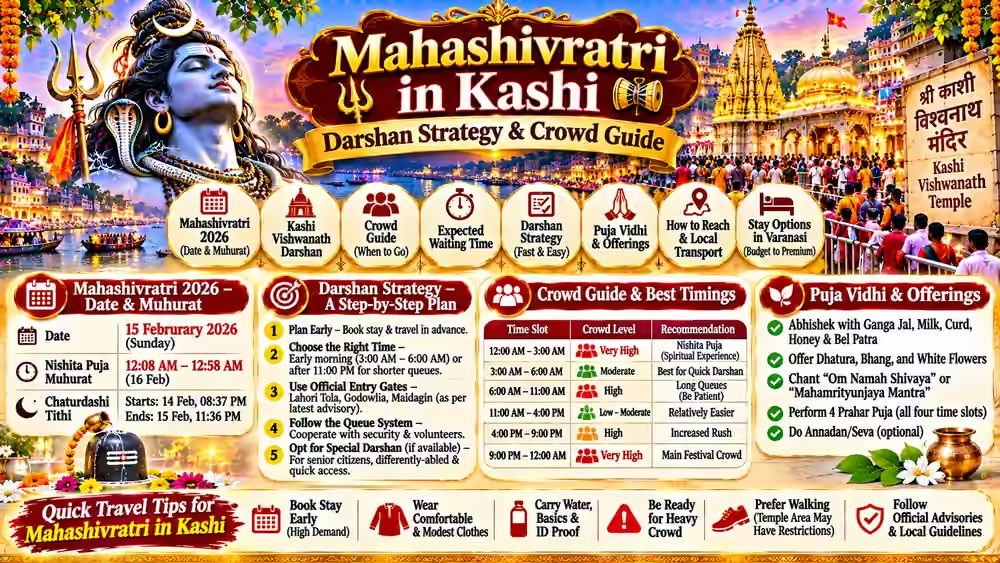
Mahashivratri 2026 – Date and Temple Timings
| Detail | Information |
|---|---|
| Festival | Mahashivratri |
| Date | Sunday, 15 February 2026 |
| Night Continues | Into the early hours of Monday, 16 February |
| Mangala Aarti | 2:15 AM – 3:15 AM |
| Temple Opens for Devotees | 3:30 AM |
| Continuous Darshan | Nearly 44 hours |
| Sanctum Doors Open | 3:30 AM on 15 February |
| Crowd Projection | 8–10 lakh devotees |
Source: The Statesman, Times of India, and Amar Ujala.
What This Means: The temple does not follow its normal schedule. The sanctum doors open at 3:30 AM on Mahashivratri and stay open for almost two full days. There is no afternoon closure in the usual sense. Darshan continues through the night.
The Four-Part Aarti Schedule
The Kashi Vishwanath Temple Trust releases a special four-part aarti schedule for Mahashivratri.
| Part | Aarti Timing | Details |
|---|---|---|
| First Part | 10:00 PM – 12:30 AM | Conch blown at 9:30 PM, darshan continues during the aarti |
| Second Part | 1:30 AM – 2:30 AM | Darshan continues |
| Third Part | 3:30 AM – 4:30 AM | Darshan continues |
| Fourth Part | 5:00 AM – 6:15 AM | Darshan continues |
Source: The Statesman.
The Other Aartis:
| Aarti | Timing |
|---|---|
| Mangala Aarti | 2:15 AM – 3:15 AM |
| Midday Bhog Aarti | 11:40 AM – 12:20 PM |
| Sapta Rishi Aarti | 7:00 PM – 8:15 PM |
| Shringar Aarti | 9:00 PM |
| Shayan Aarti | 10:30 PM – 11:00 PM |
Source: The Mandir Yatra and Namami Spiritual Yatra.
The Key Point: Darshan is not suspended during the aartis. Unlike normal days, where darshan pauses for certain rituals, Mahashivratri allows continuous darshan through the night. This is why the crowd can be managed over 44 hours rather than squeezed into a single day.
How Big Is the Crowd – The Honest Numbers
This is the part most guides understate.
| Metric | Figure |
|---|---|
| Devotees in 43 hours | 11.5 lakh |
| Devotees by 9:00 AM on Mahashivratri | 4 lakh |
| Devotees by 5:00 PM on 16 February | 8.78 lakh |
| Devotees by 7:00 PM on Mahashivratri | 5.46 lakh |
| Queue length | 4–5 km |
| Time per person at sanctum | About 2 seconds |
| Projected total | 8–10 lakh |
Sources: Bhaskar English, Amar Ujala, Times of India, and News18.
What This Feels Like:
-
The queue starts forming before dawn
-
By 9:00 AM, four lakh people have already done darshan
-
The line stretches for kilometres through the old city
-
Each devotee gets a brief glimpse — about two seconds at the sanctum
-
VIP and VVIP protocols are cancelled on Mahashivratri
The Honest Verdict: Mahashivratri at Kashi Vishwanath is not a calm darshan. It is a mass act of devotion. You will not have time to stand and pray for long. You will be moved along. The experience is in the collective energy, not in the individual quiet.
The Darshan Strategy – When to Go and When to Avoid
This is the single most important section of this guide.
The Best Windows:
| Window | Why | Expected Crowd |
|---|---|---|
| Pre-festival day (14 February) | Do one darshan before the peak | Moderate |
| 3:30–5:00 AM on Mahashivratri | The doors just opened, the first surge is manageable | High but moving |
| Late night (after 11:00 PM) | The daytime crowd has thinned | Moderate to High |
| Early morning of 16 February | The festival night is over, queues ease | Lower |
Source: Ease India Trip and ground reports.
The Windows to Avoid:
| Window | Why |
|---|---|
| 6:00 AM – 12:00 PM | The peak daytime surge |
| 4:00 PM – 8:00 PM | Evening aarti crowd plus Shiv Baraat |
| Nishita Kaal (midnight) | Spiritually powerful but the heaviest crowd |
The Practical Strategy:
-
Arrive by 3:00 AM if you want the first darshan window
-
Do a pre-festival darshan on 14 February if your trip allows — it is calmer
-
Do not plan a train or flight on the same day — the queue can eat your buffer
-
Do not try to do multiple darshans — one is enough on this day
The Honest Advice: If you are coming mainly for the experience and not for a specific ritual, do one darshan in the early morning, then spend the rest of the day at the ghats and watching the Shiv Baraat. Do not spend the whole day in the queue.
Sugam Darshan on Mahashivratri – The Reality
This is the most misunderstood part of Mahashivratri planning.
What Usually Happens:
Sugam Darshan (VIP) tickets are usually suspended or highly restricted by the temple administration on Mahashivratri to accommodate the massive general crowds.
Source: Big Cab.
What This Means:
-
The ₹300 Sugam Darshan pass that works on normal days may not be available on Mahashivratri
-
The temple prioritises the general queue
-
VIP and VVIP protocols are cancelled on the festival day
What You Should Do:
-
Check the official website (shrikashivishwanath.org) in the weeks before Mahashivratri
-
Do not buy a "VIP pass" from a tout — it will not work
-
Plan for the general queue unless the temple announces a special arrangement
The Honest Note: On Mahashivratri, the temple's priority is to move the maximum number of devotees through the sanctum. Paid fast-track queues are counterproductive to that goal. Do not assume you can buy your way past the crowd.
The Queue Route and Entry Gates
The temple manages the Mahashivratri crowd through multiple entry gates and queuing routes.
Entry Through Four Gates:
-
Arrangements are made for entry through all four gates of the temple
-
Devotees are queued through different routes to ensure smooth darshan
-
Security is tight to prevent disorder
Source: Bhaskar English.
What This Means:
-
You will not necessarily enter through the gate closest to your drop point
-
Follow the police and volunteer directions
-
The queue route may change during the day as crowd pressure shifts
The Practical Tip: Do not try to outsmart the barricades. The police and temple volunteers are managing a 5-km queue. Follow their directions.
Traffic Diversions and No-Vehicle Zones
Varanasi Traffic Police enforces a two-phase traffic plan for Mahashivratri and the Panchkroshi Yatra.
The No-Vehicle Zone:
-
Maidagin to Godowlia is declared a complete no-vehicle zone
-
The restriction comes into effect from midnight before Mahashivratri
-
Private vehicles, autos, and commercial e-rickshaws are not allowed
Source: Bhaskar and Ranbheri.
Phase 1 Diversions:
| From | Diversion |
|---|---|
| Pipalani Katra | Four-wheelers diverted toward Nati Imli |
| Vishweshwarganj | Four-wheelers diverted toward Golgadda |
| Beniabagh | Four-wheelers not allowed toward Ramapura; parked at Beniabagh |
| Laksa | Vehicles sent toward Gurubagh and Aurangabad |
| Rewdi Talab and Sonarpura | Vehicles diverted toward Bhelupur and nearby routes |
| Sanskrit University and Lahurabir | Large vehicles stopped and parked in designated spaces |
Phase 2 Diversions (if crowd pressure increases):
-
Lahurabir and Sanskrit University to Maidagin-Beniabagh: four-wheelers completely banned
-
Golgadda to Vishweshwarganj: vehicles sent toward Chaukaghat and Namo Ghat
-
Vehicles from other districts: not allowed toward Laksa; diverted toward Neemamai
Source: Ranbheri.
What This Means:
-
Your taxi cannot reach the temple gate
-
You will be dropped at a perimeter point and walk
-
Plan for 700 metres to 1.5 km of walking depending on your drop point
Parking and Drop Points
The traffic police has arranged 17 parking locations across the city.
Key Parking Locations:
| Parking Area | Capacity | Best For |
|---|---|---|
| Aglo-Bengali Inter College | 100 four-wheelers | Godowlia side |
| Dwarikadhish Temple (Shankuldhara Pokhara) | 200 two-wheelers, 200 four-wheelers | Sonarpura–Godowlia side |
| PDR Mall | Available | Sonarpura–Godowlia |
| Godowlia Multilevel Parking | Available | Central access |
| Beniabagh | Available | Closest to the temple approach |
| CHS School | Available | Sonarpura–Godowlia |
| Khojwa Road | 100 four-wheelers | North side |
| Town Hall | Available | Central |
| Harishchandra College | Available | Central |
Source: Bhaskar and Ranbheri.
The Best Drop Points:
-
Beniabagh — closest to the temple approach
-
Sonarpura — for the Godowlia side
-
Rathyatra Crossing — for the south side
-
Girjaghar / Church Crossing — for the Godowlia side
What to Tell Your Driver: Ask to be dropped at Beniabagh or Sonarpura depending on your hotel location. From there, you will walk.
The Shiv Baraat – What It Is and Where to Watch
The Shiv Baraat is the wedding procession of Lord Shiva, and it is the visual heart of Mahashivratri in Varanasi.
What Happens:
-
The procession begins from Mahamrityunjay Temple or Tilbhandeshwar Mahadev Temple
-
It concludes at Kashi Vishwanath Temple
-
People dress as gods, demons, ghosts, and animals — mimicking Shiva's unconventional wedding guests
-
Damarus and brass bands play
-
Tableaux and fire bursts are part of the procession
Source: Big Cab and The Statesman.
Where to Watch:
| Location | What You See |
|---|---|
| Maidagin | The main procession starts here in the evening |
| Godowlia | The busiest stretch |
| Chowk | The old city route |
| Lahurabir | The wider road section |
The Honest Advice: The Shiv Baraat turns the Godowlia–Maidagin stretch into a massive street festival. If you want to watch without being caught in the darshan queue, stand at Lahurabir or Maidagin rather than the temple-gate approach.
Jalabhishek and Rudrabhishek at the Temple
The central ritual of Mahashivratri is Jalabhishek — pouring holy water over the Shivling.
Jalabhishek:
-
Performed with Ganga water
-
Offered at the Shivling inside the sanctum
-
Devotees carry their own water or buy it from approved counters
Rudrabhishek:
-
A more elaborate scheduled ritual
-
Involves milk, curd, honey, ghee, and Ganga water
-
Booked separately through the temple trust
-
Takes longer and requires a priest's coordination
What to Expect on Mahashivratri:
-
The sanctum is crowded
-
You will be moved along quickly
-
The priest will accept your offering and pour it over the Lingam
-
You will have about two seconds of darshan before moving on
The Practical Tip: If you want a calmer abhishek, book a Rudrabhishek rather than joining the general Jalabhishek queue. It is a scheduled ritual, not a crowd experience.
The Panchkroshi Parikrama on Mahashivratri
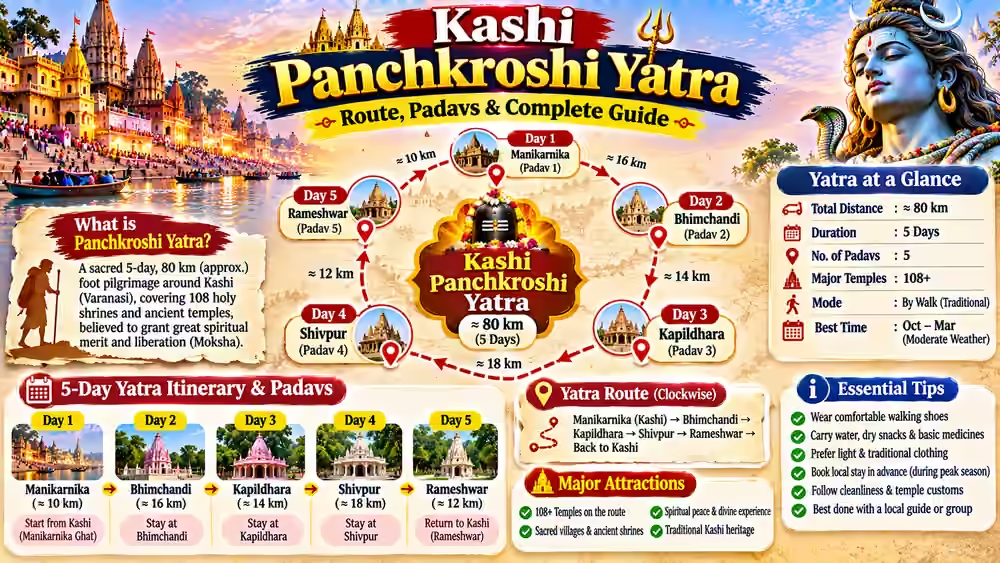
Mahashivratri coincides with the Panchkroshi Yatra — the 88.5 km circumambulation of the sacred boundary of Kashi.
What Happens:
-
The Parikrama route is packed with pilgrims
-
Devotees walk the full circuit over several days
-
The route passes through the five Padavs — Kardameshwar, Bhimchandi, Rameshwar, Shivpur, and Kapildhara
Source: Times of India and Bhaskar.
What This Means for You:
-
If you are in Varanasi for Mahashivratri, you will see pilgrims walking the Parikrama
-
The roads on the Parikrama route are busy
-
Traffic diversions are in place for both the festival and the Parikrama
The Practical Note: The Panchkroshi Yatra is a separate undertaking from the temple darshan. Do not try to combine both in one day.
Where to Stay
| Area | Best For | Price Range |
|---|---|---|
| Near Dashashwamedh Ghat | Walking distance to the temple | ₹800–₹2,500 |
| Near Assi Ghat | Quieter, boutique stays | ₹1,500–₹4,000 |
| Cantt area | Wide roads, easy car access | ₹2,000–₹5,000 |
| Sigra | Budget hotels, families | ₹1,000–₹3,000 |
Recommendation: Stay near Assi Ghat or Dashashwamedh Ghat if you want to walk to the temple. Stay in Cantt or Sigra if you want car access and will take an early-morning auto to the perimeter drop point.
Important: Book 3–4 weeks in advance. Mahashivratri fills every hotel, lodge, and dharamshala in the city.
What to Wear and Carry
What to Wear:
-
Modest clothing covering shoulders and knees
-
Comfortable slip-on shoes (removed at the temple)
-
Light cotton — February is pleasant but the crowd makes it warm
-
A light jacket for the night
What to Carry:
-
Government photo ID
-
Cash (₹2,000–₹3,000)
-
Water bottle
-
Power bank
-
Basic medicines
-
A small bag for offerings
-
A torch for the pre-dawn queue
What Not to Carry:
-
Large bags
-
Expensive jewellery
-
Electronics inside the sanctum
Safety Tips for the Crowd
1. Arrive Early
3:00–3:30 AM is the first window. The doors open at 3:30 AM.
2. Do Not Plan Tight Timelines
The queue can take 6–12 hours. Do not book a train or flight for the same afternoon.
3. Keep the Group Together
Agree on a meeting point outside the temple in case you get separated.
4. Watch the Barricades
The queue route changes during the day. Follow police directions.
5. Stay Hydrated
Carry water and ORS. The crowd is dense and the day is long.
6. Avoid the Temple-Gate Crush
If you are with children or elders, do not push into the final approach.
7. Do Not Carry Valuables
The crowds are dense. Leave jewellery and excess cash at the hotel.
8. Use the Parking Lots
Do not try to drive into the no-vehicle zone. Park at the designated lots and walk.
Accessibility for Elders
| Facility | Availability |
|---|---|
| Sugam Darshan | Usually suspended on Mahashivratri |
| Wheelchair | Available at the temple |
| Rest points | Limited inside the temple, more in the corridor |
| Drop points | Beniabagh, Sonarpura, Rathyatra |
The Honest Advice: Mahashivratri is not the best day for elderly parents. The crowd is extreme, Sugam Darshan is usually suspended, and the queue can take 6–12 hours. If you must bring them, arrive by 3:00 AM and plan for a short darshan.
How to Reach Varanasi
By Air:
-
Lal Bahadur Shastri Airport (VNS) — 25 km from the city
-
Direct flights from Delhi, Mumbai, Bengaluru, Hyderabad, Chennai, Kolkata
By Train:
-
Varanasi Junction and Kashi Station — the main railheads
-
Direct trains from Delhi, Mumbai, Kolkata, and other major cities
By Road:
-
320 km from Lucknow
-
200 km from Ayodhya
-
120 km from Prayagraj
During Mahashivratri:
-
Road routes are heavily diverted
-
Expect longer travel times
-
Pre-book a cab with a fixed fare
Final Words
Mahashivratri at Kashi Vishwanath is not a quiet night of prayer. It is a city-wide surge of devotion — a 5-km queue, a 44-hour darshan window, and a Shiv Baraat that turns the old city into a wedding procession for the gods.
You can fight the crowd, or you can plan around it. Arrive by 3:00 AM. Do a pre-festival darshan on 14 February if you can. Park at Beniabagh and walk. And when you finally reach the sanctum, do not ask for more than two seconds. That is all you will get. It is enough.
That is Mahashivratri in Kashi. That is the night Shiva's city belongs entirely to him.
Har Har Mahadev.
Plan Your Mahashivratri Darshan at Kashi Vishwanath
For bookings, queries, and custom packages:
Contact: Rohit - 7078723132
Hours: 8 AM to 9 PM daily
Our Services:
-
Mahashivratri Darshan Strategy Planning
-
Pre-Festival Darshan Arrangements (14 February)
-
Fixed-Fare Perimeter Drop and Pickup
-
Parking Guidance at Designated Lots
-
Hotel Bookings near Assi and Dashashwamedh Ghats
-
Elder-Friendly Darshan Support
-
Customised Varanasi Pilgrimage Itineraries