Namaste. I am Rohit, a guide. I have been helping pilgrims for the past 8 years. And in those years, I have walked the Panchkroshi circle of Kashi more times than I can count.
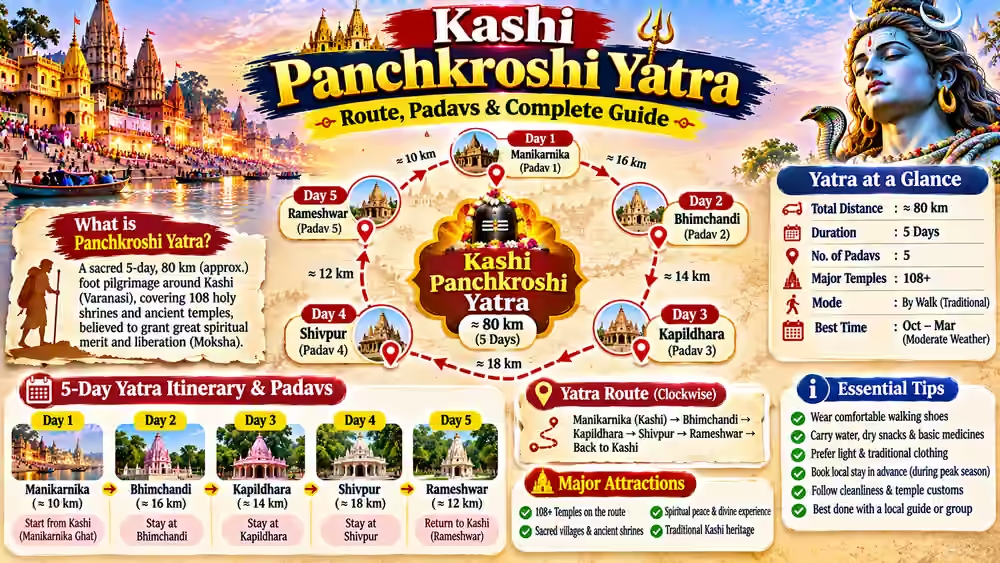
Kashi is not a city with a wall. It is a city with a sacred circle. The Panchkroshi Yatra is the act of walking that circle in devotion — an 88.5 km circumambulation that traces the cosmic boundary of Shiva's city. It is described in the Kashi Khanda of the Skanda Purana and is one of the oldest and most meritorious pilgrimages in India.
Along the route stand 108 shrines — Shiva lingams, Devi temples, and wayside shrines to Ganesha and Bhairavas — so that a single loop becomes a compressed pilgrimage to the whole of Kashi.
This guide covers everything you need to know about the Panchkroshi Yatra. The route, the five Padavs, the walking and vehicle options, the best time, the costs, and the practical tips that make the journey smooth and meaningful.
Let us begin.
What Is the Panchkroshi Yatra
The word Panchkroshi means "five krosha." The full circuit is 25 kos, about 88.5 km, and the area it encloses is held to be the true body of Kashi — the Kashi Khand, dense with temples and, by tradition, hundreds of thousands of deities.
The yatra is a parikrama — a clockwise circumambulation, with all the temples kept on your right side. It begins at Manikarnika Kund, where pilgrims bathe and take the sankalp, then moves through the five Padavs, and returns to Manikarnika to close the circle.
What It Is Not:
-
It is not a tourist sightseeing trip
-
It is not a comfortable walk through the city
-
It is not a quick ritual
What It Is:
-
A 5-day walking pilgrimage through rural village tracks and ancient temple sites
-
A test of physical endurance and spiritual resolve
-
One of the most demanding and meaningful pilgrimages a devotee can undertake in Varanasi
The Significance – 108 Shrines and the Kashi Mandala
Kashi is conceived as a mandala — a sacred geometric design representing the universe. The mandala's radius extends to five kroshas, approximately ten miles, and its borders are guarded by a multitude of deities.
What the Yatra Honors:
-
108 Shiva temples along the route, in the fuller reckoning
-
Devi shrines dedicated to the guardian goddesses of the circuit
-
Vinayaka (Ganesha) shrines at the entry and exit points
-
Bhairava shrines protecting the boundary
-
Vishnu shrines at key nodes
The Spiritual Logic:
To complete the circle is to circumambulate the living city of Shiva itself. It is believed that the yatra draws a protective boundary around Kashi Mandala, the cosmic city of Shiva, whose four cardinal edges the scriptures fix at the Ganga in the east, Gokarneshwar in the west, Bharabhuteshwar in the north, and Brahmeshwar in the south.
The Practical Logic:
A single loop becomes a compressed pilgrimage to the whole of Kashi. Pilgrims who complete the Panchkroshi are believed to have earned the merit of visiting every shrine within the sacred circle.
The Starting Point – Manikarnika and the Sankalp
Every Panchkroshi Yatra begins at Manikarnika Ghat.
What Happens:
-
Pilgrims take a holy dip in the Ganga at Manikarnika Kund
-
They take water from the kund and perform a Sankalp (sacred vow) to complete the yatra
-
They have darshan of Lord Dandapani, Dhundhiraj Ganesha, and Baba Vishwanath before starting the journey
-
Some traditions include a boat ride from Manikarnika to Assi Ghat, where the road circuit begins
The Return:
The yatra ends where it began — at Manikarnika Ghat — with a final offering and a visit to the Jau Vinayak shrine near Adi Keshav Ghat.
For Elderly Pilgrims:
If walking down the ghat stairs at dawn is difficult, the sankalp can be taken in the hotel room with pure Gangajal in a brass lota. Local priests accept this for elderly pilgrims.
The Five Padavs – Complete Guide
The five Padavs are the traditional overnight halts of the walking yatra. Each is a temple complex with a sacred kund and a specific ritual significance.
Padav 1 – Kardameshwar (Kandawa)
The First Halt: 3 kos (approximately 10 km) from Manikarnika.
| Detail | Information |
|---|---|
| Deity | Kardameshwar Mahadev (Shiva) |
| Temple Age | 10th–12th century stone temple |
| Significance | Installed by Sage Kardam |
| Sacred Kund | Kardam Kund |
| Ritual | Darshan of the Shivalinga, prayers at Kardam Kund, offering of Panch Dhanya (five sacred grains) |
Why It Matters: Kardameshwar is the oldest structure on the route. It is the first stop after the long walk from the city, and it marks the formal beginning of the rural circuit.
Padav 2 – Bhimchandi
The Second Halt: 8 kos from the start.
| Detail | Information |
|---|---|
| Deities | Maa Bhimchandi Devi and Chandikeshwar Mahadev |
| Significance | The guardian goddess of the yatra, granting courage to continue |
| Sacred Kund | Gandharva Sagar Kund |
| Ritual | Worship of Maa Bhimchandi and Chandikeshwar Mahadev |
Why It Matters: Bhimchandi is the protector of the yatra. Pilgrims pray here for the strength to complete the remaining circuit.
Padav 3 – Rameshwar
The Third Halt: 15 kos from the start.
| Detail | Information |
|---|---|
| Deity | Rameshwar Mahadev (Shiva) |
| Location | At the confluence of the Varuna and Morwa rivers |
| Significance | The Shiva linga installed by Lord Rama on his return from Lanka, to atone for the killing of Ravana |
| Guardian Deity | Maa Tulja Bhavani |
| Ritual | Darshan of Rameshwar Mahadev and Maa Tulja Bhavani, lunch stop |
Why It Matters: Rameshwar is held by many to be the most important tirtha on the route. Prayer here is said to give the merit of Rameshwaram in the South. It is a deeply emotional stop for devotees of Rama.
Padav 4 – Shivpur (Pancha Pandava)
The Fourth Halt: 20 kos from the start.
| Detail | Information |
|---|---|
| Deity | Pancha Pandava (five Shiva lingas) |
| Significance | The lingas installed by the Pandavas during their exile |
| Sacred Kund | Draupadi Kund |
| Ritual | Darshan of the five lingas, prayers at Draupadi Kund |
Why It Matters: Shivpur is where Shiva is said to rest from his cosmic dance. It is a quieter, more contemplative stop after the intensity of Rameshwar.
Padav 5 – Kapildhara
The Final Halt: 25 kos from the start.
| Detail | Information |
|---|---|
| Deity | Kapileshwar Mahadev (Shiva) |
| Significance | Established by Sage Kapila |
| Sacred Kund | Kapildhara |
| Ritual | Darshan, meditation, final prayers before returning to Manikarnika |
Why It Matters: Kapildhara is the final padav. It is a place of deep meditation, where Sage Kapila performed penance. After this, the pilgrim returns to Manikarnika to close the circle.
The Route and Distance Table
| Leg | Distance | Note |
|---|---|---|
| Manikarnika to Kardameshwar | 3 kos (~10 km) | Via Assi Ghat start |
| Kardameshwar to Bhimchandi | 5 kos (~18 km) | Rural village tracks |
| Bhimchandi to Rameshwar | 7 kos (~25 km) | Along the Varuna River |
| Rameshwar to Shivpur | 5 kos (~18 km) | Through agricultural land |
| Shivpur to Kapildhara | 5 kos (~18 km) | Final stretch |
| Kapildhara to Manikarnika | Return | Closing the circle |
Total Distance: 88.5 km (25 kos).
Walking vs Vehicle – Which Option Suits You
Walking Yatra
| Detail | Information |
|---|---|
| Duration | 5 days, 4 nights |
| Daily Distance | 15–20 km |
| Best For | Physically fit pilgrims, serious devotees |
| Accommodation | Dharamshalas at each Padav |
| Cost | Free (donations for food and stay) |
| Challenge | Physical endurance, rural tracks, heat |
What the Walking Yatra Offers:
-
The traditional experience, exactly as described in the scriptures
-
The rhythm of walking, resting, and praying
-
The fellowship of fellow pilgrims
-
The full merit of the parikrama
What It Demands:
-
Physical fitness and stamina
-
Comfortable footwear and weather-appropriate clothing
-
Patience with rural facilities
-
5 days of commitment
Vehicle-Assisted Yatra
| Detail | Information |
|---|---|
| Duration | 1 day (8–10 hours) |
| Distance | 88.5 km by car |
| Best For | Elderly pilgrims, families, time-pressed travellers |
| Cost | ₹2,600–₹8,400 depending on vehicle |
| Challenge | Long day in the car, but no physical strain |
What the Vehicle Yatra Offers:
-
The same five Padavs and the same sankalp
-
Comfort for elderly parents and children
-
Completion in a single day
-
Air-conditioned transport between stops
What It Demands:
-
An early start (5:30 AM)
-
A full day of travel
-
Acceptance that it is a different experience from walking
The Honest Verdict: The vehicle yatra is not a shortcut. It is a legitimate alternative for those who cannot walk. The merit is in the intention and the darshan, not in the distance covered on foot.
The 5-Day Walking Yatra – Day by Day
| Day | Route | Distance | Overnight Stay |
|---|---|---|---|
| Day 1 | Manikarnika → Assi Ghat → Kardameshwar | 3 kos (~10 km) | Kardameshwar Dharamshala |
| Day 2 | Kardameshwar → Bhimchandi | 5 kos (~18 km) | Bhimchandi Dharamshala |
| Day 3 | Bhimchandi → Rameshwar | 7 kos (~25 km) | Rameshwar Dharamshala |
| Day 4 | Rameshwar → Shivpur | 5 kos (~18 km) | Shivpur Dharamshala |
| Day 5 | Shivpur → Kapildhara → Manikarnika | 5 kos (~18 km) | Return to Varanasi |
The Daily Rhythm:
-
Wake before dawn
-
Bathe and pray at the Padav temple
-
Walk 4–6 hours with breaks
-
Reach the next Padav by afternoon
-
Rest, eat, and sleep
The Practical Reality: Day 3 is the longest and hardest. Plan for it. Start early. Carry water. Do not rush.
The 1-Day Vehicle Yatra – Complete Itinerary
| Time | Activity |
|---|---|
| 5:30 AM | Hotel pickup. Drive to Manikarnika Ghat |
| 5:45–6:30 AM | Holy dip and Sankalp at Manikarnika Kund |
| 6:30–7:15 AM | Drive to Padav 1: Kardameshwar. Darshan of the 12th-century Shivalinga and Kardam Kund |
| 7:15–8:15 AM | Drive to Padav 2: Bhimchandi. Darshan of Maa Bhimchandi and Chandikeshwar Mahadev |
| 8:15–9:30 AM | Drive to Padav 3: Rameshwar. Darshan of Rameshwar Mahadev and Maa Tulja Bhavani |
| 9:30–11:00 AM | Drive to Padav 4: Shivpur. Darshan of the Pancha Pandava lingas and Draupadi Kund |
| 11:00–12:30 PM | Drive to Padav 5: Kapildhara. Darshan of Kapileshwar Mahadev. Meditation |
| 12:30–2:00 PM | Return drive to Manikarnika. Lunch en route |
| 2:00–3:00 PM | Final offering at Manikarnika. Darshan of Jau Vinayak near Adi Keshav Ghat |
| 3:00 PM | Drop at hotel or Varanasi Junction |
Total Duration: 8–10 hours.
What This Covers: All five Padavs, the sankalp, the return, and the closing darshan — in a single day.
Best Time to Do the Panchkroshi Yatra
| Season | Verdict |
|---|---|
| October to March | Best. Cool, dry, comfortable for walking |
| Adhika Maas (Purushottam Maas) | Most auspicious. Tens of thousands of pilgrims walk the circuit. Dharamshalas fill up |
| Kartik (October–November) | Highly auspicious |
| Maha Shivaratri (February–March) | Highly auspicious |
| Chaitra–Vaishakh | Traditional walking season |
| April to June | Very hot. Not recommended for walking |
| July to September | Monsoon. Rural tracks become muddy |
Recommendation: For walking, choose October to March. For the most spiritually charged experience, choose Adhika Maas or Maha Shivaratri — but be prepared for crowds.
Cost of the Yatra – Walking and Vehicle
Walking Yatra
| Expense | Cost |
|---|---|
| Entry fee | Free |
| Dharamshala stay | Donation-based (₹100–₹300 per night) |
| Food | ₹200–₹400 per day |
| Total (5 days) | ₹1,500–₹3,500 per person |
Vehicle Yatra
| Vehicle | Capacity | 1-Day Circuit Fare |
|---|---|---|
| AC Sedan (Dzire/Etios) | 1–4 passengers | ₹2,600 |
| AC SUV (Ertiga) | 4–6 passengers | ₹3,500 |
| Innova Crysta | 5–6 passengers | ₹4,600 |
| 12-Seater Tempo Traveller | 7–11 passengers | ₹6,800 |
| 17-Seater Tempo | 12–16 passengers | ₹8,400 |
What the Vehicle Fare Includes:
-
Vehicle and fuel
-
Dedicated driver
-
All village road tolls
-
Temple parking tickets
What It Excludes:
-
Food
-
Personal expenses
-
Temple offerings
The Honest Verdict: The walking yatra is almost free. The vehicle yatra costs ₹2,600–₹8,400 for the whole group, which works out to ₹500–₹700 per person for a family of four.
Registration and Permissions
For Individual Pilgrims:
-
No registration is required for the general yatra
-
The route is open year-round
-
Entry to all temples is free
For Organised Groups:
-
During Adhika Maas and Maha Shivaratri, large organised yatras are conducted by temple trusts and akhadas
-
These may require prior registration through the organising body
-
The KVTT organises guided vehicle-assisted yatras for senior devotees and international pilgrims
For Vehicle Yatra:
-
No permit is needed for private cars
-
Book the vehicle in advance through a verified operator
What to Carry
For Walking:
| Item | Why |
|---|---|
| Comfortable walking shoes | 15–20 km per day |
| Two pairs of socks | Change mid-day to prevent blisters |
| Light cotton clothes | Breathable, modest |
| Wide-brimmed hat | Sun protection |
| Water bottle (2 litres) | Refill at temples |
| ORS packets | Dehydration prevention |
| Light raincoat | October–March can have unseasonal showers |
| Torch | Early morning starts |
| Basic medicines | Blisters, headaches, stomach upset |
| Government ID | Hotel and temple checks |
For Vehicle Yatra:
-
Same as above, minus the walking gear
-
A cushion for elderly parents
-
Snacks for the long day
-
A power bank for photos
Temple Etiquette and Rules
| Rule | Details |
|---|---|
| Dress code | Shoulders and knees covered |
| Shoes | Removed at every temple |
| Photography | Restricted inside sanctums |
| Silence | Maintained during darshan and aarti |
| Offerings | Flowers, fruits, and Panch Dhanya at Kardameshwar |
| Respect | Do not mock rituals or rush the priests |
How to Reach Varanasi
By Air:
-
Lal Bahadur Shastri Airport (VNS) — 25 km from the city
-
Direct flights from Delhi, Mumbai, Bengaluru, Hyderabad, Chennai, Kolkata
By Train:
-
Varanasi Junction and Kashi Station — the main railheads
-
Direct trains from Delhi, Mumbai, Kolkata, and other major cities
By Road:
-
320 km from Lucknow
-
200 km from Ayodhya
-
120 km from Prayagraj
Nearby Parking and Transport
| Location | Parking | Notes |
|---|---|---|
| Manikarnika Ghat | Limited | Use the Godowlia parking and walk |
| Assi Ghat | Available | Start point for the road circuit |
| Kardameshwar | Roadside | Village parking |
| Bhimchandi | Roadside | Village parking |
| Rameshwar | Roadside | Village parking |
| Kapildhara | Roadside | Village parking |
Local Transport: E-rickshaws and autos are the main modes within Varanasi. For the Panchkroshi route, a private vehicle is the only practical option for the vehicle yatra.
Conclusion
The Panchkroshi Yatra is not just a walk. It is a circumambulation of the cosmos — a 88.5 km circle that encloses the whole of Kashi, with 108 shrines guarding its edge.
You can walk it in five days, sleeping at ancient Padavs and waking before dawn to pray. Or you can drive it in one day, stopping at each Padav and taking the same sankalp.
Either way, you are doing what pilgrims have done for centuries — tracing the boundary of Shiva's city, keeping the temples on your right, and returning to Manikarnika to close the circle.
That is the Panchkroshi. That is Kashi.
Har Har Mahadev.
Plan Your Kashi Panchkroshi Yatra
For bookings, queries, and custom packages:
📞 Call Us: +91 7078723132 | +91 9557104160
📲 WhatsApp Us: +91 7078723132 | +91 9557104160
Hours: 8 AM to 9 PM daily
Our Services:
-
Guided Panchkroshi Yatra (Walking and Vehicle)
-
Vehicle Booking for 1-Day Circuit
-
Dharamshala Arrangements at Padavs
-
Local Kashi-born Guides
-
Sankalp and Ritual Assistance
-
Customised Itineraries for Elderly Pilgrims and Families