Namaste. I am Rohit, a guide. I have been helping pilgrims for the past 8 years. And in those years, I have learned something about Varanasi that most travellers miss.
Everyone comes to Kashi for the ghats, the aarti, and Kashi Vishwanath. But the city has another layer — a living theatre tradition that has been running for centuries. Two of them, in fact. One lasts 31 nights. The other lasts one afternoon.
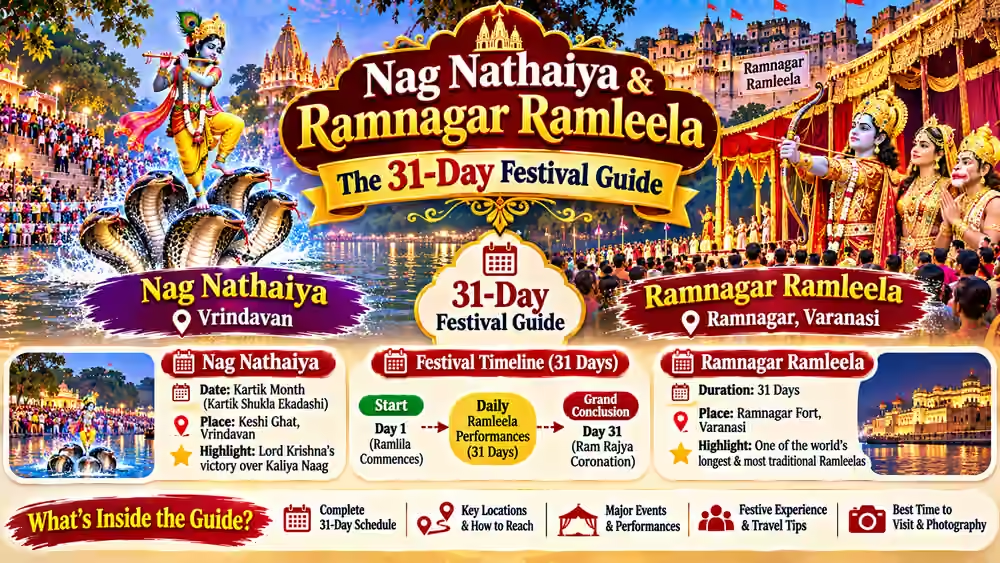
The Ramnagar Ramleela turns an entire town into a stage for a month. The Nag Nathaiya turns a stretch of the Ganga into a stage for a single hour. Together, they represent the two poles of Varanasi’s cultural calendar — the epic and the leela, the long and the short, the town and the river.
This guide is about both. It covers the 31-day Ramleela cycle, the Nag Nathaiya spectacle, the dates, the logistics, and the ground reality that makes these events unlike anything else in India.
Let us begin.
The 31-Day Festival Calendar at a Glance
| Event | Dates (2026) | Duration | Venue | Entry |
|---|---|---|---|---|
| Ramnagar Ramleela | Sept 24 – Oct 20 | 31 nights | Ramnagar town | Free |
| Nag Nathaiya | Friday, Nov 13 | 1 afternoon | Tulsi Ghat | Free |
Important: These are two separate events. The Ramleela runs through September and October. Nag Nathaiya falls in mid-November, during the Kartik season. They are not part of the same 31-day cycle. But together, they define Varanasi’s autumn festival identity.
Ramnagar Ramleela – What It Is
The Ramnagar Ramleela is the world’s most famous staging of the Ramayana. It is a 31-night enactment of Tulsidas’s Ramcharitmanas, performed across the town of Ramnagar, opposite Varanasi on the eastern bank of the Ganga.
It was begun by Maharaja Udit Narayan Singh of Kashi in the early 19th century, around 1830, and later expanded by Maharaja Ishwari Prasad Narayan Singh, who took it out of the fort and into the streets among the people. It is recognised by UNESCO as an Intangible Cultural Heritage of Humanity.
What Makes It Unique:
-
No tickets, no seats, no microphones, no electric lights
-
The entire town is the stage — Ayodhya, Janakpuri, Panchavati, Lanka, and Ashok Vatika are permanent sites scattered across a 5-square-kilometre area
-
The audience walks with the story from one location to the next
-
Actors deliver dialogues in Awadhi dialect, following Tulsidas’s verses
-
The performance is lit by oil lamps and petromax lanterns
-
The Kashi Naresh attends by tradition, arriving on an elephant on opening night
The 31-Night Cycle – Dates and Format
In 2026, the Ramnagar Ramleela begins on Anant Chaturdashi, September 24, and culminates on Vijayadashami, October 20.
| Detail | Information |
|---|---|
| Opening Night | September 24, 2026 (Anant Chaturdashi) |
| Closing Night | October 20, 2026 (Vijayadashami, Ravan Vadh) |
| Duration | 31 consecutive nights |
| Format | One leela per evening |
| Start Time | Around 4:30–5:00 PM |
| Duration per Night | 3–4 hours |
| Entry | Free |
Source: Times of India and Bharat Temples calendar.
The schedule is announced locally by the Kashi Naresh’s household each year. The exact night-by-night programme should be confirmed closer to the date.
The Moving Stage – How a Night Works
There is no single stage. There is no assigned seating. There is no amplification.
The Format:
-
A night begins at a designated site within Ramnagar
-
The swaroops (actors playing Rama, Sita, Lakshman, Bharat, and Shatrughan) deliver their lines
-
The Ramayanis — robed reciters carrying copies of the Ramcharitmanas — chant the chaupais aloud
-
The audience follows on foot from one location to the next
-
The performance is lit by oil lamps and petromax lanterns
What This Means for You:
-
Wear comfortable shoes. You will walk.
-
Expect crowds of tens of thousands on key nights.
-
The sound is carried by the human voice. Position yourself close to the swaroops if you want to hear clearly.
-
Do not expect modern theatre conveniences. This is a 200-year-old tradition.
The Swaroops and the Ramayanis
The actors are not ordinary performers. They are treated as deities for the month.
The Swaroops:
-
Young boys, mostly local, cast as Rama, Sita, Lakshman, Bharat, and Shatrughan
-
They are considered embodiments of the divine for the duration of the Ramleela
-
By tradition, they answer only to their characters’ names
-
They are treated with reverence, not as entertainers
The Ramayanis:
-
Sadhus and scholars who follow the swaroops with copies of the Ramcharitmanas
-
They recite the verses aloud as the leela unfolds
-
They provide the scriptural spine of the performance
Why This Matters: The Ramnagar Ramleela is not a play. It is a ritual. The audience is not watching a show. It is participating in a month-long act of devotion.
The Kashi Naresh Connection
The Kashi Naresh — the titular ruler of Varanasi — remains the patron of the Ramnagar Ramleela.
His Role:
-
Arrives on an elephant for the opening night
-
Attends the performance through the 31 nights
-
By tradition, absents himself from Ravana Vadh — a king unwilling to watch another king’s death
-
His representative opens the cycle with a formal salute from PAC personnel
Why It Matters: The Ramnagar Ramleela is one of the last living examples of royal patronage of the arts in India. The Kashi Naresh’s presence is not ceremonial. It is constitutive. The Ramleela exists because the royal family has sustained it for nearly two centuries.
Key Nights You Should Not Miss
| Night | What Happens | Why It Matters |
|---|---|---|
| Opening Night (Sept 24) | Birth of Ravan, the celestial prophecy, the Kashi Naresh’s arrival | Sets the tone for the month |
| Dhanush Yagya | Sita’s swayamvar and the breaking of the bow | One of the most spectacular nights |
| Lanka Dahan | Hanuman sets Lanka on fire | Visually dramatic, huge crowds |
| Nakkataiya | The night of the severed nose (Surpanakha) | A local favourite, very crowded |
| Ravana Vadh (Oct 20) | Rama slays Ravana | The climax of the 31-night cycle |
| Bharat Milap (Oct 25) | Rama reunites with Bharata | The emotional finale, a day after Vijayadashami |
Source: TasteYatra and Bharat Temples.
The Honest Advice: If you can attend only one or two nights, choose Ravana Vadh and Bharat Milap. These are the nights that stay with people for decades.
Nag Nathaiya – What It Is
Nag Nathaiya is a single-afternoon river spectacle at Tulsi Ghat in Varanasi. It re-enacts Krishna’s victory over the serpent Kaliya — the Kaliya Daman leela.
The Date: Friday, 13 November 2026.
The Tithi: Kartik Shukla Chaturthi.
Source: Kashi Taxi and Varanasi Package.
What Makes It Unique:
-
It is not a stage play. It is a living reenactment on the river itself.
-
A Kadamba tree branch is planted at the water’s edge.
-
A young boy portraying Bal Krishna climbs the branch and leaps into the Ganga.
-
He emerges standing on the hoods of the giant Kaliya effigy, playing his flute.
-
The Maharaja of Banaras arrives in his royal bajra to present a gold coin (asharfi).
Source: Kashi Taxi.
The Heritage: Nag Nathaiya is associated with Goswami Tulsidas, who lived at Tulsi Ghat and is said to have initiated this tradition in the late 16th century. It has been staged for over 450 years.
The Kaliya Daman Story
The leela re-enacts an episode from Krishna’s childhood in Vrindavan.
The Story:
The serpent Kaliya had poisoned the waters of the Yamuna. Krishna, as a child, jumped into the river and subdued the serpent. He danced on Kaliya’s hoods until the serpent surrendered. Kaliya then bowed before Krishna and was allowed to leave for Ramanaka Dweepa.
Why It Matters:
The leela is not just entertainment. It is a theological statement — the child god subduing the serpent of poison, the divine mastering the chaotic forces of nature. In Varanasi, the Ganga at Tulsi Ghat symbolically becomes the Yamuna for that one afternoon.
The Tulsi Ghat Spectacle – Timeline
| Time | What Happens |
|---|---|
| 4:30 PM | The ritual window opens. Crowds gather on the ghat steps and in boats |
| 4:45–4:50 PM | The boy portraying Bal Krishna climbs the Kadamba branch and leaps into the Ganga |
| 4:50 PM onwards | He emerges on the Kaliya effigy, playing the flute |
| 5:00 PM | The Kashi Naresh arrives in his royal bajra and presents the asharfi |
| 5:30 PM | The spectacle concludes. The crowd disperses |
Source: Kashi Taxi.
The Crowd: 1.5 to 2 lakh devotees gather across the ghat steps and boats. It is one of Varanasi’s Four Lakkha Melas — festivals drawing over one lakh people.
Why Nag Nathaiya Is Unique
| Factor | Why It Stands Out |
|---|---|
| The venue | The Ganga itself is the stage. Not a temple, not a maidan |
| The leap | A live dive into the river, from a tree branch |
| The effigy | A giant serpent hood rising from the water |
| The royal presence | The Kashi Naresh arrives by boat, not by road |
| The duration | One hour. That is all. If you miss it, you miss it for the year |
| The heritage | Over 450 years of unbroken tradition, linked to Tulsidas |
How to Attend Ramnagar Ramleela
Getting There:
-
Ramnagar is across the Ganga from Varanasi
-
Take a boat from Assi Ghat or Dashashwamedh Ghat
-
Or drive across the Ramnagar bridge (15–20 minutes from Varanasi city)
What to Expect:
-
No tickets. Walk in and join the crowd.
-
No seats. You will stand or walk.
-
No microphones. Position yourself near the swaroops.
-
Crowds. On key nights, tens of thousands of people.
Practical Tips:
-
Wear comfortable walking shoes.
-
Carry water and a light snack.
-
Arrive early on key nights (Ravana Vadh, Bharat Milap).
-
Follow the crowd. The audience moves with the story.
-
Do not expect to understand every word. The experience is in the atmosphere, not the dialogue.
How to Attend Nag Nathaiya
Getting There:
-
Tulsi Ghat is on the southern stretch of the Varanasi ghats
-
Nearest taxi drop: Assi Crossing (450 m walk) or Ravindrapuri/Anandmayee Hospital (750 m walk)
-
Boats from Assi Ghat or Dashashwamedh Ghat
What to Expect:
-
1.5–2 lakh people on the ghat steps and in boats
-
River Police boat cutoff: 3:30 PM. Boats must be anchored before this time.
-
The spectacle lasts one hour. Arrive by 3:00 PM to secure a spot.
Practical Tips:
-
Ghat steps vs boats. The ghat steps are free but crowded. Boats offer a better view but must be booked in advance.
-
Carry water. The afternoon sun and the crowd can be dehydrating.
-
Keep children close. The ghat steps are steep and crowded.
-
Do not carry valuables. The crowd is dense.
Boat vs Ghat Viewing for Nag Nathaiya
| Factor | Ghat Steps | Boat |
|---|---|---|
| Cost | Free | ₹200–₹500 per person |
| View | Crowded, obstructed | Clear, elevated |
| Comfort | Standing, cramped | Seated, stable |
| Access | Walk to Tulsi Ghat | Board at Assi or Dashashwamedh |
| Best For | Locals, budget travellers | Families, photographers, elders |
The Honest Verdict: If you can afford it, take a boat. The view of the boy leaping into the river and emerging on the Kaliya effigy is far better from the water. But book the boat in advance. The River Police cutoff at 3:30 PM is strictly enforced.
Where to Stay for Each Event
For Ramnagar Ramleela:
-
Stay in Varanasi city (Assi, Dashashwamedh, or Cantt)
-
Take a boat or cab to Ramnagar each evening
-
Ramnagar itself has limited accommodation
For Nag Nathaiya:
-
Stay in Assi Ghat area or Bhelupur — closest to Tulsi Ghat
-
Book 2–3 weeks in advance for Kartik season
Recommendation: For the Ramleela, stay in Varanasi and commute. For Nag Nathaiya, stay near Assi Ghat so you can walk to Tulsi Ghat.
What to Wear and Carry
For Ramnagar Ramleela:
-
Comfortable walking shoes (you will walk 2–3 km per night)
-
Modest clothing
-
A light shawl for the evening
-
Water bottle
-
A small bag
For Nag Nathaiya:
-
Light cotton clothing (afternoon sun)
-
A hat or cap
-
Sunglasses
-
Water bottle
-
A small cushion or mat to sit on the ghat steps
What Not to Carry:
-
Large bags
-
Expensive jewellery
-
Electronics that can get wet or damaged in crowds
Conclusion
Varanasi is not a city that performs for tourists. It performs for itself. The Ramnagar Ramleela is not a show. It is a month-long act of devotion. Nag Nathaiya is not a spectacle. It is a ritual that has been repeated for over 450 years.
One lasts 31 nights. The other lasts one afternoon. Both are free. Both are open to anyone who wants to stand in the crowd and watch.
If you can, do both. Watch the Ramleela on a cold September evening, walking from Ayodhya to Lanka with ten thousand people. Then return in November, stand at Tulsi Ghat, and watch a boy leap into the Ganga.
That is Varanasi. That is the living tradition of Kashi.
Har Har Mahadev. Jai Shri Ram.
Plan Your Nag Nathaiya & Ramnagar Ramleela Visit
For bookings, queries, and custom packages:
📞 Call Us: +91 7078723132 | +91 9557104160
📲 WhatsApp Us: +91 7078723132 | +91 9557104160
Hours: 8 AM to 9 PM daily
Our Services:
-
Ramnagar Ramleela Night Planning and Guides
-
Nag Nathaiya Boat Bookings with Designated Viewing Zones
-
Fixed-Fare Taxi Drops for Both Events
-
Hotel Bookings in Assi, Bhelupur, and Cantt
-
Local Kashi-born Guides
-
Customised Autumn Festival Itineraries
-
Senior Citizen Assistance for Nag Nathaiya Ghat Access