Namaste. I am Rohit, a guide. I have been helping pilgrims for the past 8 years. And in those years, one of the most common routes I have planned is the journey from Kashi to Bodhgaya.
Varanasi is where the Ganga flows and where Shiva speaks. Bodhgaya is where the Buddha awoke under a Peepal tree. Two of the world's oldest spiritual traditions, less than 250 km apart. Pilgrims from across the world travel this route to complete a circuit that touches both the Upanishadic and the Buddhist worlds.
But the distance is not the only thing you need to know. The route matters. The mode of travel matters. And the timing matters, because Bodhgaya's Mahabodhi Temple is best visited at dawn and the Varanasi ghats are best at dusk.
This guide gives you the honest numbers: the distance, the routes, the trains, the cabs, the buses, the costs, and the practical advice that makes the journey smooth.
Let us begin.
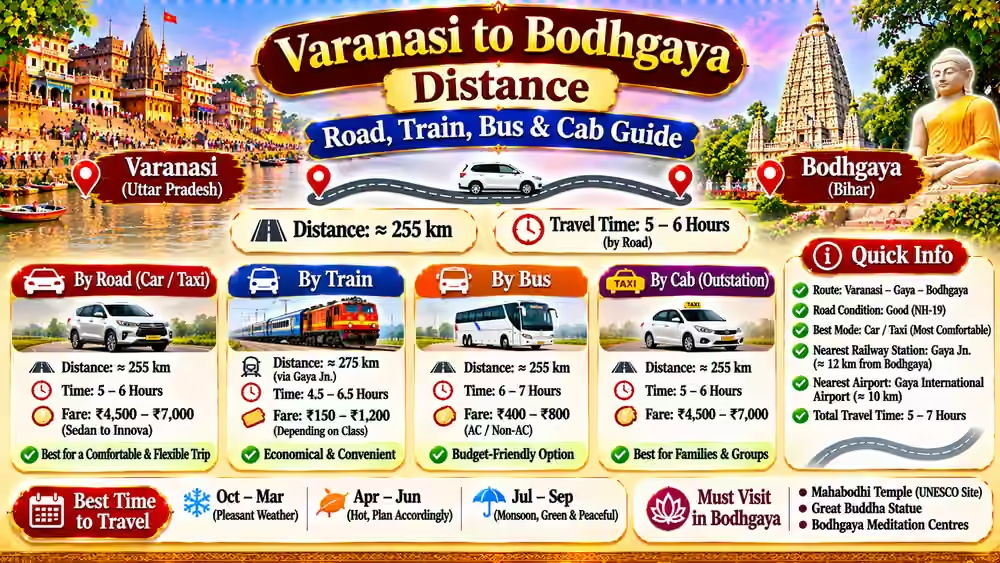
The Distance at a Glance
Here is the honest range. The numbers differ because Bodhgaya and Gaya are not the same place, and the routes are not the same road.
The Number to Remember: 236 to 260 km. Anything beyond that is a longer route, not a shorter distance.
Why the Distance Varies – Route Options
There are two main ways to drive from Varanasi to Bodhgaya. They are not the same experience.
The Practical Advice: Take the NH-19 route via Sasaram. It is the most reliable, the road quality is good, and the distance stays in the 240–250 km range. The drive is mostly highway, with small-town stretches near Aurangabad and Sherghati.
What to expect on the road:
-
A breakfast or tea stop near Chandauli or Sasaram
-
Bihar's toll plazas, which add time but not distance
-
Slower traffic near Gaya town, especially on market days
By Road – The Complete Driving Guide
What the drive is like:
The road from Varanasi to Bodhgaya is a proper highway journey. You leave the crowded lanes of Kashi, cross into Bihar near Chandauli, and spend most of the drive on NH-19. The landscape shifts from the Gangetic plain to the dry, rocky stretches around Sasaram.
Stops worth making:
-
Sasaram – the tomb of Sher Shah Suri sits on a lake in the middle of the town. A 30-minute detour is worth it if you have time.
-
Aurangabad – a tea and snack stop.
-
Sherghati – the last major town before Gaya.
The honest warning: Do not attempt this drive in the dark if you are not familiar with Bihar's highways. Trucks, unlit stretches, and small-town traffic make night driving tiring.
By Train – The Fastest Option
- Distance: About 230–240 km
- Time: 3.5 to 4.5 hours
- Best For: Solo travellers, budget pilgrims, anyone who does not want to drive
The train is the fastest way to cover the distance. Varanasi Cantt and Varanasi Junction connect to Gaya Junction, and several express trains run this route daily.
Fares: Trains on this route are affordable, with sleeper class from around ₹200–₹300 and higher classes up to ₹600 depending on the train and availability.
The catch: The train drops you at Gaya Junction, not Bodhgaya. From there, you need a 16 km auto or taxi ride, which takes 30–40 minutes. Pre-paid autos and taxis are available outside the station.
Total door-to-door time: 4 to 6 hours, including the last leg.
By Bus – The Budget Option
Buses run between Varanasi and Gaya, including a dedicated interstate service introduced for the Pitru Paksh pilgrimage season. That service covers nearly 260 km through Chandauli, Sasaram, Aurangabad, and Sherghati.
The honest assessment: The bus is the cheapest option, but it is also the slowest. The special Pitru Paksh bus departs Varanasi at 8 pm and reaches Gaya by 4 am, which is convenient if you plan to begin Pind Daan rituals at dawn. For regular travel, a daytime bus will take most of your day.
By Taxi – The Comfort Option
A private cab is the most comfortable way to make this journey. You leave when you want, stop when you want, and arrive at your hotel door in Bodhgaya.
What to confirm before booking:
-
Is the fare one-way or round trip?
-
Are tolls and parking included?
-
Is driver allowance included?
-
What is the cancellation policy?
The advantage over the train: The cab takes you directly to your Bodhgaya hotel. No Gaya Junction transfer, no auto negotiation, no luggage handling.
How Long Does the Journey Really Take?
Here is the honest door-to-door picture, from your Varanasi hotel to your Bodhgaya hotel.
The planning rule: Do not schedule anything important on arrival day. Add one hour of buffer for traffic, station transfers, and check-in.
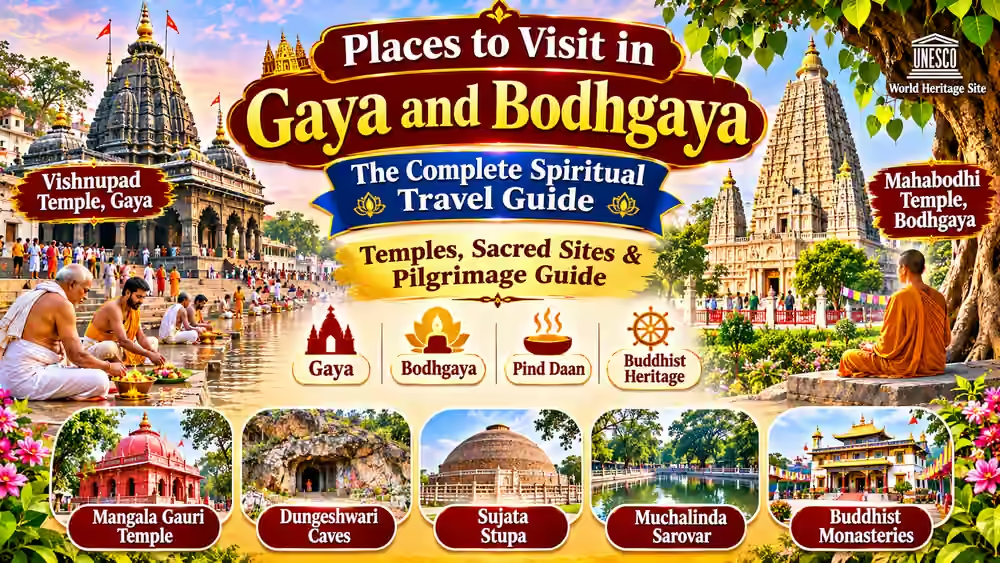
Varanasi to Bodhgaya vs Varanasi to Gaya
These are not the same destination, and the difference matters.
The practical advice: If your purpose is Pind Daan, travel to Gaya. If your purpose is Bodhgaya's temples and monasteries, travel to Bodhgaya. If you want both, base yourself in Bodhgaya and make a day trip to Gaya (12–17 km, 20–30 minutes).
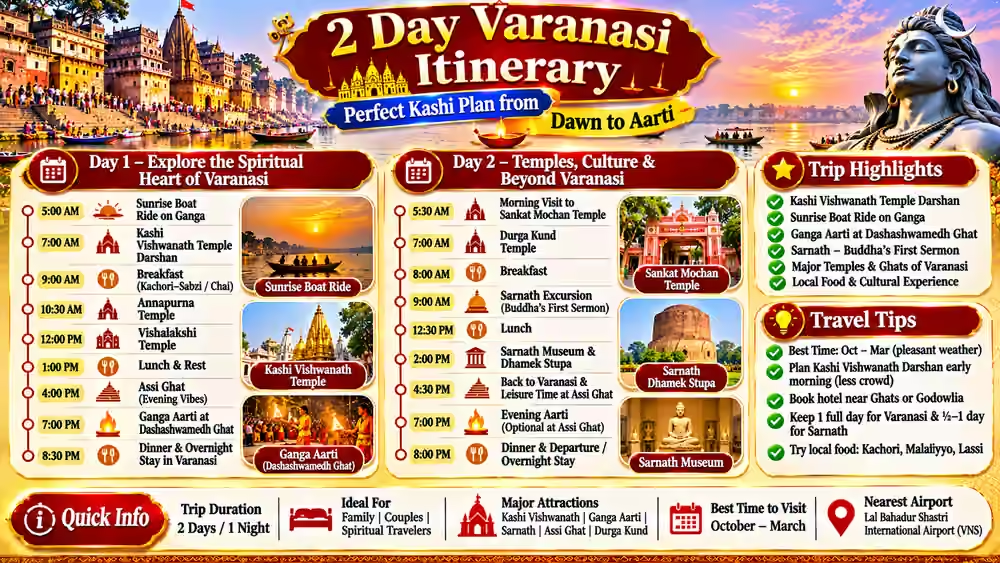
Sample 2-Day Kashi–Bodhgaya Itinerary
| Day | Activity |
|---|---|
| Day 1 | Morning: Varanasi ghats and Kashi Vishwanath darshan. Afternoon: drive or train to Bodhgaya (5–6 hours). Evening: Mahabodhi Temple at dusk, butter lamps, Bodhi Tree meditation |
| Day 2 | Early morning: 5:30 AM chanting at Mahabodhi Temple. Great Buddha Statue, Thai and Bhutanese Monasteries. Afternoon: Sujata Stupa. Evening: return to Varanasi or continue to Gaya for Pind Daan |
Why this works: It captures Bodhgaya at its two most powerful hours — dawn and dusk — without rushing the journey.
Best Time to Travel This Route
Recommendation: November to February is the sweet spot. Cool mornings for the Mahabodhi Temple, pleasant afternoons for the drive, and no festival crush.
Nearby Parking and Drop-Off Points
| Location | Drop-Off / Parking | Notes |
|---|---|---|
| Mahabodhi Temple | Designated parking near the entrance | Short walk to the complex |
| Bodhgaya hotels | Direct vehicle access | Most hotels on the main road allow cab drop-off |
| Gaya Junction | Paid parking | Pre-paid autos to Bodhgaya: ₹200–₹300 |
| Vishnupad Temple, Gaya | Parking near the Falgu River | Short walk to the temple |
What to Carry
Essentials:
-
Government photo ID (Aadhaar, Passport)
-
Cash (₹2,000–₹5,000 — ATMs are limited in Bodhgaya)
-
Water bottle
-
Comfortable walking shoes
-
Modest clothing covering shoulders and knees
-
Power bank
-
Basic medicines
For the train journey:
-
A light blanket or shawl for AC coaches
-
Snacks for the 4-hour ride
What not to carry:
-
Phones and electronics inside the Mahabodhi Temple inner complex (lockers available)
-
Large bags
-
Expensive jewellery
Budget Breakdown
Note: These are transport costs only. Add hotel, food, and temple offerings separately.
Conclusion
Varanasi to Bodhgaya is not a long journey. Two hundred and fifty kilometres. Five hours on the highway. Four hours on a train. But it connects two of the most important spiritual landscapes on earth.
Leave Kashi after the morning aarti. Drive through Sasaram and Aurangabad. Reach Bodhgaya before dusk. And when you sit under the Bodhi Tree as the butter lamps are lit, you will understand why pilgrims have walked this route for centuries.
Know the distance. Choose the mode. Add the buffer. And let the road take you from the Ganga to the Bodhi.
Radhe Radhe. Namo Buddhaya.
Plan Your Varanasi to Bodhgaya Journey
For bookings, queries, and fixed-fare cab arrangements:
📞 Call Us: +91 7078723132 | +91 9557104160
📲 WhatsApp Us: +91 7078723132 | +91 9557104160
Hours: 8 AM to 9 PM daily
Our Services:
-
Varanasi to Bodhgaya Private Cab with Fixed Fare
-
Kashi–Bodhgaya–Gaya Pilgrimage Packages
-
Train Booking Assistance
-
Hotel Reservations in Bodhgaya and Gaya
-
Local Guide for Buddhist and Hindu Sites
-
Pind Daan Ritual Assistance
-
Customized Itineraries for Families, Couples, and Groups