Namaste. I am Rohit, a guide. I have been helping pilgrims for the past 8 years. And in those years, I have taken hundreds of first-time visitors through Ayodhya.
The pattern is always the same. They arrive excited. They have seen the Ram Mandir on television. They have heard the stories. And then they step out of Ayodhya Dham Junction and realise they do not know where to begin.
Should they go to Ram Mandir first or Hanuman Garhi? Do they need a pass? Where do they leave their phones? Why are the lanes so crowded? Why is the temple closed at noon?
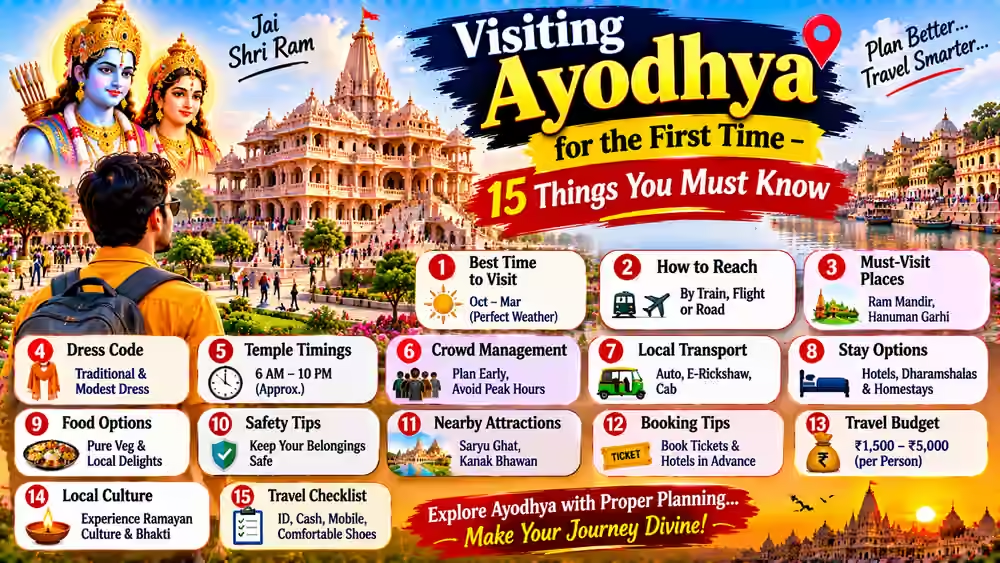
This guide answers those questions. It is not a list of attractions. It is a list of things you must know before you arrive. Fifteen things that will save you time, money, and frustration.
Let us begin.
Thing 1 – You Need an Original ID, Not a Photocopy
This is the single most common mistake first-time visitors make.
The Ram Mandir requires a valid original government photo ID — Aadhaar, Passport, Voter ID, or Driving Licence. A photocopy is not accepted. A digital copy on your phone is not accepted. A photograph of your Aadhaar is not accepted.
What This Means:
-
Carry the physical card
-
Ensure the name matches your Sugam Darshan e-pass
-
Every adult in your group needs their own ID
-
Children below a certain age may be exempt, but confirm at the gate
I have seen families turned away because the father carried everyone's Aadhaar card except his own. Do not let this happen to you.
Thing 2 – Phones Are Banned Inside Ram Mandir
Phones, cameras, smartwatches, power banks, and any electronic device are not allowed inside the Ram Mandir complex.
What Happens:
-
You must deposit them at the free locker or cloakroom
-
The queue for the cloakroom can be 200 people deep at peak times
-
You will stand in two queues — one for the locker, one for darshan
The Solution:
Leave your phone at the hotel. Do not bring it at all. You will not need it for the 2–3 hours you are inside the temple complex.
If you must bring it (for photos outside), carry a small lockable pouch and deposit it quickly. Do not carry a large bag.
Important: This rule applies to everyone, including elderly parents. If your parent cannot stand in two queues, leave the phone behind.
Thing 3 – Darshan Is Free Everywhere
There is no entry fee at any major temple in Ayodhya.
| Temple | Entry Fee |
|---|---|
| Ram Mandir | Free |
| Hanuman Garhi | Free |
| Kanak Bhawan | Free |
| Dashrath Mahal | Free |
| Nageshwar Nath | Free |
| Mani Parvat | Free |
| Saryu Ghat Aarti | Free |
What This Means:
-
You do not need to budget for "temple tickets"
-
You do not need to pay anyone for darshan
-
You do not need to buy a "special pass"
The only things you pay for are your transport, your stay, your food, and optional offerings like prasad or a boat ride.
Thing 4 – There Is No VIP Pass
This is the most important myth to clear.
There is no paid VIP darshan at Ram Mandir or any temple in Ayodhya.
The Sugam Darshan e-pass is free. Anyone offering a "VIP pass" for money is a tout. The temple trust does not sell access.
What Does Exist:
-
Sugam Darshan e-pass — free, online, 15 days in advance
-
Senior citizen lane — free, dedicated queue
-
Women's lane — free, dedicated queue at all gates
What Does Not Exist:
-
Paid VIP darshan
-
"Special darshan ticket"
-
"Fast-track pass" sold by agents
-
Any legitimate paid access to the sanctum
If someone approaches you outside the temple offering a shortcut for money, walk away. They are lying.
Thing 5 – Book Sugam Darshan 15 Days in Advance
The Sugam Darshan e-pass is the only official way to reduce your queue time. It is free.
How It Works:
-
Book on online.srjbtkshetra.org
-
Slots open exactly 15 days before your visit date, at midnight
-
They sell out within minutes on popular dates
-
You receive an e-pass with a QR code
-
Carry a printed copy and your original ID
Why It Matters:
The general queue can take 60–90 minutes on a weekday and 2–3 hours on a weekend. The Sugam Darshan queue is significantly shorter.
What You Need:
-
Mobile number for OTP
-
Name, age, and ID details for each pilgrim
-
The ID must match what you carry
For Elderly Parents: Book Sugam Darshan for them even if you do not book it for yourself. The senior citizen lane is also faster, but the e-pass adds another layer of convenience.
Thing 6 – Start at Hanuman Garhi, Not Ram Mandir
This is a local tradition that most first-time visitors do not know.
Hanuman Garhi opens at 5:00 AM. Ram Mandir opens at 7:00 AM. If you start at Hanuman Garhi, you complete one temple before the Ram Mandir queue builds.
Why This Order Works:
-
Hanuman Garhi is a 76-step climb — easier at 6:00 AM than at 11:00 AM
-
It is a 5-minute walk from Ram Mandir
-
It is the traditional first stop for pilgrims
-
You will be back on the road to Ram Mandir by 7:00 AM
The Alternative:
If you cannot climb 76 steps (elderly parents, knee issues), skip Hanuman Garhi and go directly to Ram Mandir at 6:30 AM. Do not attempt the climb if your parents cannot manage it.
Thing 7 – Temples Close in the Afternoon
This catches every first-time visitor.
Ram Mandir:
-
Morning: 7:00 AM – 11:30 AM
-
Afternoon closure: 11:30 AM – 2:00 PM
-
Afternoon: 2:00 PM – 7:00 PM
Hanuman Garhi:
-
Morning: 5:00 AM – 12:00 PM
-
Afternoon closure: 12:00 PM – 4:00 PM
-
Afternoon: 4:00 PM – 9:00 PM
Kanak Bhawan:
-
Morning: 8:00 AM – 12:00 PM
-
Afternoon closure: 12:00 PM – 4:00 PM
-
Afternoon: 4:00 PM – 9:00 PM
What This Means:
You cannot visit temples between roughly 11:30 AM and 2:00 PM (or 4:00 PM for some). Plan your day around this.
What to Do During the Closure:
-
Lunch
-
Rest at the hotel
-
Visit Mani Parvat, which stays open from 6:00 AM to 6:00 PM
-
Walk the Saryu ghats
-
Visit the Lata Mangeshkar Chowk or local markets
Thing 8 – Ayodhya Is Compact, Not Spread Out
Ayodhya is not a large city. Most major sites are within 2 km of each other.
The Core Cluster:
| Site | Distance from Ram Mandir |
|---|---|
| Hanuman Garhi | 500 m |
| Kanak Bhawan | 800 m |
| Dashrath Mahal | 850 m |
| Nageshwar Nath | 1.2 km |
| Saryu Ghat | 1.5 km |
| Mani Parvat | 3 km |
What This Means:
-
You can walk most of the core circuit
-
You do not need a car for the main temple cluster
-
You do need an e-rickshaw or auto for Mani Parvat and Sugriv Kila
The Practical Advantage:
Most first-time visitors expect a sprawling city and plan for a car. In reality, the temple cluster is walkable, and the car is only needed for the outer sites.
Thing 9 – Cars Cannot Reach Most Temple Gates
Private cars cannot enter the narrow lanes around the Ram Mandir, Hanuman Garhi, or Kanak Bhawan.
What Happens:
-
Your cab will drop you at the main road
-
You will walk the last 200–500 metres
-
Or you will take an e-rickshaw
E-Rickshaw Fares:
| Route | Fare |
|---|---|
| Short hop | ₹20–₹40 |
| Ram Mandir to Mani Parvat | ₹40–₹60 |
| Full-day hire | ₹400–₹600 |
What This Means:
-
Do not expect door-to-door car service
-
Wear comfortable shoes
-
If travelling with elders, plan for e-rickshaw transfers
For Parking: Use Ram Mandir Main Parking, Naya Ghat Parking, or Hanuman Garhi Road Parking. All fill up early on weekends.
Thing 10 – Ayodhya Is a Dry, Pure Vegetarian City
This surprises many first-time visitors.
What This Means:
-
No alcohol is sold or allowed
-
No meat, fish, or eggs are available in most restaurants near the temples
-
Vehicles are checked for alcohol at entry points
-
Do not carry alcohol in your luggage
What You Can Eat:
-
North Indian thalis
-
Kachori and sabzi
-
Chaat and samosa
-
Sweets, especially the Hanuman Garhi besan laddu
-
Pure veg restaurants near Ram Mandir
The Practical Advice:
If you are a non-vegetarian, you will eat vegetarian food in Ayodhya. Accept it and enjoy it. The food is fresh, simple, and deeply satisfying.
Thing 11 – The Saryu Aarti Is the Real Highlight
Most first-time visitors plan their day around the Ram Mandir. That is correct. But the experience they remember most is often the Saryu Aarti at Ram Ki Paidi.
What Happens:
-
Priests gather at the ghat with large brass lamps
-
The lamps are lit as the sun sets
-
Devotees sit on the steps
-
The sound of conches and bells fills the air
-
The river reflects the light
Timings:
| Season | Aarti Time |
|---|---|
| Winter (October–March) | 6:00 PM |
| Summer (April–September) | 7:00 PM |
What to Do:
-
Arrive by 5:30 PM for a good spot on the steps
-
Carry a shawl or mat to sit on
-
Keep your phone in your pocket (this is not a phone-free zone, but be respectful)
-
Stay until the end
The Honest Note: This is not a ticketed event. It is free. Anyone asking for money for a "good seat" is not official.
Thing 12 – Two Days Is the Minimum
One day in Ayodhya is a teaser. Two days is the minimum for a meaningful visit.
What 1 Day Covers:
-
Ram Mandir
-
Hanuman Garhi
-
Kanak Bhawan
-
Saryu Aarti
What 2 Days Add:
-
Dashrath Mahal
-
Nageshwar Nath
-
Mani Parvat
-
Sugriv Kila
-
Treta Ke Thakur
-
A relaxed pace with rest breaks
What 3 Days Add:
-
Bharatkund (15 km)
-
Nandigram (20 km)
-
The Jain temple and other outer sites
The Recommendation: If you are coming from far, take 2 days. If you are combining Ayodhya with Varanasi, take 3 days.
Thing 13 – Avoid Festival Dates on Your First Trip
Ayodhya's festivals are spectacular. They are also extremely crowded.
Festivals to Avoid on a First Trip:
| Festival | Date | Why |
|---|---|---|
| Ram Navami | March–April | Lakhs of pilgrims; impossible to move |
| Deepotsav | November | Spectacular but dangerously crowded |
| Diwali | November | Massive crowds at Ram Mandir |
What Happens During Festivals:
-
Hotels double their rates
-
The Ram Mandir queue runs for 3–4 hours
-
Roads are closed
-
Parking is impossible
-
Elders and children find it difficult
The Recommendation: Visit on a normal weekday in October, November (after Deepotsav), February, or March. You will get the darshan without the crush.
If You Must Visit During a Festival: Book 3 months in advance, use Sugam Darshan, and keep the itinerary light.
Thing 14 – Beware of Touts Outside the Temple
Ayodhya's touts are persistent. Here is what they will try.
| Scam | What They Say | The Truth |
|---|---|---|
| VIP darshan | "I can get you in faster for ₹500" | There is no VIP darshan. Darshan is free |
| Special prasad | "This is the official prasad" | Official prasad is sold at temple counters |
| Tilak demand | "I will do your puja" then demand money | Decline politely. Give via donation box |
| Fake guides | "I am a licensed guide" | Ask for ID. Real guides carry credentials |
| Rickshaw overcharge | "₹200 for 500 metres" | Agree fare before sitting |
The Golden Rule: A polite, firm "no" and keep walking. You do not owe anyone a conversation.
Thing 15 – Do Not Skip Mani Parvat and the Museum
Most first-time visitors focus on Ram Mandir and skip the quieter sites. Do not make this mistake.
Mani Parvat:
-
A 65-foot hillock in the Kami Ganj area
-
Believed to be a fragment of the Sanjeevani mountain Hanuman carried
-
Houses a Buddhist stupa built by Emperor Ashoka
-
Open 6:00 AM to 6:00 PM — perfect for the afternoon closure window
-
76 steps to the top
-
Panoramic views of Ayodhya
Government Museum, Mathura (Nearby):
If you are also visiting Mathura, the museum there holds one of India's finest collections of Kushan and Gupta sculptures. But in Ayodhya, the Mani Parvat stupa and the Sugriv Kila are the historical counterpoints to the devotional circuit.
Why This Matters:
Ayodhya is not just a temple town. It has Buddhist, Jain, and Islamic layers. Skipping them means you miss half the city's story.
How to Reach Ayodhya
By Air:
-
Maharishi Valmiki International Airport (AYJ) — about 10 km from Ram Mandir
-
Direct flights from Delhi, Mumbai, Bengaluru, Ahmedabad, Kolkata, Chennai, Hyderabad
By Train:
-
Ayodhya Dham Junction — within a 15-minute walk of Ram Mandir
-
Direct trains from Delhi (10–12 hours), Varanasi (2–3 hours), Lucknow (3 hours)
By Road:
-
From Lucknow: 135 km, 3 hours
-
From Varanasi: 200 km, 4–5 hours
-
From Delhi: 630 km, 10–12 hours
Recommendation for First-Timers: The train to Ayodhya Dham Junction is the most convenient. The station is close to the temple cluster, and you avoid road traffic.
Nearby Parking and Transport Options
| Parking Area | Distance from Ram Mandir | Notes |
|---|---|---|
| Ram Mandir Main Parking | ~1 km | Paid, fills early |
| Naya Ghat Parking | ~2 km | Near Saryu ghats |
| Hanuman Garhi Road Parking | ~800 m | Limited |
| Ayodhya Dham Junction Parking | ~2 km | For train arrivals |
Local Transport:
-
E-rickshaws: ₹20–₹40 per ride
-
Autos: Available but cannot reach temple lanes
-
Walking: Best for the core temple cluster
-
Private cab: Best for Mani Parvat and outer sites
Where to Stay on Your First Visit
| Area | Best For | Price Range |
|---|---|---|
| Near Ram Mandir | Walking distance to main temple | ₹1,500–₹5,000 |
| Near Railway Station | Easy train access | ₹800–₹2,000 |
| Near Saryu River | Scenic, peaceful | ₹1,000–₹3,000 |
| Faizabad Road | Budget options | ₹500–₹1,500 |
Recommendation: Stay near Ram Mandir if you want to walk to the temple at dawn. Stay near the railway station if you have an early departure.
Important: Book 2–3 months in advance for October–March and festival dates.
What to Eat
Local Specialties:
-
Hanuman Garhi Besan Laddu — the legendary prasad. Buy only from the official temple counter
-
North Indian Thali — at Dalmia's Saffron Vatika near Ram Mandir
-
Pure Veg Thali — at Kanak, a pure veg restaurant
-
Street food — kachori, samosa, and sweets
Where to Eat:
-
Dalmia's Saffron Vatika (near Ram Mandir)
-
Kanak – A Pure Veg Delight
-
Cafe Bollyfood (theme restaurant)
-
Local dhabas near the bus stand
What to Wear and Carry
What to Wear:
-
Modest clothing covering shoulders and knees
-
Comfortable closed-toe slip-on shoes
-
Light cotton in summer
-
Warm layers in winter (November–February)
-
Avoid heavy jewellery
What to Carry:
-
Original government photo ID
-
Sugam Darshan e-pass (printed)
-
Cash (₹2,000–₹5,000)
-
Water bottle
-
Power bank (for outside the temple)
-
Small bag for essentials
-
Medicines
What Not to Carry:
-
Large bags
-
Phones inside Ram Mandir
-
Alcohol
-
Non-vegetarian food
-
Expensive items
Budget Breakdown for a First Trip
| Expense | Budget (Per Person) | Mid-Range (Per Person) |
|---|---|---|
| Travel (within Ayodhya) | ₹200–₹400 | ₹400–₹800 |
| Accommodation (1 night) | ₹800–₹1,500 | ₹2,500–₹5,000 |
| Food (2 days) | ₹300–₹500 | ₹600–₹1,000 |
| E-rickshaws | ₹100–₹200 | ₹200–₹300 |
| Temple offerings | ₹100–₹300 | ₹300–₹600 |
| Total | ₹1,500–₹2,900 | ₹4,000–₹7,700 |
Note: This excludes travel to Ayodhya and assumes a 2-day/1-night trip.
Conclusion
Ayodhya is not a difficult city. It is a city that rewards preparation.
Carry the right ID. Leave the phone behind. Book the pass in advance. Start at Hanuman Garhi. Rest in the afternoon. Save your evening for the Saryu.
And when you stand before Ram Lalla for the first time, all the planning will disappear. What will remain is the darshan.
That is why you came.
Jai Shri Ram.
Plan Your First Ayodhya Trip
For bookings, queries, and custom packages:
📞 Call Us: +91 7078723132 | +91 9557104160
📲 WhatsApp Us: +91 7078723132 | +91 9557104160
Hours: 8 AM to 9 PM daily
Our Services:
-
First-Time Ayodhya Tour Packages
-
Sugam Darshan Pass Booking Assistance
-
Private AC Cab for Ayodhya Darshan
-
Local Guide for Temple Circuit
-
Hotel Reservations in Ayodhya
-
Senior Citizen and Wheelchair Support
-
Customized Itineraries for Families, Couples, and Groups