Namaste. I am Rohit, a guide. I have been helping pilgrims for the past 8 years. And in those years, I have watched people arrive in Ayodhya and Varanasi with the wrong bag.
I have seen families in December shivering at the Saryu Aarti in thin cotton kurtas. I have seen tourists in May collapse at the Kashi Vishwanath queue in jeans and a heavy backpack. I have seen monsoon travellers slip on the ghat steps because they wore smooth-soled shoes.
Packing for these two cities is not like packing for a beach holiday. Ayodhya and Varanasi are temple towns with specific demands. You will walk a lot. You will remove your shoes constantly. You will stand in queues. You will sit on stone floors. And you will do all of this in weather that swings from 5°C in January to 46°C in May.
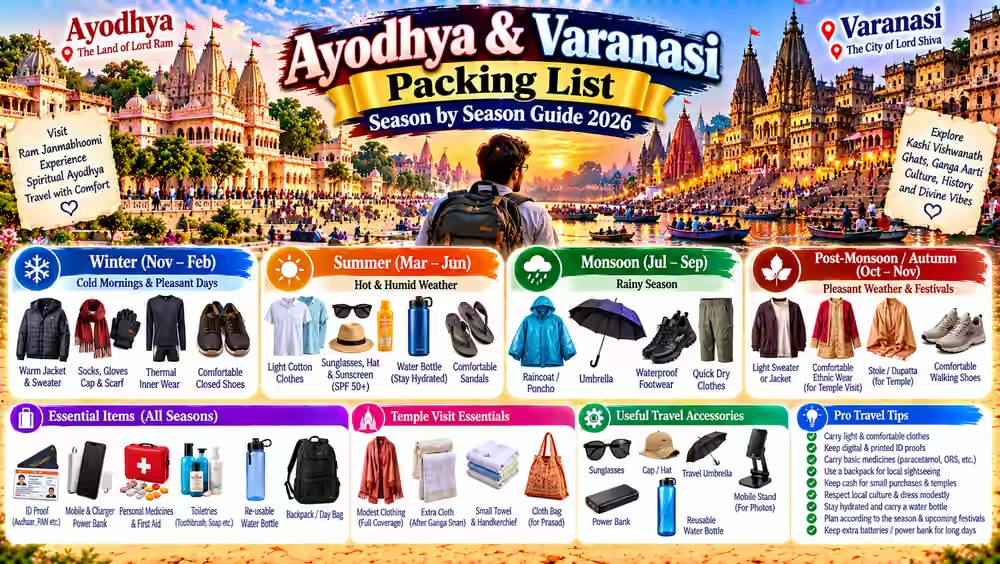
This guide gives you a season-by-season packing list for both cities. It covers clothes, footwear, documents, medicines, and the small items that make the difference between a comfortable pilgrimage and a miserable one.
Let us begin.
The One Item You Cannot Forget
Before we go season by season, there is one item that applies to every trip, every season, and both cities.
Your original government photo ID.
The Ram Mandir in Ayodhya requires a valid government photo ID (Aadhaar, Passport, Voter ID, or Driving Licence) for every visitor. Without it, you will not get past the security gate.
Carry the original, not a photocopy. A digital copy on your phone is not accepted.
Winter Packing List (October to March)
This is the best season to visit both cities. The weather is pleasant, and all temples run full schedules.
What to Expect
| City | Temperature | Conditions |
|---|---|---|
| Ayodhya | 8–25°C | Cool mornings, pleasant days |
| Varanasi | 7–24°C | Cold mornings, fog in December–January |
December and January are the coldest months. Morning temperatures can drop to 5–8°C. Fog can delay trains and flights.
Clothing
| Item | Why |
|---|---|
| Thermal innerwear (1–2 pairs) | For December–January mornings |
| Sweater or fleece (2) | Layering |
| Light jacket or windcheater | For early morning aartis |
| Shawl or wrap | For temple sitting and head covering |
| Full-sleeve cotton kurtas | Modest and comfortable |
| Full-length trousers or leggings | Temple dress code |
| Woollen socks (2–3 pairs) | Temple floors are cold |
| Woollen cap | For morning aartis by the river |
The Key Principle: Layers. Winter days in Ayodhya and Varanasi can be warm (22–25°C), while mornings and evenings are cold (8–12°C). You need to be able to add and remove layers easily.
Footwear
| Item | Why |
|---|---|
| Closed-toe slip-on shoes | Easy to remove at temples |
| Woollen socks | Warmth on cold stone floors |
Avoid: Sandals, flip-flops, and laced shoes. You will remove your footwear at every temple, and laces slow you down.
Winter Extras
-
Lip balm and moisturiser — dry winter air
-
Thermos flask — for hot water or tea
-
Light blanket — for train journeys
-
Sunglasses — bright winter afternoons
-
Torch or phone light — for early morning aartis before sunrise
Summer Packing List (April to June)
This is the hottest season. Ayodhya and Varanasi can reach 46°C in May and June. The heat is dry in Ayodhya and humid in Varanasi.
What to Expect
| City | Temperature | Conditions |
|---|---|---|
| Ayodhya | 35–46°C | Dry heat, dusty winds |
| Varanasi | 32–45°C | Humid heat, intense sun |
Clothing
| Item | Why |
|---|---|
| Light cotton kurtas (3–4) | Breathable, modest |
| Light cotton trousers or leggings | Temple dress code |
| Loose, light-coloured clothing | Reflects heat |
| Cotton scarf or dupatta | Sun protection and head covering |
| Wide-brimmed hat or cap | Essential for the walk between temples |
| Sunglasses | UV protection |
Avoid: Dark colours, synthetic fabrics, jeans, and tight clothing. They trap heat and cause rashes.
Footwear
| Item | Why |
|---|---|
| Slip-on sandals with good grip | Cooler than closed shoes |
| Cotton socks | If wearing closed shoes |
Important: Temple floors in summer can be extremely hot. You will need socks or thick-soled sandals to walk on them.
Summer Extras
-
ORS packets (3–4) — for dehydration
-
Water bottle (1 litre, refillable)
-
High-SPF sunscreen
-
Wet wipes — for sweat and dust
-
Electrolyte powder
-
Cooling towel or handkerchief
-
Compact umbrella — for sun, not rain
Monsoon Packing List (July to September)
This is the most challenging season. The heat breaks, but humidity is high, and the lanes and ghats become slippery.
What to Expect
| City | Temperature | Conditions |
|---|---|---|
| Ayodhya | 28–35°C | Humid, occasional flooding |
| Varanasi | 27–34°C | Very humid, ghat steps slippery |
The Yamuna and Ganga can rise during heavy monsoon. Some ghats may be partially closed.
Clothing
| Item | Why |
|---|---|
| Quick-dry cotton or synthetic blend (3–4 sets) | Dries fast after rain |
| Light raincoat or poncho | Essential |
| Waterproof trousers or a change of clothes | You will get wet |
| Light full-sleeve clothing | Modest and protects from mosquitoes |
| Cotton scarf or dupatta | Head covering at temples |
Avoid: Denim, heavy cotton, and white clothes that show mud splashes.
Footwear
| Item | Why |
|---|---|
| Waterproof sandals or floaters | Drain water, grip wet steps |
| Avoid leather shoes | They will be ruined by water |
The Ghat Reality: Varanasi's ghat steps become very slippery in the rain. Shoes with proper grip are not optional — they are a safety requirement.
Monsoon Extras
-
Umbrella (compact, windproof)
-
Waterproof bag or pouch for phone, wallet, and documents
-
Extra plastic bags for wet clothes
-
Mosquito repellent — essential
-
Quick-dry towel
-
Sanitizer
-
Extra pair of footwear — one pair will be wet
Festival Season Packing List
Ayodhya and Varanasi have major festivals that change the packing equation.
| Festival | Date | Extra Items |
|---|---|---|
| Ram Navami (Ayodhya) | March–April | Light cotton, ORS, water bottle, patience for crowds |
| Deepotsav (Ayodhya) | November | Warm layers, camera, extra power bank |
| Dev Deepawali (Varanasi) | November | Warm layers, camera, tripod (if allowed), extra batteries |
| Ganga Mahotsav (Varanasi) | November | Light woollens, comfortable shoes for evening walks |
| Holi (Varanasi) | March | Old white clothes, sunglasses, waterproof phone pouch |
| Mahashivratri (Varanasi) | February–March | Woollens, ORS, patience for long queues |
Festival Rule: During festivals, crowds triple. Carry only what you can wear or fit into a small day bag. Do not bring large suitcases to the ghats.
Temple-Specific Essentials
These items apply to both Ayodhya and Varanasi, in every season.
| Item | Why |
|---|---|
| Slip-on footwear | You will remove shoes at every temple |
| Socks (2–3 pairs) | Temple floors are hot, cold, or slippery |
| Modest clothing | Shoulders and knees covered |
| Scarf or dupatta | Head covering at some shrines |
| Small cross-body bag | Keep hands free and valuables close |
| Government photo ID | Mandatory for Ram Mandir |
| Sugam Darshan e-pass (printed or digital) | For Ram Mandir |
| Cash (₹3,000–₹5,000) | Many places are cash-only |
| Water bottle | Refill at hotels |
| Tissues and wet wipes | Public toilets are basic |
| Hand sanitizer | Before prasad and after toilets |
The Phone Rule: Phones are not allowed inside Ram Mandir and many temples. Carry a small lockable pouch or leave your phone at the hotel. The cloakroom queue at peak times can be 200 people deep.
Footwear Guide
Footwear is the single most important packing decision for these two cities.
| Type | Winter | Summer | Monsoon |
|---|---|---|---|
| Closed-toe slip-on shoes | Best | Good | Not ideal |
| Sandals with grip | Not ideal | Best | Best |
| Flip-flops | No | No | No |
| Laced shoes | Avoid | Avoid | Avoid |
| Leather shoes | Avoid | Avoid | Never |
| Sports shoes | Good for walking | Too hot | Bad in rain |
The Rule: You will remove your shoes at least 10–15 times a day. Laced shoes are a waste of time. Leather shoes are ruined by monsoon water. Flip-flops have no grip on wet stone.
Best Choice: Slip-on sandals with a textured sole in summer and monsoon. Closed-toe slip-on shoes in winter.
Documentation Checklist
| Document | Why |
|---|---|
| Government photo ID (original) | Ram Mandir security, hotel check-in |
| Sugam Darshan e-pass (printed) | Ram Mandir fast-track queue |
| Hotel confirmations (printed) | Some hotels ask for a hard copy |
| Train/flight tickets (printed or digital) | Station and airport checks |
| Emergency contact list | Hotel, local guide, family |
| Medical prescriptions | If you carry medicines |
| Travel insurance (if applicable) | For medical emergencies |
| Cash (₹3,000–₹5,000) | ATMs run out during peak season |
Important: For Ram Mandir, the name on the e-pass must match the ID. Do not book for a family member using your ID.
Medicine Kit
Carry a small kit regardless of season.
| Item | Purpose |
|---|---|
| Paracetamol | Fever, headache |
| ORS packets (4–6) | Dehydration (summer) |
| Antacid | Spicy food |
| Anti-diarrhoeal | Stomach upset |
| Antiseptic cream | Cuts, scratches, monkey bites |
| Band-aids | Blisters from walking |
| Sunscreen | Summer |
| Mosquito repellent | Monsoon |
| Any prescription medicines | Regular use |
| Thermometer | If travelling with children or elders |
Note: If you have a heart condition, diabetes, or asthma, carry your medication in original packaging with the prescription.
What Not to Pack
| Item | Why |
|---|---|
| Large suitcase | You cannot drag it through temple lanes or ghats |
| Expensive jewellery | Pickpocket risk in crowds |
| Leather items | Not allowed in some temple precincts; ruined by rain |
| Heavy electronics | Phones are not allowed inside temples |
| Alcohol | Both cities are dry, religious towns |
| Non-vegetarian food | Both cities are 100% vegetarian |
| More than one pair of formal shoes | You will not use them |
| Books | You will not have time to read |
| Excessive cash | Carry enough for 2–3 days only |
Ayodhya vs Varanasi – Any Difference?
There is a small but important difference between packing for the two cities.
| Factor | Ayodhya | Varanasi |
|---|---|---|
| Terrain | Flat, wide roads near Ram Mandir | Narrow lanes, steep ghat steps |
| Footwear priority | Comfortable walking shoes | Grip is essential — wet or stone steps |
| Phone restrictions | Strict at Ram Mandir | Allowed at most ghats and temples |
| Water proximity | Saryu ghats (limited steps) | Ganga ghats (steep, numerous steps) |
| Crowd density | Concentrated near Ram Mandir | Spread across ghats and old city |
| Climate | Dry heat in summer | Humid heat in summer |
For Varanasi specifically: Add a small torch for early morning aarti at the ghats, and extra socks because the ghat steps are steep and stone-cold in winter.
A Compact Day-Bag Checklist
Every morning, you will leave your hotel with a small bag. Here is what it should contain.
| Item | Why |
|---|---|
| Government photo ID | Ram Mandir and temple checks |
| Sugam Darshan e-pass | If visiting Ram Mandir |
| Cash (₹1,000–₹2,000) | Offerings, e-rickshaw, snacks |
| Water bottle | Refill at hotel |
| Tissues and wet wipes | Toilets are basic |
| Sanitizer | Before prasad |
| Sunglasses | Summer |
| Raincoat or umbrella | Monsoon |
| Phone (charged) | For photos outside temples |
| Power bank | Phone drains fast |
| Small cloth bag | For shoes at temples |
What to leave in the hotel: Passport (unless foreign national), extra cash, large camera, laptop, and anything you cannot carry all day.
Common Packing Mistakes
1. Packing for one temperature
Ayodhya and Varanasi have hot days and cold mornings in winter. Pack layers, not single items.
2. Bringing laced shoes
You will remove your shoes at every temple. Laces slow you down and get dirty on temple floors.
3. Wearing leather shoes in monsoon
Leather absorbs water, dries slowly, and smells. Wear waterproof sandals instead.
4. Carrying a large suitcase
Temple lanes are narrow. Ghat steps are steep. You cannot drag a suitcase through them. Pack a small bag.
5. Forgetting the original ID
A photocopy is not accepted at Ram Mandir. Carry the original.
6. Wearing shorts or sleeveless tops
Both cities enforce modest dress at temples. You will be turned away.
7. Packing dark clothes in summer
Dark colours absorb heat. Wear light colours.
8. Not carrying ORS in summer
Dehydration is the most common health issue for pilgrims. ORS packets cost ₹20 and prevent a hospital visit.
9. Carrying expensive jewellery
You will be in crowds. Keep it simple.
10. Packing too much
You will shop for peda, prasad, and souvenirs. Leave room in your bag.
Conclusion
Packing for Ayodhya and Varanasi is not about carrying more. It is about carrying the right things.
In winter, it is a shawl and woollen socks. In summer, it is ORS and a wide hat. In monsoon, it is waterproof sandals and a raincoat. And in every season, it is your original ID, slip-on footwear, and modest clothing.
These two cities will ask you to walk, remove your shoes, sit on stone floors, and stand in queues. Pack for that reality, not for a holiday brochure.
Travel light. Pack smart. And let the pilgrimage be about the darshan, not about your bag.
Jai Shri Ram. Har Har Mahadev.
Plan Your Ayodhya-Varanasi Trip
For bookings, queries, and custom packages:
📞 Call Us: +91 7078723132 | +91 9557104160
📲 WhatsApp Us: +91 7078723132 | +91 9557104160
Hours: 8 AM to 9 PM daily
Our Services:
-
Ayodhya-Varanasi Tour Packages (all seasons)
-
Season-Specific Packing Guidance
-
Private AC Cab Between Cities
-
Hotel and Dharamshala Reservations
-
Local Guides for Both Cities
-
Darshan Assistance and Queue Management
-
Customized Itineraries for Families, Couples, and Groups