TRAVEL GUIDE•Travel Guide•UPDATED OCT 2026

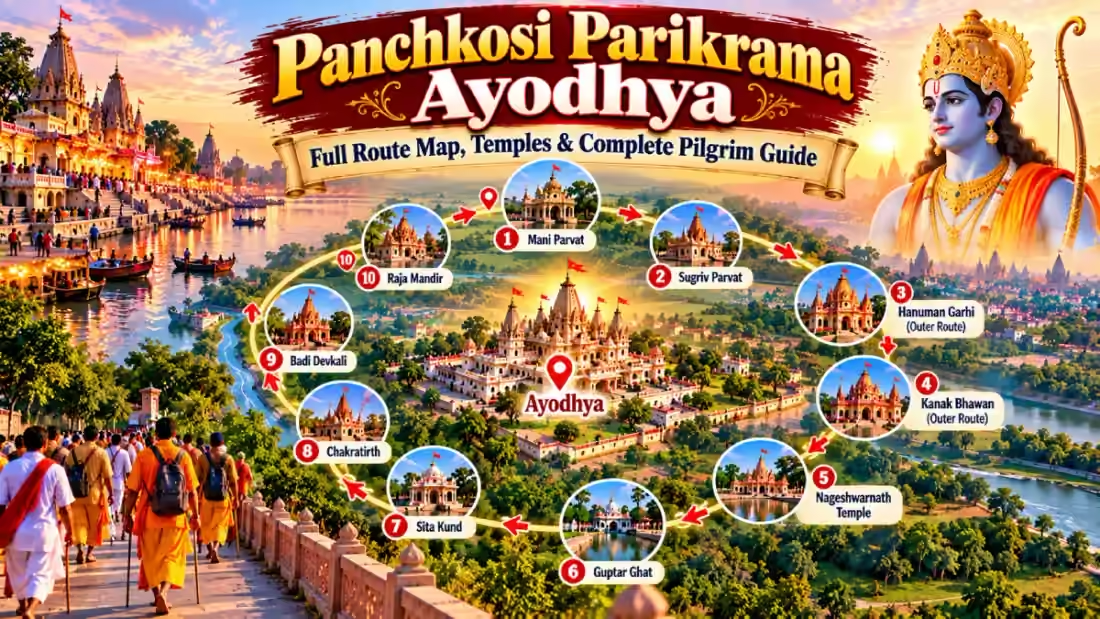
Panchkosi Parikrama Ayodhya: Full Route Map, Temples & Complete Pilgrim Guide

By Rohit•18 Oct 2026
Panchkosi Parikrama Ayodhya: Full Route Map, Temples & Complete Pilgrim Guide
Quick Answer

Panchkosi Parikrama Ayodhya is a ~15-km barefoot circumambulation of the sacred Panchkos circle, held on Kartik Shukla Ekadashi (Devuthani Ekadashi) — expected in late October to mid-November 2027. It starts and ends at Naya Ghat after a Saryu dip. The route covers Ram Ghat, Guptar Ghat, Sita Kund, Mani Parvat, Sugriv Parvat, Lakshman Ghat, Ram Ki Paidi, Hanuman Garhi, Kanak Bhawan, and Ram Janmabhoomi. The event runs about 22–24 hours; actual walking is 6–9 hours. Walk barefoot, carry water and blister plasters, book stay 2–3 months in advance, and confirm the 2027 date on the official Ayodhya Dham portal. For guided assistance, contact Rohit at 7078723132.

Quick Enquiry

The‍‍‍ 15-km Panchkosi Parikrama is the shortest and hence most popular circumambulation parikrama of Ayodhya. It involves walking around the sacred Ram City area (Panchkos area) which has been demarcated by the Ram Temple committee to represent the original Rama city area. Devotees normally do this parikrama on Kartik Shukla Ekadashi (Devuthani Ekadashi). Starting the day with a holy dip in the Saryu river, they walk barefoot around the sacred boundary of the city. The path takes them through Ram Janmabhumi, Hanuman Garhi, Kanak Bhawan, Ram Ki Paidi and Saryu ghats.

Hello. I am Rohit, and I have been a guide for pilgrims for 8 years. In the latter days I have mostly guided pilgrims for Ayodhya Parikramas including Ram Mandir darshan. The Panchkosi is the one and a half hour parakrama and it is the ideal first step for the pilgrim who is a complete novice and wants to understand the culture of Ayodhya.

The guide below provides you the entire route temple-by-temple, the upcoming 2027 date, the guidelines, what you will need to carry, and practical tips so that your parikrama goes off smoothly and meaningfully.

What Is Panchkosi Parikrama?

Parikrama is essentially walking around sacred places in devotion. Ayodhya has 5 parikramas routes: Antargrihi (shortest), Panchkosi (15 km), Chaudahkosi (42-45 km), Chaurasikosi (240-252 km), and Ramkot ki Parikrama.

The Panchkosi is the inner most circle which represents the original Rama city area. This parikrama is done within one hour, mostly begins with day-light hours and finished before sunrise of next day.

The reason for walking circumambulating is that the devotees feel that the parikrama cleanses a person of all past deeds (karma) and it can be a steppingstone to moksha (liberation) or spiritual enlightenment. It can also bestow a sense of peace and divine blessings upon ‍‍‍oneself.

Panchkosi Parikrama 2027: Date and Timings

The parikrama is held every year on Kartik Shukla Ekadashi, also known as Devuthani Ekadashi or Dev Uthani Ekadashi — the day the gods wake from their four-month sleep.

Detail Information
Tithi Kartik Shukla Ekadashi (Devuthani Ekadashi)
Expected 2027 window Late October to mid-November 2027
Duration Approximately 22–24 hours (one full day and night)
2025 reference Started 4:02 AM, 1 November; ended 2:57 AM, 2 November
Distance ~15 km (some official sources list 16 km)
Start/End point Naya Ghat (holy dip in Saryu first)

Important: The exact 2027 date depends on the Hindu lunar calendar. Confirm with the official Ayodhya Dham portal or a local panchang closer to the date. Do not book travel on an assumed date.

Panchkosi Parikrama Route Map: Temple by Temple

The route starts and ends at Naya Ghat on the Saryu. The table below follows the traditional sequence, combining the route listed by the Ayodhya Dham portal, UP Tourism, and local guides.

Stop What It Is Why It Matters
Naya Ghat Saryu riverfront ghat Holy dip and prostration before starting
Ram Ghat One of Ayodhya's main ghats Traditional starting stretch along the Saryu
Guptar Ghat Ghat associated with Ram's disappearance Quiet, deeply revered spot
Sita Kund Sacred tank Associated with Sita
Mani Parvat Small hill Ancient Buddhist-Jain-Hindu site; Ramayana link
Sugriv Parvat Hillock Named after Sugriva, the vanara king
Lakshman Ghat Ghat named after Lakshmana Saryu riverfront
Ram Ki Paidi Stepped ghats and evening aarti site The ceremonial heart of Ayodhya's riverfront
Chakratirtha Sacred tank Mentioned in UP Tourism's route
Dashrath Kund Tank named after King Dasharatha Associated with Ram's father
Hanuman Garhi Fort-temple of Hanuman One of Ayodhya's most important shrines
Kanak Bhawan Temple of Ram and Sita Traditional stop on the parikrama
Ram Janmabhoomi Birthplace of Lord Ram The spiritual centre of the route
Jogiana / Ranopali / Jalpanala / Mahatabagh Localities on the circuit Traditional route markers
Back to Naya Ghat Completion point Parikrama concludes

Note: The exact sequence can vary slightly depending on the administration's route plan for that year. The core stops — Naya Ghat, Ram Ghat, Guptar Ghat, Sita Kund, Mani Parvat, Sugriv Parvat, Lakshman Ghat, Ram Ki Paidi, Hanuman Garhi, Kanak Bhawan, and Ram Janmabhoomi — remain consistent.

Distance and Duration: What to Expect

Factor Reality
Total distance ~15 km (official UP Tourism lists 16 km)
Walking time 6–9 hours of actual walking
Total event window ~22–24 hours (includes darshan stops, rest, crowd delays)
Surface Paved roads, lanes, ghat steps, some uneven stretches
Crowd Lakhs of devotees — 4–5 lakh in recent years
Footwear Barefoot (traditional rule)

The 15 km figure is the circuit length. But you will walk more than 15 km in practice — detours to temple entrances, queue movements, and ghat steps add distance. Plan for 20,000–25,000 steps.

Rules and Rituals of the Parikrama

Before Starting

  • Holy dip in the Saryu at Naya Ghat

  • Prostration on the parikrama path before beginning

  • Sankalp (formal resolve) to complete the parikrama

During the Parikrama

  • Walk barefoot — this is the tradition

  • Chant "Jai Shri Ram" or sing bhajans

  • Do not reverse or cut across the route — follow the direction of the circuit

  • No non-vegetarian food or alcohol — the entire Panchkosi area is effectively a vegetarian and alcohol-free zone

  • Do not carry leather items into temple premises

After Completion

  • Darshan at the temples along the route

  • Return to Naya Ghat and conclude with prayers

What to Carry for Panchkosi Parikrama

Item Why
Comfortable footwear for the return You walk barefoot, but need footwear for the journey home
Water bottle 15 km barefoot is dehydrating; refill points are available but crowded
Light cotton clothes October–November Ayodhya is warm by day, cool at night
A light shawl or jacket Night walking gets chilly
ORS sachets For hydration and electrolyte balance
Blister plasters Barefoot walking causes blisters; carry a small first-aid kit
Small backpack Keep hands free; avoid large bags
ID proof Security checks are strict
Cash ATMs may run out; small shops along the route need cash
Phone with a power bank For emergencies and group coordination

Do not carry: Valuables, jewellery, large luggage, or leather items.

How to Reach Ayodhya

Mode From Lucknow From Delhi From Varanasi
Train 2–2.5 hrs to Ayodhya Dham Junction 8–10 hrs 3–4 hrs
Road 135 km, 2.5–3 hrs 650 km, 10–12 hrs 200 km, 3.5–4 hrs
Air Lucknow (135 km) Delhi (650 km) Varanasi (200 km)

Nearest airport: Maharishi Valmiki International Airport, Ayodhya (AYJ) — now operational with direct flights from major cities. Otherwise, Lucknow (LKO) is the practical alternative.

Nearest railway: Ayodhya Dham Junction (formerly Faizabad Junction) and Ayodhya Cantt.

Where to Stay During Panchkosi Parikrama

Book at least 2–3 months in advance. Lakhs of devotees arrive, and hotels, dharamshalas, and ghat-side rooms fill up fast.

Area Suits
Near Naya Ghat / Ram Ki Paidi Walkable to start point; book very early
Near Hanuman Garhi / Ram Janmabhoomi Central, but crowded and no vehicle access in lanes
Faizabad Road / Civil Lines Modern hotels, parking, easier access
Ayodhya Cantt area Budget stays, railway access

Tip: If you cannot find a room in Ayodhya, stay in Faizabad (now Ayodhya's twin city) and travel in early. It is 7–8 km from the parikrama route. For Ayodhya hotel and tour assistance, visit tripmyayodhya.com.

Safety Tips for the Parikrama

  • Start early. The official start is around 4 AM. Join the flow early to avoid the worst crush.

  • Stay with your group. Decide a meeting point at Naya Ghat in case you separate.

  • Mobile networks jam during peak hours. Do not rely on phones to find each other.

  • Watch your step. The route includes uneven stretches, open drains, and ghat steps. The administration covers open ducts and sets barricades, but stay alert.

  • Use the medical camps. Temporary health centres and ambulances are stationed along the route.

  • Elderly and children: The full 15 km barefoot is demanding. Consider doing a shorter stretch or the Antargrihi Parikrama instead.

  • Follow police instructions. Around 2,000 police, PAC, and ATS personnel are deployed, with CCTV and drone surveillance.

Panchkosi vs Chaudahkosi vs Chaurasikosi

Parikrama Distance Duration Suits
Antargrihi Short (within city) Half day Elderly, first-timers
Panchkosi ~15–16 km 1 day Most devotees
Chaudahkosi ~42–45 km 1–2 days Serious pilgrims
Chaurasikosi ~240–252 km 15–21 days Saints, long-distance walkers

For most first-time pilgrims, Panchkosi is the right choice.

Conclusion

The Panchkosi Parikrama is not a walk. It is an act of surrender. You walk barefoot around the land where Ram ruled, past the ghats where he bathed, the hills where the vanaras stood, and the temple where he was born. Fifteen kilometres. One day. Lakhs of voices chanting "Jai Shri Ram."

Start at Naya Ghat with a dip in the Saryu. Walk slowly. Stop at Hanuman Garhi, Kanak Bhawan, and Ram Janmabhoomi. Do not rush the darshan. Eat light, drink water, and protect your feet.

If you are coming in 2027, confirm the date with the official Ayodhya Dham portal, book your stay months in advance, and arrive a day early. The parikrama rewards preparation.

Jai Shri Ram.

Contact

Call Us: +91 7078723132 | +91 9557104160
WhatsApp Us: +91 7078723132 | +919557104160

Hours: 8 AM to 9 PM daily
Ayodhya Tours: tripmyayodhya.com
Pan-India Yatra: tripmybharat.com
Mathura Vrindavan Tours: vrindavanmathuratourism.com

Our Services:

  • Ayodhya Panchkosi Parikrama Assistance

  • Ayodhya Ram Mandir Darshan Tours

  • Private AC Cab for Ayodhya & Braj

  • Local Guides in Ayodhya and Mathura Vrindavan

  • Hotel Reservations

  • Customized Pilgrimage Itineraries

PLAN YOUR VISIT WITH LOCAL EXPERTS

Ready to Plan Your Sacred Ayodhya & Varanasi Yatra?

Get customized itineraries with dedicated private AC cabs, verified hotel stays, and temple timing coordination.

Plan Your Journey →
Rohit
🏛️Resident Pilgrimage GuideView Profile →

Rohit

8+ Years on Ground

🛕Founder & Senior Pilgrimage CoordinatorAyodhya & Varanasi Resident Guide

Rohit is the Founder of Trip My Bharat Network with over 8+ years coordinating pilgrimages through the sacred shrines of Ayodhya, Varanasi, Prayagraj, and Gaya. He specializes in verified temple schedules, sthala purana documentation, and crowd-safe darshan planning.

Founder, Trip My Bharat Network
8+ Years Local Pilgrimage Experience
Resident Route Planning
Seasonal Darshan Details Reviewed
HAVE A QUESTION ABOUT THIS ROUTE?Ask Rohit on WhatsApp
Direct pilgrimage advice • Zero obligation
FREQUENTLY ASKED QUESTIONS

Frequently Asked Questions About Panchkosi Parikrama Ayodhya: Full Route Map, Temples & Complete Pilgrim Guide

Verified answers from local pilgrimage guides for peaceful temple darshans, timings, and transportation.

QWhat is Panchkosi Parikrama in Ayodhya?▼
It is a ~15-km barefoot circumambulation of Ayodhya's sacred Panchkos circle, performed on Kartik Shukla Ekadashi (Devuthani Ekadashi).
QWhen is Panchkosi Parikrama in 2027?▼
It falls on Kartik Shukla Ekadashi, expected in late October to mid-November 2027. Confirm the exact date with the official Ayodhya Dham portal closer to the time.
QHow many kilometres is Panchkosi Parikrama?▼
Approximately 15 km. UP Tourism lists it as a 16-km circuit.
QWhere does Panchkosi Parikrama start and end?▼
It starts and ends at Naya Ghat on the Saryu River, after a holy dip.
QHow long does Panchkosi Parikrama take?▼
The event window is about 22–24 hours. Actual walking time is 6–9 hours, with darshan stops and crowd delays adding more.
QIs Panchkosi Parikrama done barefoot?▼
Yes, walking barefoot is the tradition. Devotees walk barefoot, chanting bhajans and "Jai Shri Ram."
QWhich temples are covered in Panchkosi Parikrama?▼
The core route includes Naya Ghat, Ram Ghat, Guptar Ghat, Sita Kund, Mani Parvat, Sugriv Parvat, Lakshman Ghat, Ram Ki Paidi, Hanuman Garhi, Kanak Bhawan, and Ram Janmabhoomi.
QDo I need to fast for Panchkosi Parikrama?▼
Fasting is not mandatory for the parikrama itself, but many devotees eat light satvik food. Avoid heavy meals before walking.
QIs non-vegetarian food available in the Panchkosi area?▼
No. Non-vegetarian food and alcohol are effectively banned within the 15-km Panchkosi Parikrama area around the Ram temple.
QCan elderly people do Panchkosi Parikrama?▼
The full 15 km barefoot is demanding. Elderly pilgrims should consult a doctor and consider the shorter Antargrihi Parikrama instead.
QCan children do Panchkosi Parikrama?▼
Older children can, but the crowd and distance are challenging for young children. Keep them close and plan rest stops.
QWhat should I wear for Panchkosi Parikrama?▼
Light cotton clothes, a light shawl for the night, and comfortable footwear for the return journey. You will walk barefoot during the parikrama.
QWhat should I carry for Panchkosi Parikrama?▼
Water, ORS, blister plasters, a light jacket, ID proof, cash, and a power bank.
QIs parking available near Naya Ghat?▼
Limited parking is available, but the area is extremely crowded. Use designated parking zones and walk or take shuttles.
QHow do I reach Ayodhya for Panchkosi Parikrama?▼
By train to Ayodhya Dham Junction, by air to Maharishi Valmiki International Airport, or by road from Lucknow (135 km).
QWhere should I stay during Panchkosi Parikrama?▼
Book near Naya Ghat, Hanuman Garhi, or Civil Lines. Book at least 2–3 months in advance.
QIs Ayodhya safe during Panchkosi Parikrama?▼
Yes, with heavy police deployment, CCTV, drones, medical camps, and barricades. Stay with your group and follow instructions.
QHow many devotees attend Panchkosi Parikrama?▼
Recent years have seen 4–5 lakh devotees, with some estimates higher.
QCan I do darshan at Ram Janmabhoomi during the parikrama?▼
Yes, Ram Janmabhoomi is a core stop. Expect queues and security checks.
QIs photography allowed during Panchkosi Parikrama?▼
Photography is allowed on the route, but not inside temple sanctums.
QWhat is the difference between Panchkosi and Chaudahkosi Parikrama?▼
Panchkosi is ~15 km (1 day). Chaudahkosi is ~42–45 km (1–2 days). Panchkosi is the inner circle; Chaudahkosi is the outer circuit.
QWhat is Devuthani Ekadashi?▼
It is the Kartik Shukla Ekadashi when the gods wake from their four-month sleep. Panchkosi Parikrama is held on this day.
QIs there a registration process for Panchkosi Parikrama?▼
There is no mandatory registration for individual devotees. Follow the administration's route and security instructions.
QAre medical facilities available on the route?▼
Yes. Temporary health centres, ambulances, and beds in local hospitals are arranged for the event.
QCan I do the parikrama by vehicle?▼
The traditional parikrama is done on foot. The route is a walking circuit.
QWhat time does the parikrama start?▼
In 2025, it started at 4:02 AM on 1 November. The start time shifts each year with the tithi.
QWhat time does the parikrama end?▼
In 2025, it ended at 2:57 AM on 2 November. It runs through the night.
QIs there food available along the route?▼
Yes, satvik food stalls and water points operate along the route. Carry cash.
QCan I join the parikrama midway?▼
Technically yes, but the tradition is to complete the full circuit from Naya Ghat. Midway joining is discouraged.
QWhat is the spiritual benefit of Panchkosi Parikrama?▼
Devotees believe it washes away past karma, grants moksha, and brings peace and divine blessings.
QHow do I book a guided Ayodhya tour?▼
Contact Rohit at 7078723132 or visit tripmyayodhya.com for guided Ayodhya tours and parikrama assistance.
EXPLORE MORE GUIDES

More Useful Reading for Your Yatra

View All Articles
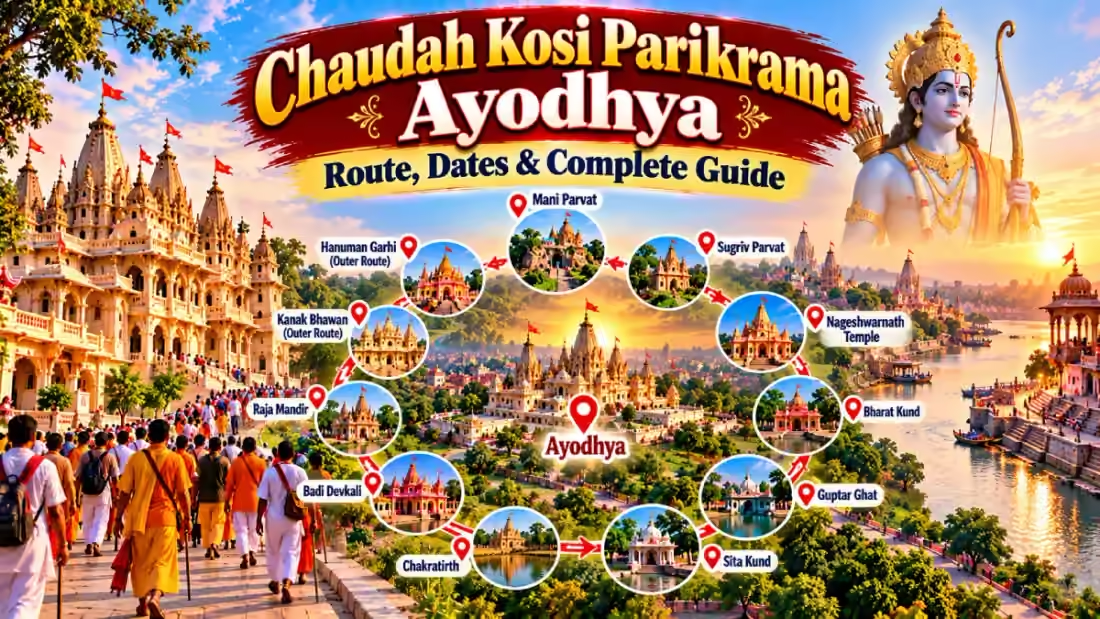
Chaudah Kosi Parikrama Ayodhya: Route, Dates & Complete Guide
🪔Ayodhya Utsav
18 Oct 2026
Verified Guide

Chaudah Kosi Parikrama Ayodhya: Route, Dates & Complete Guide

Chaudah Kosi Parikrama 2027 falls on Sunday, 7 November, on Kartik Shukla Navami, in Ayodhya. It is a 42–45 km barefoot circumambulation of the holy city, performed over two days. The route starts at Naya Ghat after a holy dip and circles the outer boundary of Ayodhya. Over 30 lakh devotees participate, making it one of India's largest religious gatherings. It is believed to cleanse karma and open the path to moksha. Physical preparation is essential. Book stay 4–6 months in advance. For guided assistance, contact Rohit at 7078723132 or visit tripmyayodhya.com.

Kartik Purnima Snan in Ayodhya: The Complete Saryu Snan Guide
🪔Ayodhya Utsav
18 Oct 2026
Verified Guide

Kartik Purnima Snan in Ayodhya: The Complete Saryu Snan Guide

Kartik Purnima Snan in Ayodhya is on 24 November 2026 and 14 November 2027. The main ghats are Ram Ki Paidi and Naya Ghat. A dip in the Saryu on this day is believed to wash away sins and carry the merit of the entire Kartik month. Reach the ghat by 3:30–4:00 AM for the pre-dawn snan. The traditional sequence is Saryu snan, Nageshwar Nath jalabhishek, Hanumangarhi, and Ram Lala darshan. Return in the evening for the Dev Deepawali diya offering. Lakhs attend, so arrive a day early, book stay months in advance, and follow one-way crowd routes. For guided snan assistance, contact Rohit at 7078723132.

Varanasi to Prayagraj to Ayodhya Road Trip Guide 2026
📖Pilgrim Guide
17 Oct 2026
Verified Guide

Varanasi to Prayagraj to Ayodhya Road Trip Guide 2026

The Varanasi to Prayagraj to Ayodhya road trip covers approximately 285 to 300 kilometers of driving. The route flows from Varanasi to Prayagraj (121 km), then to Ayodhya (165 km), and finally back to Varanasi (200 km) if returning. The roads are excellent, four-lane national highways, making it a smooth 3-day journey. A private cab for this full circuit costs around ₹9,900 for a sedan. The best time to drive is from October to March. Contact Rohit at 7078723132 for a customised cab and darshan itinerary.